
Data Revolution on the Bosphorus
From “feeling the game” to measuring everything
Turkish football used to be all about intuition, charisma of the coach and the noise from the stands. Over the last decade, that picture has changed fast. Clubs in the Super Lig now buy detailed event data for every ball touch, GPS records for every sprint and even biomechanical profiles of academy kids. According to several industry reports, more than half of top-tier Turkish clubs now work with dedicated data analysts, whereas ten years ago this role barely existed. The question in Istanbul and Trabzon is no longer “Should we use numbers?”, but “Which numbers actually change the scoreline?” That’s where a new mix of coaching savvy and football analytics software for coaches is quietly reshaping training grounds and boardroom decisions across the country.
In everyday language, data has become an extra assistant coach — one that never sleeps and remembers every mistake.
Key Metrics That Changed Turkish Training
Tracking every sprint, press and passing lane

At the heart of this shift are sports data analysis tools for football teams that record thousands of micro‑events in each match. Turkish analysts routinely monitor expected goals, pressing intensity (PPDA), pass networks and high‑intensity runs. For example, when İstanbul Başakşehir rose to the top of the league, internal staff openly talked about using tracking data to manage player load and maintain a compact defensive block. Their analysts showed that when the distance between the back line and midfield exceeded roughly 18–20 meters, the team conceded significantly more shots. Training was then redesigned to rehearse coordinated pressing waves that kept this vertical gap tight, and the metric became a daily reference, not just a post‑match curiosity.
In many clubs, video meetings now start not with a motivational speech, but with simple visual dashboards players can understand at a glance.
Case study: pressing smarter at Beşiktaş
One Istanbul analyst describes how Beşiktaş adjusted their pressing in home matches. Before analytics came in, the team pressed emotionally: roar of the crowd, everyone jumps. After a season of structured tracking, staff realized that “all‑out” pressing for 20 minutes led to a clear drop in high‑intensity sprints after the 60th minute and more late goals conceded. Using a player tracking and match analysis platform, they identified specific trigger zones: opposition centre‑backs receiving with their weaker foot, or a backwards pass in the right half‑space. The press became more selective; total number of sprints per game actually went down, but the share of sprints that directly led to regaining possession increased. The lesson was simple but powerful: in modern Turkish football, energy is a budget, and data tells you where to spend it.
Recruitment: Finding Value Before Rivals Do
Galatasaray, Trabzonspor and the art of smart signings
Money still talks, yet it whispers differently when you combine scouting intuition with data. Galatasaray’s recent rebuilds are a good example: instead of relying only on highlight videos, the club leaned on large databases tracking progressive passes, expected threat and pressing ability across dozens of leagues. That’s how relatively undervalued players from mid‑tier European clubs landed in Istanbul and immediately improved ball progression through midfield. Trabzonspor followed a similar pattern, using quantitative filters to shortlist full‑backs who could both overlap and deliver low crosses at high volume, matching their tactical model. For smaller Anatolian clubs fighting relegation, analytics has other priorities: they focus on aerial duel success, set‑piece impact and defensive positioning to discover affordable centre‑backs. The result is that recruitment meetings increasingly resemble start‑up pitch sessions, with charts and scatter plots alongside traditional scouting reports.
Agents have noticed too; they now arrive at negotiations armed with their own custom dashboards to justify salary demands.
When clubs decide to “buy” analytics, not just players
This shift also appears in procurement decisions. A decade ago, if a board allocated extra money, it usually went to transfer fees or bonuses. Today some boards choose to buy football performance analysis system packages instead: integrated solutions combining video breakdown, tracking data, GPS and wellness monitoring. Turkish clubs that made this investment early report fewer soft‑tissue injuries and more consistent training intensity across long seasons that include European competitions. The debate is no longer whether the system is “nice to have”, but how deeply to embed it into daily workflows: should every age group get the same dashboard, or do you keep the heavy analytics for the first team and U19s? That is a strategic decision with long‑term implications for club identity and playing style.
Economic Impact: From Cost Center to Competitive Asset
How data changes budgets, salaries and transfer margins
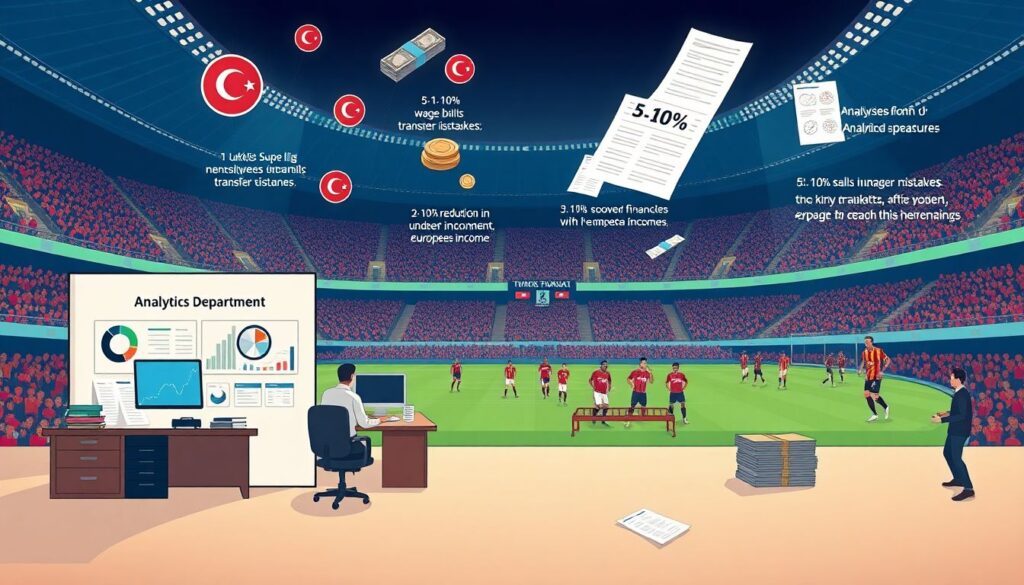
On the surface, analytics departments are small line items in big budgets, but their ripple effect is large. Turkish Super Lig wage bills have grown significantly, putting pressure on clubs that lack consistent European income. In this environment, shaving even 5–10% off transfer mistakes can mean the difference between stability and crisis. Data‑driven scouting aims exactly at that: reduce the number of highly paid benchwarmers. Some club executives publicly admit they now require a positive “data check” before finalizing major transfers, especially for foreign players over 26, where resale value is limited. Moreover, performance‑based contracts increasingly include measurable metrics: minutes played, defensive actions, key passes, sometimes even distance covered at high speed. With reliable tracking, these clauses are easier to enforce, changing how risk is shared between clubs and players. In short, analytics quietly rewrites the economic rules of Turkish football.
For mid‑table sides, a single successful data‑driven sale to a top‑five league can finance their entire analytics staff for years.
Growing market for tech and services around the game
Around the clubs, a new ecosystem of technology companies has formed. Local start‑ups build niche modules, from opponent set‑piece catalogs to machine‑learning models that predict injury risk. International vendors provide football coaching software with data analytics features tailored to Turkish workflows, including instant translation, region‑specific heat stress indexes and integration with existing medical systems. As more academies adopt these tools, the domestic market becomes big enough to support specialized careers: video coders, tracking operators, data engineers. For universities, this opens new paths for graduates combining sport science and statistics, and some Turkish institutions already run joint programs with clubs. What began as imported technology is gradually turning into a homegrown knowledge industry with export potential.
Modern Coaching Philosophies in the Turkish Context
Blending local football culture with global methods
Turkish coaches operate in a unique environment: intense media scrutiny, passionate fans and boards that demand instant results. Analytics doesn’t remove that pressure, but it does offer more levers to act. Some younger managers openly collaborate with analysts during live matches, using real‑time dashboards to adjust pressing height or switch the overload side. Others prefer weekly deep dives into shot quality, set‑piece design and substitution timing. A recurring pattern is that coaches who embrace data also insist on communication: they translate complex metrics into simple language players can relate to. Instead of saying, “Our xG is too low,” they talk about “attacking the box earlier” and demonstrate it via clipped videos. The blend of numbers, clips and clear messaging seems particularly effective with younger Turkish players who grew up with technology in every aspect of life.
The biggest cultural challenge is trust: convincing veterans that data is there to extend, not replace, their careers.
Case study: youth academies and injury prevention
One of the most promising areas is academy development. Several Super Lig clubs use sports data analysis tools for football teams at the youth level, even if in a simplified form. GPS vests track growth‑phase players to avoid overload during rapid height increases, when injury risk spikes. In one Anatolian club, analysts noticed a pattern of recurring hamstring issues in their U17 squad. Load data showed a mismatch: intense weekend games followed by equally hard Monday sessions. After adjusting the microcycle and adding individualized strength work based on asymmetry scores, soft‑tissue injuries reportedly dropped in the following season. For the academy director, this wasn’t an abstract victory: it meant more consistent playing time for prospects and a better chance that at least one of them would progress to the first team — the most valuable “transfer” a club can produce.
Looking Ahead: Forecasts for Turkish Football Analytics
What the next five to ten years may bring
If the current trajectory holds, analytics in Turkey is likely to move from descriptive (“what happened?”) to predictive and prescriptive (“what should we do next?”). Machine learning models will estimate not just expected goals but also expected points from different tactical plans, letting coaches simulate scenarios before kick‑off. We can also expect deeper integration with sports science: hydration data, sleep patterns and psychological profiling linked to performance metrics. Financially, as UEFA pressure around sustainability grows, Turkish clubs will lean even more on data to justify spending and prove long‑term planning. Smaller teams may adopt modular solutions instead of full platforms, renting specific features as budgets allow. As decision‑makers gain confidence, “data vetoes” — situations where analytics blocks a tempting but risky transfer — could become more common in boardrooms from Izmir to Konya.
The endgame is not robots on the touchline, but a league where good decisions are less random and more repeatable.
Why the gap between data‑rich and data‑poor clubs will widen
One final prediction: inequality of information will mirror inequality of budgets. Clubs that invest early and deeply in analytics pipelines will accumulate advantages that are hard to copy quickly: historical databases, refined models, staff who know both code and tactics. Late adopters may still buy football performance analysis system licenses, but without clear processes and culture, these tools risk becoming expensive toys. Conversely, savvy smaller clubs can punch above their financial weight by using lean, well‑targeted solutions rather than trying to match the giants feature for feature. In that sense, analytics offers both a threat and an opportunity for Turkish football. Those who treat data as a living part of their identity — not a seasonal trend — are likely to shape the competitive landscape of the Super Lig for years to come.
Комментарии
Вторую перепланировку уже делал с помощью ребят из Перепланировка 23 — они подготовили полный пакет документов, подсказали, что можно узаконить без лишних рисков, что лучше не трогать, и в целом довели дело до согласования. По деньгам вышло дешевле, чем мои «эксперименты» в одиночку, да и нервы целее. Для тех, кто не хочет вникать во все нюансы законодательства, это прям хорошее решение.