
The business of sports in Turkey is driven by sponsorship, broadcasting and club finances that are tightly linked. Brands use sports sponsorship Turkey-wide to reach mass audiences; Turkish Super Lig broadcasting rights and other Turkish football TV rights deals shape media visibility and revenues, while clubs must balance commercial growth with regulation and financial risk.
Executive summary for practitioners
- Sponsorship, media rights and matchday income are the core economic pillars; each behaves differently in volatile macro conditions.
- Well-structured sponsorship deals in Turkey work only when activation is funded and measured, not just logo exposure.
- Turkish Super Lig broadcasting rights drive awareness and negotiating power, but clubs should avoid overdependence on a single broadcaster.
- Disciplined cost control is as important as finding new revenue; wage and transfer spending can easily outpace income.
- Licensing and FFP-style rules limit aggressive strategies; viable plans must include realistic cash-flow projections.
- Turkey sports marketing agencies can de-risk execution for brands and clubs through packaging, sales and activation services.
- For anyone investing in Turkish sports clubs, governance quality and transparency often matter more than short-term sporting results.
Overview of Turkey’s sports economy and market size
The Turkish sports economy is an ecosystem built around professional football, basketball and volleyball, with football dominating media attention and commercial value. Revenue comes primarily from sponsorship, broadcasting, ticketing, merchandising and player trading, complemented by public and municipal support for facilities and grassroots programmes.
In commercial terms, the most visible component is top-tier football, where Turkish Super Lig broadcasting rights, club sponsorships and matchday revenues interact. Around this core sits a wider market of agencies, media companies, betting partners, digital platforms and event organisers that monetise fandom through content, data and experiences.
A practitioner treating sports as an asset class should see each club, league or federation as a portfolio of rights: naming, shirt, stadium, digital, data and hospitality. The value of these rights in Turkey depends on fan base size, competitive success, brand strength, stadium quality, city demographics and regulatory stability.
Because reliable, public financial data is limited, decisions often rely on qualitative indicators: stadium occupancy trends, social media engagement, sponsor retention, and the strength of Turkish football TV rights deals with domestic and international broadcasters. This makes structured due diligence and conservative assumptions especially important.
Sponsorship landscape: brands, contract types, and activation tactics
Sponsorship in Turkey connects consumer brands, financial institutions, telcos, betting and fast-moving consumer goods with clubs, leagues, federations and athletes. Successful structures balance exposure assets (logos, backdrops, digital inventory) with rights that can be converted into sales and data (promotions, CRM, content integration).
- Key sponsorship categories in practice
- Front-of-shirt, back-of-shirt and sleeve partners in football and basketball.
- Stadium naming rights and training ground naming rights.
- Official banking, airline, telco and betting partners at league and club level.
- Sector-exclusive partners (payment, fuel, automotive) with bundled assets.
- Common contract structures
- Fixed fee per season with optional performance bonuses for league position or European qualification.
- Multi-year deals with step-up clauses tied to media exposure or competition level.
- Hybrid deals where part of the value is delivered in kind (media inventory, logistics, technology).
- Tiered rights packages sold via Turkey sports marketing agencies handling negotiation and fulfillment.
- Activation tactics that actually move the needle
- In-stadium promotions linked to ticketing, membership or loyalty programmes.
- Co-branded content on social platforms using players and coaches in authentic formats.
- Retail and e-commerce campaigns with limited-edition merchandise or matchday bundles.
- Data capture mechanics (contests, apps, fantasy games) to build first-party databases.
- Evaluation and KPIs
- Brand metrics: awareness, preference and share-of-voice during the season.
- Business metrics: incremental sales, new accounts, usage of promo codes and partner products.
- Engagement metrics: content views, interactions and time spent with branded experiences.
- Execution roles
- Clubs provide access, content and on-ground operations.
- Brands own campaign strategy and internal integration.
- Turkey sports marketing agencies often orchestrate sales packaging, creative and reporting across multiple rights-holders.
Broadcasting and TV rights: models, major broadcasters, and revenue splits
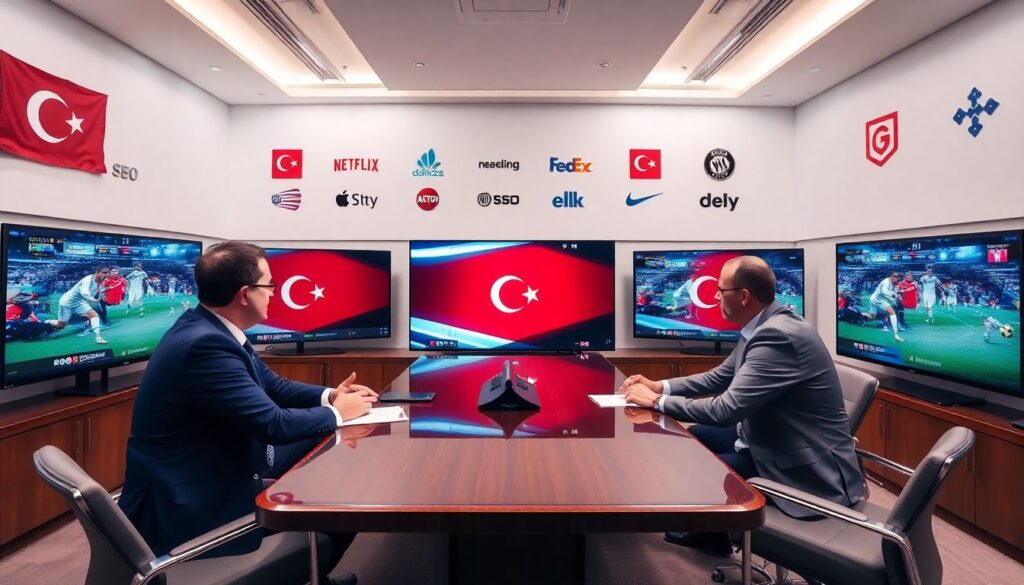
Broadcasting and digital rights determine how Turkish sport reaches fans and how media revenue flows through the system. Rights are usually centralised at league or federation level, then sold to national broadcasters, pay-TV, OTT platforms and, in some cases, free-to-air partners.
In football, Turkish football TV rights deals for the top division have historically been the single largest commercial contract in the market. The structure of Turkish Super Lig broadcasting rights typically includes domestic live matches, highlight packages, delayed broadcasts and international distribution, sometimes complemented by streaming-only packages or mobile rights.
- Rights packaging models
- Central sale by the league or federation, with revenue distributed to clubs via pre-agreed formulas.
- Sub-licensing of certain matches or packages (e.g., highlights) to secondary broadcasters.
- Digital-only bundles sold to OTT platforms targeting younger audiences.
- Typical broadcaster commitments
- Rights fee payable over instalments across the season.
- Production of matches (cameras, crews, presentation) meeting league standards.
- Marketing support to grow league and club reach domestically and abroad.
- Revenue flows and risk points
- Leagues depend heavily on timely payments from broadcasters; contract instability can damage club budgets.
- Clubs relying excessively on central media income are vulnerable to renegotiations or currency swings.
- Broadcasters face subscriber churn and advertising cycles, which may trigger pressure to cut fees.
- Scenarios practitioners must model
- A new long-term rights cycle where fees grow slower than club wage inflation.
- A fragmented model where some games move to digital-only, lowering exposure for smaller clubs.
- A change in primary broadcaster leading to different kickoff times and fan habits.
Before designing sponsorship or media-led strategies, practitioners should run scenario planning around media visibility: What happens to a club or brand plan if live TV coverage is reduced, moved behind a different paywall, or supplemented by a club-owned streaming channel?
Club finances: income streams, cost structures, and budgeting practices
Club finances in Turkey depend on assembling a balanced mix of recurring revenues while keeping football-related costs under control. The balance is fragile because sporting pressure pushes spending up, while economic and currency volatility can compress income or increase debt burdens.
| Revenue or cost item | Typical role for Turkish clubs | Key sensitivity | Practical management focus |
|---|---|---|---|
| Broadcasting income | Primary or major revenue stream for top-tier clubs | League performance, TV contracts, payment timelines | Diversify beyond central media money; plan conservative scenarios |
| Sponsorship & commercial | Critical for big-city clubs and strong brands | Team results, brand compatibility, macroeconomic conditions | Build multi-year deals; invest in activation and reporting |
| Matchday & hospitality | Important for clubs with modern stadiums and loyal fan bases | Stadium utilisation, pricing, fan experience | Segment products; enhance premium seating and non-match events |
| Player trading | Upside revenue rather than core operating income | Scouting quality, contract management, international demand | Adopt portfolio thinking; avoid forced sales to plug budget gaps |
| Wages & bonuses | Largest recurring cost for professional squads | League ambitions, negotiation discipline, contract length | Set strict wage-to-income targets; use performance-weighted pay |
| Transfer fees & agent commissions | Volatile cost tied to squad changes | Market cycles, pressure from fans and media | Use data in recruitment; cap total spend per window |
| Financing & stadium costs | Significant for clubs with debt or new facilities | Interest rates, currency movements, maintenance needs | Refinance where possible; plan long-term maintenance budgets |
Upsides of the current Turkish club business model
- Strong football culture supports fan engagement and long-term sponsor interest.
- Large derbies and European participation create premium inventory for partners.
- Clubs can leverage local passion to sell memberships, fan tokens and digital products.
- Youth development systems can generate high-margin player sales when well-managed.
Constraints and structural weaknesses to watch
- High dependence on broadcasting and a limited number of large sponsors.
- Exposure to currency risk where income and costs are in different currencies.
- Political and regulatory influence on stadiums, federations and licensing decisions.
- Short-termism in squad building, driven by pressure for immediate on-pitch success.
- Limited transparency in some clubs, complicating external investing in Turkish sports clubs.
Regulation and governance: licensing, FFP-like rules, and oversight bodies
Regulation in Turkish sport is designed to keep clubs solvent, protect competition integrity and align with international standards. Licensing systems check financial, legal, infrastructural and sporting criteria before allowing clubs to compete domestically and in European competitions.
- Assuming regulation is purely formal – A common error is treating licensing as paperwork rather than a real limit on unsustainable spending. In practice, non-compliance can lead to fines, transfer bans or competition exclusions.
- Underestimating FFP-style constraints – Some clubs believe new investors or political support automatically override break-even rules. In reality, persistent deficits and overdue payables can still trigger sanctions.
- Misreading oversight roles – Federations, leagues, state bodies and UEFA all have different mandates. Confusing them leads to unrealistic expectations about who can approve restructurings or postpone sanctions.
- Ignoring creditor and player protection – Late payments to players, staff or other clubs are not just internal issues; they directly affect licensing and reputation, limiting future business.
- Overconfidence in related-party deals – Some believe that inflating sponsorship fees from friendly companies will always solve FFP tests. Without market justification, such deals may be challenged by regulators.
- Weak board-level governance – Boards that do not track financial covenants, cash flow and regulatory ratios month-by-month tend to face last-minute crises around licensing deadlines.
From concept to practice: monetisation tactics, partnerships, and risk controls

To turn the Turkish sports business landscape into actionable plans, practitioners need structured monetisation tactics and clear risk controls. This means aligning commercial strategy, sports operations and compliance in a single roadmap rather than treating each as a separate project.
Practical monetisation levers for Turkish clubs and partners
- Repackaging rights for modern sponsors
- Create combined on-site, broadcast-visible and digital packages rather than selling each asset separately.
- Use insights from sports sponsorship Turkey campaigns to design performance-based elements (e.g., bonuses tied to leads or sign-ups).
- Leveraging media exposure
- Align sponsor messaging with key matchdays broadcast under Turkish football TV rights deals to maximise reach.
- Use clips, highlights and behind-the-scenes content within what rights allow to extend exposure beyond live games.
- Deepening fan monetisation
- Develop membership tiers combining ticket priority, digital content and partner offers.
- Cross-sell partner products to members using club channels, sharing data insights within privacy rules.
- Professionalising sales and servicing
- Build a central commercial team or work via specialised Turkey sports marketing agencies with clear revenue-share arrangements.
- Standardise proposals, inventory pricing and post-campaign reports to speed up sales cycles.
- Embedding financial risk controls
- Set internal limits on wage-to-revenue ratios, transfer spending per window and net debt levels.
- Use scenario planning around changes in Turkish Super Lig broadcasting rights and macroeconomic shocks.
Mini case study: restructuring a mid-table Turkish football club
A mid-table club with stagnant revenues, rising wage costs and overdue payables wants to stabilise and grow. The board appoints a new CEO who focuses on three parallel workstreams over a multi-season horizon.
- Commercial reboot
- Audit all sponsorships and media inventory; identify undervalued assets around derby matches and national TV exposure.
- Partner with a Turkey sports marketing agency to build new sponsorship tiers including digital content, youth team branding and women’s team rights.
- Close a multi-year front-of-shirt and sleeve package with activation budgets tied to fan engagement KPIs.
- Cost and squad discipline
- Introduce clear wage bands and shorter contracts with performance incentives.
- Establish a recruitment committee that evaluates each transfer against projected resale and wage impact.
- Invest modestly in analytics and scouting rather than expensive last-minute signings.
- Governance and investor readiness
- Improve financial reporting, cash-flow forecasting and regulatory monitoring on a monthly basis.
- Prepare transparent presentations for potential partners interested in investing in Turkish sports clubs, focused on governance and risk controls.
- Use improved governance and cleaner books to negotiate better terms with lenders and sponsors.
Within this structured approach, sporting performance still matters, but it is embedded in a financially realistic plan that assumes volatility in broadcasting contracts and economic conditions rather than hoping they will always improve.
Practitioners’ common questions and clarifications
How dependent are Turkish clubs on broadcasting income today?
Top-tier Turkish clubs are heavily reliant on broadcasting income, but the exact share varies by size and fan base. For resilience, budgets should be set so that core operations remain viable even if media revenues decline or are delayed.
What should a brand new to sports sponsorship Turkey focus on first?
Start by clarifying target audiences, measurable business goals and budget for activation, not just rights fees. Then select clubs or leagues whose fan profiles match your customers, and insist on a clear inventory list plus reporting framework.
Are Turkish football TV rights deals attractive for international investors?
They can be, but contracts and market conditions change over time. Any investor should analyse regulatory stability, currency risk, subscriber trends and alternative monetisation paths like OTT before committing capital.
What is the safest entry point for investing in Turkish sports clubs?
Minority stakes with governance rights, or structured partnerships around specific assets (e.g., stadium projects, academies, commercial subsidiaries), generally offer better risk control than taking over entire clubs with legacy debt and obligations.
How can smaller clubs negotiate better sponsorships?
They should package local strength: community engagement, regional media exposure and access to grassroots programmes. Detailed fan data, flexible activation ideas and professional servicing can compensate for lower national visibility.
Do Turkey sports marketing agencies replace the need for in-house commercial staff?
Not necessarily. Agencies can extend reach and expertise, but clubs still need internal people who understand the brand, coordinate rights delivery and manage long-term relationships with sponsors and media partners.
What happens if a club breaches licensing or FFP-like rules?
Consequences range from fines and squad registration limits to transfer bans and competition exclusions. It is more effective to negotiate realistic settlement agreements early than to rely on last-minute political or legal solutions.