From Amateur Lanes to Global Circuits: A Short Backstory
If you looked at Turkish athletics in the 1980s, it was mostly a local affair: school meets, military competitions and a few standout middle‑distance runners in Europe. The real turning point came in the late 1990s and 2000s, when the federation started targeting distance events and systematically sending athletes to altitude and warm‑weather camps abroad. By the mid‑2010s, investment flipped direction: instead of chasing facilities in Kenya or Ethiopia, Turkey began building its own dense network of tracks and road‑race circuits. That shift set the stage for the 2020s, where Turkish names appear regularly in Diamond League start lists and big‑city marathon results, not just as participants, but as contenders and pacemakers shaping race dynamics.
What “Rising on the Global Stage” Actually Means
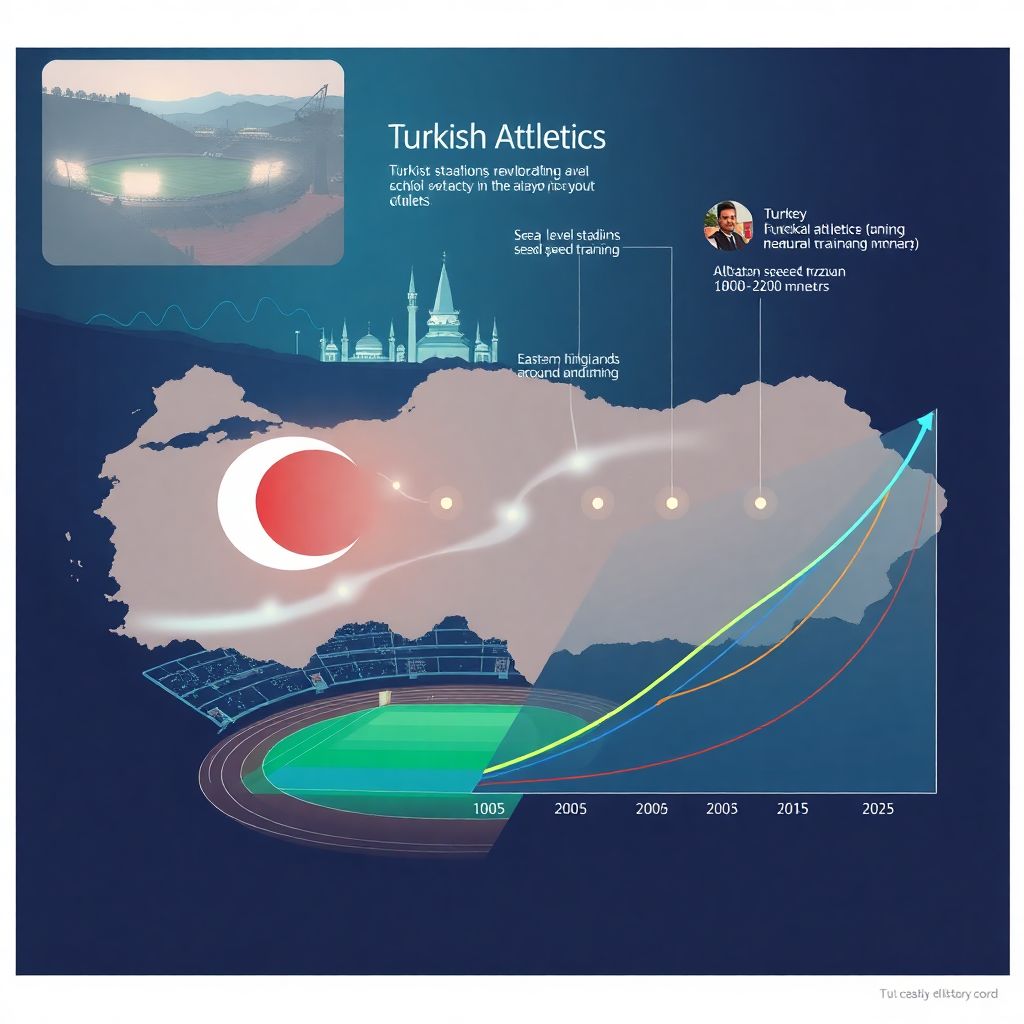
Let’s define terms so we’re not hand‑waving. When we say Turkish athletics is “rising”, we’re talking about three measurable things: more athletes hitting World Athletics qualifying standards, more podiums and top‑eight finishes at major championships, and more internationally recognized events hosted in the country. Picture a simple line diagram over 20 years: the x‑axis is time from 2005 to 2025, while the y‑axis tracks medals, finalists and World Athletics‑certified events; all three lines slope upward after about 2012 and spike again post‑2020. Compared to traditional powerhouses like the UK or Germany, Turkey is still catching up, but its growth rate is sharper, especially in women’s middle‑ and long‑distance races and in road running, where depth used to be minimal.
Infrastructure: From Single National Stadium to Training Ecosystem
Historically, focus sat on one or two emblematic stadiums in Ankara and Istanbul. Now, the pattern looks more like a cluster map: multiple World Athletics‑class tracks in mid‑size cities, indoor arenas for winter prep, plus endurance hubs near Erzurum and the highlands for altitude work. Imagine a “hub‑and‑spoke” diagram: Istanbul and Ankara in the middle as logistics centers, with arrows to coastal cities offering sea‑level speed training and to eastern plateaus for aerobic development. This distributed model reduces travel stress for athletes and allows coaches to periodize training around geography, not just the calendar. Compared with some European systems still centralized around one national center, Turkey’s layout is more modular and surprisingly agile, especially for road and cross‑country squads.
Why Training Camps in Turkey Suddenly Matter
In the last decade, Turkish athletics training camps for international runners have quietly become a serious alternative to Kenya’s Iten or Ethiopia’s Sululta. Altitude zones around Erzurum and Erzincan might not have the same romantic aura, but they offer 1800–2200 meters of elevation, decent air links and growing sports science support. Think of a layered bar diagram: one bar for altitude, one for travel time from Europe, one for total cost. Kenya wins on altitude, Turkey often wins on travel time and logistical simplicity, and the cost bar sits in the middle. For European clubs with tight budgets and limited vacation days, that trade‑off is enticing: less jet lag, easier communication, facilities that match Western standards and a climate that allows productive sessions nearly year‑round.
Coaching and Performance: From Volume to Smart Volume

For a long time, local programs were obsessed with sheer mileage: more laps, more weekly kilometers. Since roughly 2018, there’s been a shift toward data‑driven planning and more nuanced speed‑endurance work, especially in athletics coaching in Turkey for elite track runners. Coaches now integrate lactate testing, GPS pacing and HRV‑based recovery checks, but they still keep the traditional toughness of group sessions. Imagine a pie chart by training emphasis: in 2005, volume might occupy 70% of the pie; by 2025, it’s closer to 45%, with strength, speed mechanics and recovery tools each taking a serious slice. Compared with some Western setups, which can be gadget‑heavy but culture‑light, Turkish groups often win on cohesion and competitive training environments, which matter enormously in middle‑distance development.
Road Running and the Push Toward Marathon Majors
On the road, the country has gone from a handful of national races to a dense calendar that attracts global elites. The Istanbul Marathon is now a Gold Label event, and the Antalya races have been steadily upgrading fields and organization. To visualize the ambition, imagine a staircase diagram: each step is a new label level, deeper elite field, and cleaner logistics, leading toward realistic conversations about one Turkish race eventually joining the marathon majors. Even the dry phrase Turkey marathon 2025 registration Istanbul Antalya hides a bigger story: standardized entry systems, better crowd management and stronger anti‑doping protocols. These are precisely the boring but crucial ingredients that organizations like Abbott look for when considering expansion beyond the classic six majors.
Sports Tourism: Races as Travel Anchors
One under‑appreciated driver of this rise is simple: people want interesting places to run fast. Sports tourism Turkey athletics and marathon packages now bundle start numbers with seaside hotels, historical tours and even light training guidance. Picture a Venn diagram with three circles: high‑quality competition, tourist appeal and logistical ease. Turkey sits increasingly in the overlap: you can race on a certified course in the morning and be in a UNESCO heritage site by afternoon, without brutal time‑zone shifts. Compared with, say, Chicago or Tokyo, Turkish events might still be building prestige, but they win on cultural density per race weekend and on the ability to connect a competition schedule with family holidays or club trips that feel more like mini‑training camps.
Clubs and Community: Why Foreign Runners Are Showing Up
Under the radar, the best Turkish running clubs for foreign athletes have become micro‑hubs of integration. They help with paperwork, language gaps and, crucially, training structure. Picture a flow diagram: an incoming athlete lands, joins a club, gets placed into an appropriate training group, then is funneled toward either track circuits, road races or mountain running based on strengths. Unlike some Western clubs that separate elites and hobby runners almost completely, Turkish clubs often mix levels in warm‑ups and base sessions, only splitting for quality work. That setup creates organic mentoring: international newcomers can see how national‑level athletes prepare, while locals get exposure to different racing cultures and pacing habits brought by foreign teammates.
How Runners Actually Plan a Season in Turkey
To see how all these elements connect in practice, consider a typical planning sequence for a serious amateur or developing elite in 2026:
1. Winter base at a mild coastal city with one weekly track session.
2. Early‑spring altitude block in the east to build aerobic depth.
3. Summer focus on speed and championship‑style track races.
4. Autumn preparation for a major city marathon or half.
Draw this as a timeline diagram: blocks of different colors for base, speed, and race phases along the calendar. Turkey’s geography lets these phases happen mostly in‑country, cutting costs and transit fatigue. Compared with athletes in colder northern climates, Turkish runners can maintain consistent outdoor quality sessions deeper into winter, which is a quiet but real performance advantage across the 1500m‑marathon spectrum.
What Still Needs Work Before True “Major” Status
Despite the momentum, there are clear gaps. Depth beyond the top tier remains thin, especially in technical events, and not every regional meet hits international organizational standards. Anti‑doping vigilance has improved, but the country still has to prove over a longer time span that past issues are firmly behind it. For foreign participants, Turkey marathon 2025 registration Istanbul Antalya procedures have become smoother, yet visa questions and communication consistency sometimes lag behind Western benchmarks. The trajectory, however, is pointed upward: as coaching education tightens, sports science embeds more deeply and international athletes keep choosing Turkish races and camps, the country’s athletics scene is shifting from “interesting alternative” to a regular fixture in the global racing calendar.
Комментарии