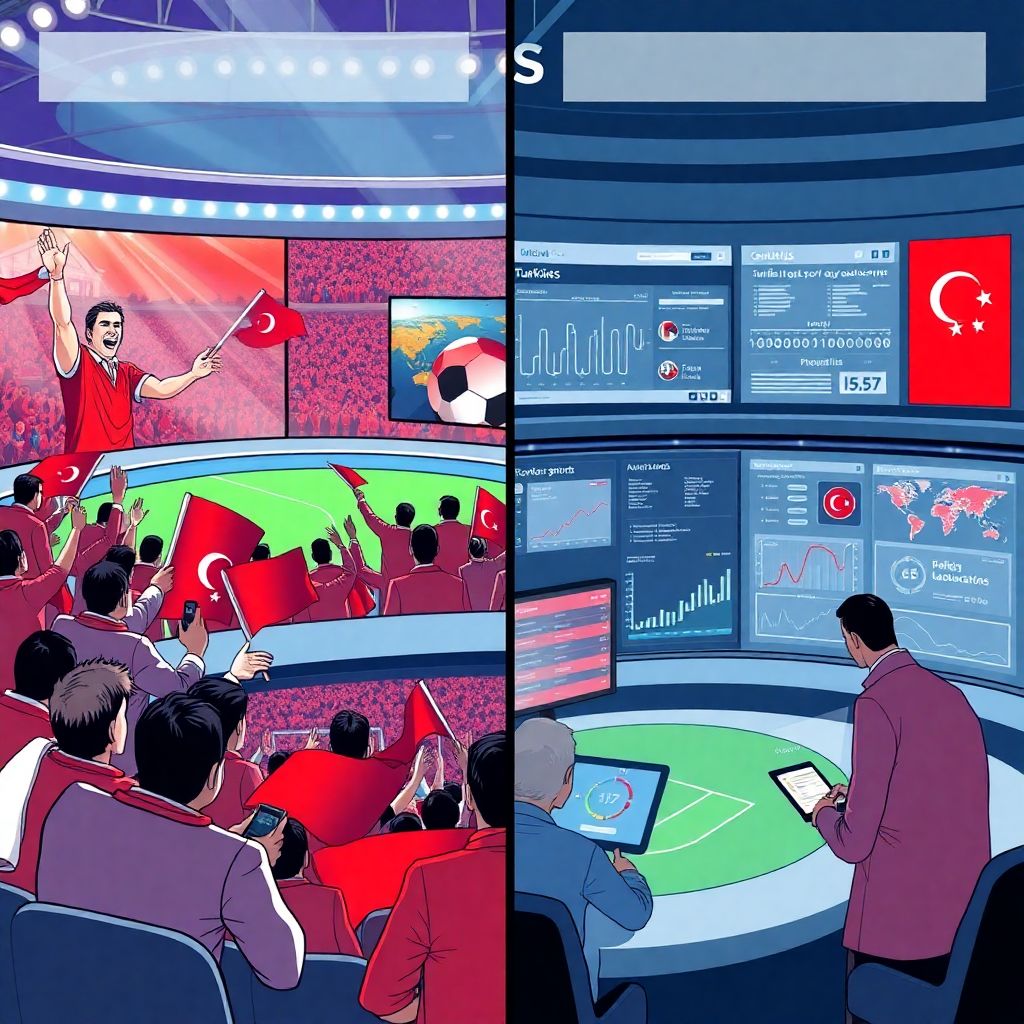
Most people assume that a Champions League final or the Olympics look the same on TV and online, no matter where you are. But once you start comparing how sports media in Turkey frames those events with how UK, US or pan‑European outlets do it, you realise you’re not watching the same story at all.
This guide walks you through those differences and, more importantly, gives you a practical, almost “laboratory” way to study and understand them yourself.
—
What Makes Turkish Sports Coverage Its Own Ecosystem
Turkish outlets are operating in a very specific mix of factors: a hyper‑passionate football culture, heavy social media use, strong club identities and a news environment where politics are never really separate from sport. That cocktail shapes how global events are narrated.
While an international broadcaster might describe a Champions League night mostly in tactical or commercial terms, a Turkish channel will often anchor the same game in national pride, club history and long‑running rivalries. A Premier League transfer saga, for instance, is not just “Player X moves for €80m” but “What this means for the Turkish player pipeline, for Super Lig clubs and for our international reputation.”
—
Necessary Tools for Comparing Coverage Like a Pro
You don’t need a newsroom to run your own turkey vs europe sports media comparison—you just need the right digital toolkit and a bit of method.
At a minimum, experts recommend:
1. A browser with multiple profiles or containers (so you can stay logged into different sites and languages at once).
2. A reliable VPN to bypass regional blocks and access live turkish football streaming or foreign broadcasters when needed.
3. Translation tools (Chrome built‑in translation, DeepL, or similar) to contrast Turkish articles with turkish sports news in english.
4. RSS or news aggregation apps (Feedly, Inoreader) to track updates across the best turkish sports websites and major international outlets.
5. Social‑media monitoring tools (even basic ones like Twitter/X lists) to see how stories evolve in real time.
With these, you can reproduce the basic workflow media researchers use, but from your laptop or phone.
—
Step‑by‑Step: How to Study the Differences Yourself
Let’s turn the theory into a clear process you can follow whenever a big global sports story breaks—World Cup, NBA Finals, Olympics, you name it.
1. Pick one concrete event
Choose something with clear time boundaries: a match, a transfer, a doping scandal, or a big tournament opening ceremony. The clearer the event, the easier it is to compare.
2. Select your Turkish and international sources
On the Turkish side, include at least:
– One TV‑backed portal (e.g. a large sports channel site)
– One digital‑native outlet
– One or two club‑oriented sources or fan portals
On the international side, combine:
– A UK or European broadcaster
– A US‑based site
– A global wire service or neutral‑ish outlet
3. Capture the first wave of coverage
Within the first 1–3 hours after the event, save screenshots and URLs. Notice: headlines, featured images, subheads, and the first paragraph. This is where framing is most obvious.
4. Track the “second wave”
Over the next 24–48 hours, follow follow‑up stories: opinion pieces, talk‑show clips, YouTube segments, and social media threads. Add these to your collection.
5. Look for recurring angles and metaphors
Now compare:
– Are Turkish outlets discussing “respect” and “prestige” more than foreign media?
– Do internationals focus more on data, business and geopolitics?
– Are players framed as “heroes,” “victims,” or “assets”?
6. Note what’s emphasized vs. minimized
An expert trick: what’s missing is as meaningful as what’s present. If international outlets push human‑rights narratives at a World Cup in Qatar while Turkish outlets foreground match quality and regional diplomacy, that’s not accidental.
7. Summarise your findings like a mini‑study
Write a short paragraph or voice note: what did Turkish coverage highlight, what did international coverage highlight, and which audiences those angles seem to be serving?
Follow this every time a big global story hits and you’ll quickly build an intuitive feel for structural differences.
—
How Turkish Sports Media Frames Global Stories
Researchers who specialise in media framing usually point to three dominant lenses in Turkish coverage of global sport: national identity, club identity and perceived respect from abroad. These lenses colour almost every major story.
When a Turkish athlete wins a medal or a Turkish club shocks a European giant, the message is not just “success” but “proof we belong at the top table.” That’s why even neutral‑looking reports often contain subtle references to “how Europe sees us” or “how this result will be talked about in foreign media.”
—
Turkey vs International Outlets: Key Content Differences
When you run your own turkey vs europe sports media comparison, several patterns tend to repeat:
1. Emotional intensity vs. analytical distance
Turkish coverage of global events is more emotionally charged, especially when a Turkish player or club is involved. International outlets, particularly Anglo‑American ones, lean more on stats and tactics even when the stakes are huge.
2. National storyline vs. global storyline
A Champions League semi‑final: Turkish outlets might foreground “the Turkish referee,” “the Turkish reserve player,” or how the result will impact Turkish clubs’ UEFA coefficients. International outlets build a broader narrative about money, tactics, or coaching legacies.
3. Highlighting Turkish contribution
When global stars with Turkish heritage appear—whether in basketball, MMA or football—local media amplify that heritage and link it back to domestic debates about youth development and migration. Foreign outlets usually treat that heritage as a side note at best.
4. Political context is never fully absent
International sports pages try (not always successfully) to cordon off politics to “special reports.” Turkish sports shows and sites let political talk spill into sport more naturally: from stadium naming rights to diplomatic tensions affecting matches or fan travel.
—
Live Streaming and Match‑Day Culture
Match‑day is when the difference is easiest to feel, because every platform shifts into “event mode.” Accessing live turkish football streaming underlines how commentary tone, sideline interviews and in‑studio reactions shape the story.
International broadcasts often stick to a calmer, globally intelligible style. Turkish commentators lean into drama: long emotional arcs, historical flashbacks, quick references to domestic league storylines and even off‑pitch gossip. For someone used to British understatement, Turkish commentary can feel like a blend of sports, theatre and talk‑radio.
—
Where to Look: Sites and Languages

If you only read turkish sports news in english, you’re already dealing with a filtered version of the ecosystem. English‑language sections often tone down insider references, club slang and political nuance because they’re aimed at foreign readers, sponsors and scouts.
That said, these English pages on some of the best turkish sports websites are excellent “bridges” if you’re not yet confident with Turkish. Experts advise using them alongside auto‑translated Turkish pages from the same outlet; when you compare the two, you’ll spot which details are being trimmed or re‑framed for an international audience.
—
Expert Tips: How to Read Turkish Coverage Critically

Media analysts and sports journalists who work across countries often share similar advice for making sense of Turkish coverage of global events.
First, they suggest always asking, “For which audience is this piece written?” A transfer story aimed at fans of a Big Three club will look different from the same event described for a business‑oriented sports magazine. Recognising the audience helps you interpret the tone rather than taking it at face value.
—
Expert Recommendations You Can Apply Immediately
Here are distilled recommendations from cross‑border media experts and bilingual sports journalists:
1. Pair sources
For every Turkish article or show you consume about a global event, pair it with at least one foreign source on the same story. Don’t rely on one ecosystem.
2. Watch the same game twice (in different languages)
If you can, watch the first half on an international channel and the second half via a Turkish feed. You’ll often feel like the stakes, heroes and villains have quietly changed.
3. Track vocabulary, not just facts
Notice words like “respect,” “injustice,” “history,” “legacy,” “betrayal.” Turkish and international outlets use very different emotional dictionaries for the same play or referee decision.
4. Separate data from narrative
Stats and raw clips travel easily between countries; interpretations do not. When a story looks explosive, ask: what’s the data, and what’s the local narrative wrapped around it?
5. Follow at least one bilingual journalist
A bilingual reporter or analyst on X/Instagram who moves between Turkish and English is often the best “translator” of not just language, but of cultural meaning.
—
Common Pitfalls and How to Troubleshoot Your Analysis
Even with a good process, it’s easy to misread what you’re seeing. That’s where a bit of “troubleshooting” comes in.
If you find Turkish coverage “too biased” compared to international outlets, pause and check whether you’re simply more familiar with one set of biases than another. A British or American site has its own blind spots—toward Premier League centrality or US college sports, for example—that just feel “normal” if you grew up with them.
—
Troubleshooting: Practical Problems You’ll Hit
You’ll likely run into three very down‑to‑earth issues:
1. Language barriers
Machine translation can mangle idioms and club slang. To fix this, cross‑check key terms (especially political or cultural ones) with a second translator or a bilingual friend, and don’t over‑interpret single phrases.
2. Geo‑blocking and access
Some streams and replays, Turkish and foreign, are region‑locked. This is where your VPN and multiple platforms matter. If you can’t access one broadcaster’s coverage, try highlights and talk shows on YouTube, where editorial framing still shows clearly.
3. Algorithmic bubbles
Social media and news apps will feed you more of whatever you click on. If you mostly open sensational headlines, you’ll think all Turkish coverage is sensationalist. To counter this, deliberately subscribe to a mix of mainstream, niche and critical outlets on both sides.
Think of troubleshooting not as an annoyance but as part of your “fieldwork”: each obstacle tells you something about how the media system itself is structured.
—
Putting It All Together
Once you start paying attention this way, you’ll notice that sports media turkey isn’t simply “behind” or “ahead” of international outlets—it’s optimised for a distinct emotional and cultural environment. The same global event becomes a canvas for different anxieties, hopes and identities.
By using a few simple tools, a clear step‑by‑step process and the expert recommendations above, you can move from passively consuming highlights to actively decoding how stories are built. And after that, every final, every scandal and every transfer window will look richer, more layered—and a lot more interesting—no matter which country’s coverage you’re watching.
Комментарии