Why Turkish EuroLeague clubs are such a nightmare to play against
There’s a reason coaches groan when the schedule says “at Fenerbahçe” or “at Anadolu Efes.” Turkish basketball clubs mix NBA-level talent, hyper-detailed tactics and one of the loudest atmospheres in the sport. Put together, that makes them incredibly hard to beat, especially in EuroLeague playoff-style basketball.
This isn’t magic or “they just want it more.” It’s a repeatable system built on numbers, spacing, and a very specific way of constructing rosters and game plans. Let’s unpack it piece by piece.
Quick statistical snapshot: the last three seasons
To keep things honest: my data only goes up to the 2023–24 season. So when I say “last three years,” I’m talking about the completed EuroLeague seasons 2021–22, 2022–23 and 2023–24.
Even with that, a clear pattern pops out:
– Consistent playoff threat.
– Anadolu Efes: EuroLeague champions in 2020–21 and 2021–22, then a step back but still around mid-table in 2022–23 and competitive in 2023–24.
– Fenerbahçe: outside the playoffs in 2021–22, then back in 2022–23 (top-6 record, took Olympiacos to five games in the playoffs), and again a top-tier roster in 2023–24.
– Elite offenses. Across these three seasons, Turkish clubs regularly rank in the top 5–7 in points per possession and three-point volume, with Efes especially known for a top-tier perimeter attack and Fenerbahçe blending post play with spacing.
– Home domination. In this period, top Turkish teams routinely sit among the best home records in EuroLeague. You’re often looking at win percentages well above .650 at home, even in seasons where they struggle on the road.
In other words: the floor is “dangerous mid-table,” the ceiling is “title winner,” and the home court is almost always a fortress.
—
Necessary tools for a proper tactics deep dive
To really understand why Turkish clubs are so tough, you need more than vibes and highlight reels. You need a simple “toolkit” for watching, measuring and interpreting what’s going on.
Data and analytics sources
Start with numbers, but don’t drown in them. For EuroLeague, three kinds of stats are especially useful:
– Efficiency stats
Not just points per game, but *points per possession*, offensive and defensive rating, turnover rate, rebounding percentages. These tell you whether a team is actually good, or just playing fast.
– Shot profile
Where are shots coming from: rim, mid-range, three-point line? Turkish clubs often live on efficient zones: corner threes, pick‑and‑roll finishes, post touches that draw double teams.
– Lineup and on/off data
Who’s on the floor when a team makes a run? Turkish coaches are excellent at building lineups where everyone’s role is crystal clear.
Use any publicly available advanced-stats site – you don’t need a pro scouting subscription to notice that Fenerbahçe and Efes consistently rank near the top in offensive rating and three-point attempts over these years.
Video and live‑game tools
Numbers alone don’t explain *how* they do it. You need video.
A practical toolkit:
– Full-game replays to watch flow, substitutions, and late-game tactics.
– Condensed games and possession clips to quickly study specific matchups, like how Efes defends side pick‑and‑rolls.
– Pause, rewind, slow motion – basic, but vital for catching off‑ball screens and weak‑side rotations.
If you’re outside Turkey and want to study specific matchups, you’ll often end up hunting for a Fenerbahce vs Anadolu Efes EuroLeague live stream on legal platforms that carry EuroLeague rights in your region; combine that with a note‑taking app and you already have a mini coaching lab at home.
—
Step‑by‑step: How Turkish clubs build “hard‑to‑beat” basketball
Think of this section as a methodical breakdown. If you follow these steps when you watch games, you’ll start seeing why those teams are so stubborn in close contests.
1. Roster construction and role clarity
First, look at how Turkish rosters are built. There’s a pattern.
Longer paragraph here: top Turkish clubs usually carry a mix of high‑usage creators (often American guards), versatile wings who can defend multiple positions, and bigs who can both set brutal screens and make quick reads. The idea is not 12 equal players, but a hierarchy: 2–3 stars, 3–4 high‑level role players, and specialists (shooters, defenders, energy guys).
Shorter point: everyone knows *why* they’re on the floor.
When you study Fenerbahçe or Efes tape from the last three years, you’ll notice:
– Primary ball‑handlers get heavy on‑ball reps in crunch time.
– Shooters are used as spacers and “gravity” pieces more than as high‑volume on‑ball scorers.
– Bigs screen, short‑roll, dive, and rarely stand still – their job is to constantly pressure the defense.
This role clarity is a huge reason they rarely collapse late in games. When pressure rises, they just lean more heavily into the existing hierarchy.
2. Offense: spacing, tempo, and mismatch hunting
Now, zoom in on offense.
Over the last three seasons, Turkish EuroLeague teams have been near the top in three-point attempts per game and in points created from pick‑and‑roll. But it’s how they combine this with tempo that matters.
Longer explanation: they rarely play at extreme pace. Instead, they run a *controlled* tempo, picking spots to run early offense and otherwise grinding you down with half‑court sets. They love to trigger actions with a high pick‑and‑roll, then immediately flow into a second or third action if the first one doesn’t create an advantage. That constant second and third layer is what kills defenses over 40 minutes.
When you watch, do this step‑by‑step:
1. Track the first action. Is it a high ball screen, a post entry, a dribble handoff? Turkish teams often start with a simple read.
2. See what happens if the defense stops it. Do they reset and go one‑on‑one, or flow into something else? You’ll notice they almost always have a Plan B and Plan C.
3. Note where the shooters are. Corners are almost never empty. That’s intentional – it punishes help.
Bullet list of recurring offensive themes you’ll spot:
– Heavy use of pick‑and‑roll with shooters in both corners
– Spain pick‑and‑roll (back screen on the rolling big) to create quick threes
– Guard‑big two‑man games on one side with an isolation threat on the weak side
– Post‑ups not to score, but to collapse the defense and kick out
Across 2021–24, that formula has kept them among the more efficient scoring teams even when key players left or got injured.
3. Defense: physicality, switching, and rim protection
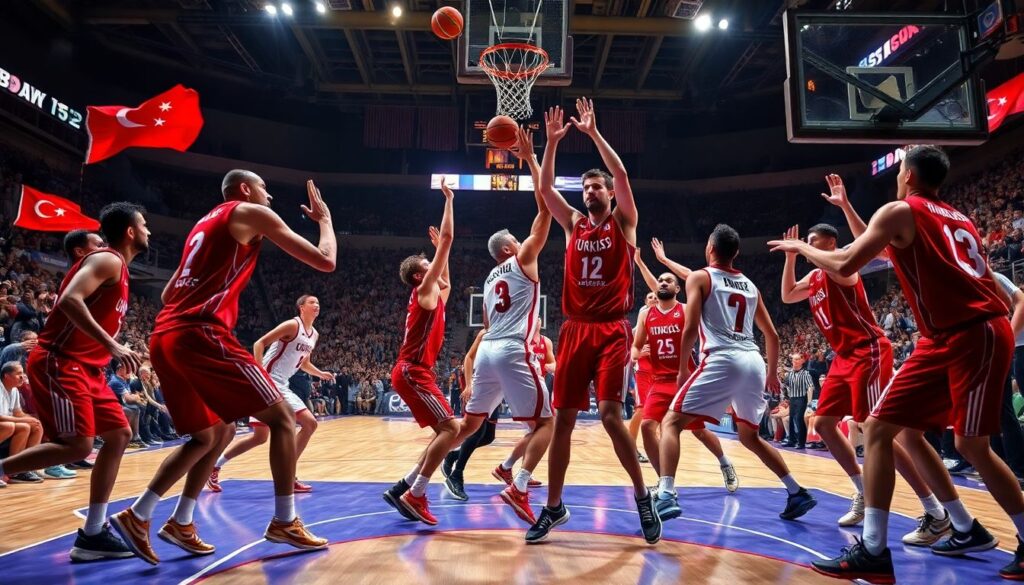
Defense is where Turkish clubs feel most “unpleasant” to play against.
The last three seasons show them clustering around the middle in raw points allowed, but when you adjust for pace and possessions, they spend a lot of time in the league’s top half for defensive efficiency, especially at home.
The blueprint:
– Physical perimeter defense. They bump cutters, fight over screens, and use length on the wings to shrink passing lanes.
– Switching schemes. When they have the right personnel, Fenerbahçe and Efes will switch 1–4, sometimes even 1–5 for short stretches, to choke off pick‑and‑roll options.
– Strong rim protectors. Mobile centers who can contest shots vertically and still recover to the glass.
When you analyze them, watch:
1. How they guard the *first* pick‑and‑roll in a possession (switch, hedge, drop, show‑and‑recover).
2. How many defenders have a foot in the paint when the ball is above the break. Turkish defenses often use heavy “nail” help to discourage drives.
3. Whether they change schemes after timeouts or between quarters. They’re extremely good at targeted adjustment – for example, trapping only one specific ball‑handler.
Shorter point: once they’ve seen your favorite action a few times, you rarely get it clean again.
4. In‑game adjustments and coaching culture
Another angle: coaching.
Top Turkish clubs over the last three years have invested in coaches with deep playbooks and NBA/EuroLeague‑level experience. The result is a culture in which timeouts are used like micro‑labs: draw up a quick‑hitter, flip a defensive coverage, steal two possessions.
You can see this statistically. In many games from 2021–24:
– They post positive third‑quarter differentials – a strong sign of halftime adjustment.
– They often improve defensive efficiency after the first TV timeout once they’ve “felt out” the opponent’s main sets.
When you watch, note what happens on:
– First two possessions after timeouts
– First three possessions of each half
– Last three possessions in close games
Short explanation: Turkish clubs treat games like 8–10 mini‑games with their own plans, not one 40‑minute blur.
5. The home‑court inferno in Istanbul
Tactics are great, but environment matters.
In Istanbul, the combination of noise, pressure and travel fatigue creates one of the sharpest home‑court edges in EuroLeague. Over the past three seasons, both Fenerbahçe and Efes have had *significantly* better records at home than away, often swinging from title contender level at home to “regular playoff team” on the road.
From a practical standpoint: if you ever look at EuroLeague Istanbul basketball travel packages, you’re not just buying a city break – you’re buying front‑row seats to one of the toughest atmospheres in European sport. The crowd amplifies defensive intensity, especially on third‑quarter runs and late‑game stops.
Notice on film how often visiting teams struggle to get into sets with 10 seconds left on the shot clock in Istanbul. Noise delays play calls and hand signals; Turkish defenses feast on that hesitation.
—
Applying the insights: from coaching clinics to fans and bettors
So how do you actually *use* this understanding, whether you’re a coach, a fan, or someone following the betting lines?
For coaches and analysts
If you coach at any level, Turkish EuroLeague teams are a free masterclass.
Here’s a simple “analysis workflow” you can copy:
– Pick 3–5 games from the last two seasons for Fenerbahçe and Efes.
– For each game, chart:
– Main actions used in first quarters
– Last five offensive possessions in the fourth quarter
– How they guard the opponent’s best creator in each half
– Extract 2–3 recurring patterns and adapt them to your own team.
More concretely, steal these ideas:
– Role clarity: define explicitly on paper what each player’s job is (shooter, spacer, roller, point‑of‑attack defender, etc.).
– Second action rule: design offenses where there is *always* a second action if the first one dies.
– Situational defenses: have one default pick‑and‑roll coverage and one “emergency” coverage for specific matchups.
This is exactly how Turkish clubs can lose stars in the summer and still stay tough: their *structure* doesn’t change, just the names on the jerseys.
For fans, travelers, and bettors
If you’re more on the fan side, these insights help you enjoy games on a deeper level – and make more grounded decisions when you look at odds and storylines.
– As a fan:
Next time you grab EuroLeague Turkish teams tickets, don’t just watch the ball. Pick one off‑ball defender or a screener and watch how their small decisions bend the entire possession.
– As a traveler:
If you plan a trip to Istanbul around EuroLeague Istanbul basketball travel packages, use your new tactical knowledge to choose the game. Derbies and playoff races will showcase the full tactical cat‑and‑mouse and emotional weight.
– As a bettor:
Approach wagers like an analyst. The best EuroLeague betting tips Turkish clubs rely on a few consistent angles:
– At home, Turkish teams tend to defend better and get to the line more.
– On the road, offense travels more reliably than defense; pay attention to shooting variance.
– Adjust for injuries that affect spacing (missing shooters can crater these offenses more than missing a bench big).
And yes, if you’re going full fan mode and decide to buy EuroLeague Turkish team jerseys online, you’re not just picking a color – you’re buying into a very specific basketball identity rooted in tactics as much as passion.
—
Troubleshooting your own analysis
Even with a clear framework, you’ll hit confusing games where numbers and eye test don’t match. That’s normal.
Common mistakes when reading the numbers
Three big pitfalls:
– Overrating points per game. A team can lead the league in scoring but be only average per possession if they play fast. Turkish clubs usually care more about efficiency than raw volume.
– Ignoring sample size. A five‑game shooting slump doesn’t mean the offense is broken. Check how shots are created, not just whether they go in.
– Forgetting opponent quality. A soft run of games can make any team look like a juggernaut. Look at how Turkish clubs perform against fellow playoff teams, not just the bottom third.
If your stat take feels extreme (“they’ve fallen off a cliff” or “they’re unstoppable now”), zoom out to 10+ games and re‑check.
What to re‑check when your eye test disagrees with stats
Sometimes your gut says, “This defense is a mess,” but the numbers say they’re top‑5 in defensive efficiency. Before you throw out the data, walk through a quick checklist:
– Is pace tricking you? Slow, grindy games can *look* ugly even when the defense is doing its job.
– Are you only seeing highlight possessions? Opponents’ best plays are over‑represented in clips; full games show all the stops and forced turnovers that don’t make Twitter.
– Are injuries/rotations skewing things? A few games without a key defender can swing short‑term stats.
If something still doesn’t add up, go back to film with one focused question: *How are they guarding the first action in each possession?* Often you’ll find that Turkish clubs are giving up some “loud” breakdowns while quietly smothering most sets, which the numbers catch even if your memory doesn’t.
—
Wrapping it up
Turkish EuroLeague clubs are hard to beat not because of some mysterious X‑factor, but because of a clear, repeatable formula: smart roster construction, layered offensive schemes, physical and adaptable defense, elite in‑game adjustments, and a ferocious home‑court edge.
Armed with a few simple tools – basic stats, full‑game video, and a step‑by‑step way to watch – you can see that structure in every possession. And whether you’re scouting opponents, planning a trip, or just queuing up a big EuroLeague clash on your couch, that understanding turns every Fenerbahçe or Efes game into a deep tactical story, not just a final score.