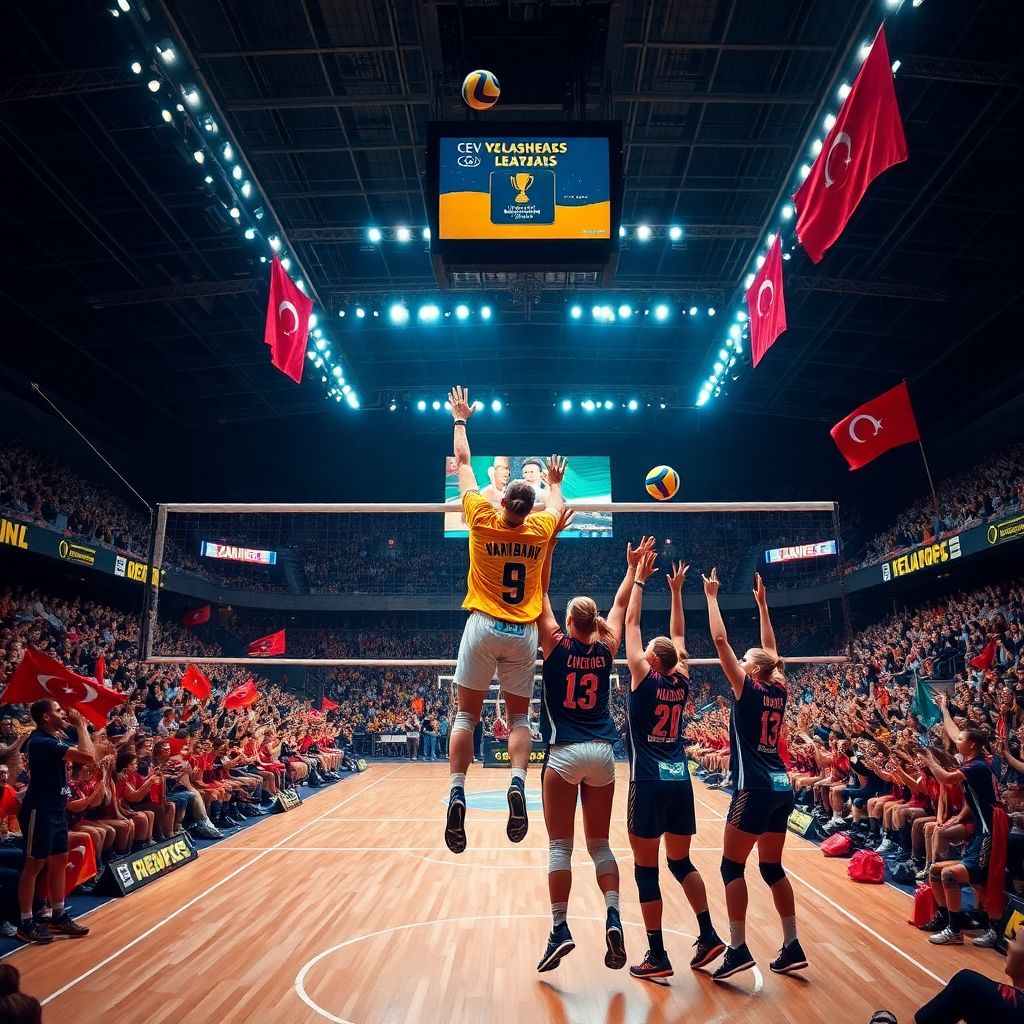
Inside the World of Turkish Volleyball: Why Turkish Women’s Teams Dominate Europe
From Regional Outsiders to European Powerhouse
If you zoom out and look at European women’s volleyball in the mid‑1990s, Turkey is almost a footnote. Italy, Russia, later Poland and some Balkans teams ruled the scene. Turkish clubs existed, of course, but nobody was calling them the best Turkish women’s volleyball teams in Europe — the phrase itself would have sounded strange. Fast‑forward to the mid‑2020s and Türkiye is the gravitational center: clubs like VakıfBank, Eczacıbaşı Dynavit and Fenerbahçe Opet set tactical trends, sign the biggest stars and hoard continental trophies. The national team sits consistently in the world top tier, and Istanbul has quietly become what Milan once was for football: a must‑see destination for any serious volleyball fan.
This shift didn’t come from one lucky generation or one rich sponsor. It’s the result of thirty years of layered decisions: federation politics, club management, youth development, TV rights, even how gyms are built and used. To understand why Turkish women’s teams dominate Europe, you have to look at the entire ecosystem — not just who scores the last point in a Champions League final, but how that player was scouted, developed, paid, protected and constantly pushed to improve.
—
Historical Turning Points: How the Foundation Was Built
The story really starts in the late 1990s and early 2000s, when a few Istanbul clubs made a strategic bet: women’s volleyball could become a flagship sport, not a secondary project. While many European clubs treated women’s sections as an afterthought, Turkish corporate‑backed teams did the opposite. Eczacıbaşı, backed by a major industrial group, and later VakıfBank, supported by a state‑owned bank, invested in infrastructure, foreign coaches and international stars. This wasn’t just about buying players; it was about importing know‑how from Brazil, Italy and the Balkans, then adapting it to local realities.
A real turning point arrived when the Turkish Volleyball Federation aligned its calendar, TV deals and youth policies to support women’s competitions with the same seriousness as men’s football in other countries. League matches were moved to prime‑time slots, quality broadcasts became routine, and suddenly it was normal for families to plan weekends around games, or for fans abroad to watch Turkish women’s volleyball live stream instead of Italian or Russian leagues. That stable audience justified even more investment and kept the cycle spinning: better product, larger audience, higher budgets, stronger teams.
—
Case Study #1: VakıfBank and the “Industrialization” of High Performance
VakıfBank’s rise is one of the clearest real‑world cases of structured dominance. From the early 2010s onward, the club built what is essentially a volleyball factory: centralized training facilities, a coherent playing philosophy from youth teams to the senior squad, and long‑term contracts with top coaches like Giovanni Guidetti. Instead of reacting to each season as a separate crisis, they ran the club like a multi‑year project, tracking every parameter: workload, sleep, injury patterns, tactical trends in Europe, even psychological profiles of players.
Their less obvious decision was to prioritize stability over constant star‑chasing. Many European clubs are tempted to change half the roster each season. VakıfBank accepted short‑term dips in form to preserve long‑term continuity — keeping a core of players and staff through multiple cycles. That continuity meant that by the time other clubs finished integrating their new signings, VakıfBank already operated on automatic mode, with shared language and automatisms in attack and block‑defense. In finals, that difference between “team” and “collection of stars” is often decisive, and Turkish managers understood it earlier and exploited it better than many rivals.
—
Case Study #2: The Rise of the “Filenin Sultanları” and the Feedback Loop
On the national team side, the “Filenin Sultanları” — the Sultans of the Net — illustrate another powerful feedback loop. As Turkish clubs grew stronger, they attracted and developed top Turkish talent. Those players then formed the backbone of a national team that could finally compete with USA, Brazil, Italy and Serbia. European and World Championship medals, plus Nations League success, dramatically increased visibility at home. Young girls suddenly saw role models on prime‑time television who looked and sounded like them, winning titles against global powers.
This, in turn, made volleyball a socially acceptable — even prestigious — path for families who might previously have pushed their daughters toward medicine or law instead of professional sport. Youth academies swelled. Sponsors followed. Governmental and municipal programs promoting girls’ sports began featuring volleyball at the center, not on the margins. The key here is timing: Turkish clubs were ready to absorb this wave of talent because they had already built structures; it wasn’t just enthusiasm, it was enthusiasm landing on a prepared runway.
—
Non‑Obvious Decisions: What Turkey Did Differently Behind the Scenes
It’s easy to say “they spent money and hired good foreigners,” but that description also fits plenty of clubs in Italy, Russia or Azerbaijan that never built the same sustained success. The more interesting layer is the quiet, non‑obvious decisions that shaped the Turkish model. One such decision was to treat women’s volleyball as entertainment content first, not just a sporting competition. That meant prioritizing camera angles, commentary quality, storytelling around players and social media presence. When a teenager in Berlin or Paris buys Turkish women’s volleyball league tickets as part of a weekend in Istanbul, it’s only partly because of the quality of play; it’s also because the clubs have become brands with recognizable narratives and stars.
Another subtle move was the way Turkish teams balanced foreign talent with local development. Rules limiting the number of foreign players on court forced coaches to trust and develop Turkish athletes instead of filling every gap with imports. This constraint, often criticized early on, became an advantage. While some European leagues flooded rosters with mid‑level foreigners and neglected local pipelines, Turkish teams were essentially forced to create elite Turkish players — the same ones who now dominate on the national stage.
—
Alternative Models in Europe — and Why They Fell Short
To understand why the Turkish approach worked, it helps to compare it with alternative methods used elsewhere. In some countries, like Russia or parts of Eastern Europe, the model remained heavily centralized and state‑driven. Clubs depended on unstable public budgets, with little incentive to build marketing or fan engagement. The technical quality could be high, but the product was invisible outside hard‑core fans. When economic or political turbulence hit, funding evaporated and rosters collapsed.
In Italy, the traditional powerhouse, the club model relied on a combination of local sponsors and historically strong volleyball culture. But fragmentation hurt them: multiple strong but small markets, frequent financial crises at club level, and inconsistent long‑term planning. Individual Italian clubs still win titles, yet the league as a whole doesn’t generate the same unified narrative or gravitational pull as the Turkish system. Meanwhile, some rich clubs in Azerbaijan or Kazakhstan tried the “checkbook” model — buying aging stars without building pathways for local kids, infrastructure or domestic audiences — and predictably faded once the money cooled.
The Turkish system sits somewhere in between. It uses strong corporate backing like the Eastern models, but with Western‑style emphasis on branding, audience growth and commercial viability. It leans on foreign expertise, but within strict rules that force local development. That hybrid, though messy, produced resilience where other approaches produced short peaks and long declines.
—
How Clubs Turned Fans into “Stakeholders”
One underrated factor in Turkish dominance is how clubs interact with fans. Home games in Istanbul or Ankara aren’t just matches; they’re events, with music, choreography, kids’ zones and constant social media content wrapped around them. This environment matters for performance: packed, noisy arenas create real home‑court advantage and make it far more attractive for top players to sign long‑term contracts. The league essentially sells a lifestyle, not just a ninety‑minute contest.
Monetization also plays a role. A fan who buys season tickets, visits a Turkish women’s volleyball merchandise shop, follows players on Instagram and travels away with the team is financially and emotionally bound to the club. This is why you’ll see European supporters organizing volleyball tours to Turkey for European fans, combining sightseeing in Istanbul with Champions League fixtures. That kind of tourism‑meets‑sport behavior used to be reserved for football; now, Turkish women’s volleyball has joined that tier of attractions, feeding back into TV rights and sponsor value.
—
Training Innovations: What’s Really Happening in the Gym
On the court, Turkish dominance isn’t just about taller middles and harder serves. The training culture has become a laboratory for integrating sports science into daily practice. Clubs widespreadly use GPS tracking, force‑plate testing and detailed video analytics, but the non‑obvious difference is how they translate this data into coaching language players actually adopt. Instead of analysts operating in a parallel universe, they’re embedded in the staff, present on the court, adjusting drills in real time based on fatigue and technical flaws.
Another innovation is the emphasis on role clarity. Turkish teams often define extremely specific micro‑roles — “serve specialist vs jump‑float pressure server,” “secondary passer in rotation 1,” “transition‑only attacker from pipe.” That allows them to use players who might be considered “limited” elsewhere but become weapons in a tightly scripted system. It also helps with load management: you don’t need every athlete to be a complete six‑rotation star if the system exploits their 2–3 key strengths to the maximum.
—
Five Practical Takeaways for Coaches and Professionals
1. Design for stability, not just peak performance
The Turkish case shows that building a core of players and staff over several years often beats constant “upgrades.” For professional coaches, this means arguing for longer contracts, clearer succession plans and shared terminology across age groups. It’s less glamorous than signing a big name, but far more powerful over a decade.
2. Treat women’s volleyball as a media product
Even if your league is small, prioritize camera quality, basic graphics, storytelling on social media and a reliable way for fans to watch. When a random viewer decides to watch Turkish women’s volleyball live stream, what keeps them there is the feeling that they’re watching a serious, high‑value production — not a shaky amateur feed.
3. Use constraints to force development
Instead of complaining about foreign‑player limits or budget caps, Turkish clubs turned these rules into engines for local talent growth. Coaches elsewhere can do the same: if you can’t buy a solution, you’re forced to create one inside your academy. That pressure is often where innovation actually happens.
4. Invest in environment, not just equipment
Turkish teams put serious thought into the match‑day atmosphere and daily training environment: lighting, sound, crowd management, locker room layout, even how easily players can access recovery tools. Professionals should ask not only “Do we have technology?” but “Do players actually feel like they’re in a high‑performance space every day?”
5. Build international pathways for your athletes
Turkish clubs normalized international competition, friendlies and tournaments, making trips abroad and hosting foreign teams a routine part of the calendar. Even smaller clubs can mimic this on a budget with joint camps, shared scouting and online seminars, creating that same sense of being connected to a larger volleyball world.
—
Hidden Drivers: Culture, Gender and Aspirations
Beyond structures and tactics, there’s a cultural dimension that often gets overlooked. In a society where debates about women’s roles are still very alive, successful female athletes in Türkiye occupy a special symbolic space. They represent modernity, global integration and meritocracy. Brands and public institutions have been eager to associate with that image, which paradoxically gives women’s volleyball access to sponsorship and political support that some men’s sports can’t easily tap.
This status comes with pressure, but it also creates a virtuous circle of visibility and aspiration. A girl in a mid‑sized Anatolian city doesn’t just see volleyball as “sport”; she sees it as a recognized pathway to education, travel, financial independence and public respect. That perception is crucial. Talent doesn’t appear randomly; it follows perceived opportunity. Turkey managed to turn women’s volleyball into one of the clearest, least controversial opportunities for girls to “go big” without leaving the country too early.
—
Looking Ahead: Can the Dominance Last?
Standing in 2026, the main question isn’t whether Turkish women’s teams are strong — they are — but whether this level is sustainable. Financially, the risk is over‑reliance on a few big sponsors and the broader health of the Turkish economy. Sportingly, the danger is complacency: once a system becomes the dominant model, it can resist change just when a new evolution is needed. Other countries are learning from Turkey, investing more in marketing, youth academies and data‑driven coaching; the gap will not stay this wide forever.
Still, the structural foundations look solid. A dense network of clubs, a large and passionate fan base, and a federation that understands the media business give Türkiye a significant head start. European clubs and federations analyzing how the best Turkish women’s volleyball teams in Europe were built will find no single magic trick to copy. Instead, they’ll see a decade‑spanning blend of smart constraints, patient investment, cultural momentum and relentless attention to how the sport feels for players and fans.
If there’s one overarching lesson, it’s this: domination in modern sport rarely comes from one genius coach or one golden generation. It comes from building an ecosystem where talent, money, culture and storytelling all point in the same direction. Turkish women’s volleyball didn’t accidentally stumble into the top; it climbed there, step by deliberate step — and, for now, it’s still writing the playbook everyone else is trying to read.