
Why Turkish youth academies suddenly matter to the whole football world
Walk into a modern Turkish youth academy and it feels less like a school pitch and more like a compact high‑performance lab. GPS vests charging on the wall, analysts cutting video on laptops, nutrition charts taped near the dining hall. Over the last decade Turkey has quietly upgraded its talent factories, and the results are visible: from Arda Güler’s leap from Fenerbahçe’s setup to Real Madrid to Abdülkadir Ömür’s rise at Trabzonspor. The question is no longer whether Turkish academies can produce elite players, but how systematically they can do it year after year.
From dusty pitches to data‑driven development
The core shift is structural. In the early 2000s many club academies were semi‑professional: one or two part‑time coaches, shared grass, minimal sports science. Today, the “big four” — Galatasaray, Fenerbahçe, Beşiktaş, Trabzonspor — plus clubs like Başakşehir and Altınordu operate integrated pathways from U8 to U19 with defined game models. According to Turkish FA figures, the number of licensed youth players has more than doubled since 2010, while the share of Süper Lig minutes played by U21 locals has slowly crept upward, fluctuating around 7–10% in recent seasons, with a clear upward trend at clubs willing to sell rather than hoard talent.
Day‑to‑day reality: what training actually looks like
Strip away the marketing slogans and a weekday at a top academy is brutally simple. Mornings are usually for school; training blocks hit late afternoon. A typical U15 session opens with movement prep and injury‑prevention drills, followed by small‑sided games designed to overload specific principles — pressing triggers, third‑man runs, or breaking a low block. Turkish coaches, heavily influenced by Spanish and German methodology, now rely on ball‑centric conditioning: sprint metrics are tracked inside positional games, not on lonely running tracks. Recovery and sleep hygiene are discussed almost as much as tactics, which is a major cultural change from the “just work harder” mentality of the 1990s.
Case study 1: Altınordu and the “sell, don’t star‑chase” model
Altınordu FK, based in İzmir, turned its back on quick fixes and foreign signings to focus on youth. Their pitch‑side slogan “İyi birey, iyi vatandaş, iyi futbolcu” (“Good person, good citizen, good footballer”) is not just PR. The club invests heavily in education, psychology and character building, and insists on giving academy graduates first‑team minutes. This long‑term bet paid off with players like Cengiz Ünder and Çağlar Söyüncü, later sold to Roma and Leicester City. Those transfers did two things at once: validated the academy model for skeptical Turkish directors and pumped millions of euros back into facilities, scouting and staffing, creating a feedback loop that smaller clubs are now trying to copy.
Stats behind the success: how big is the talent pool?
Youth participation in Turkey is massive by European standards. The Turkish FA reports more than a million registered players across age groups, with several hundred thousand in formal club structures. Yet the conversion rate to the Süper Lig and top five European leagues remains modest, suggesting that the bottleneck is quality of training and transition to pro level, not raw numbers. In the last five to six years, transfer data shows a steady increase in outbound moves of Turkish‑developed players under 23 to Italy, Germany and Spain, often via smaller stepping‑stone clubs. Scouts from Bundesliga and Serie A sides now routinely attend turkish football academy trials 2024 and beyond, treating them as low‑cost markets compared to saturated Western Europe.
Economics: why youth development has become a financial strategy

For many Turkish clubs, youth academies shifted from “community service” to core business. Currency fluctuations and UEFA’s Financial Fair Play pushed boards to cut unsustainable wage bills. Developing and selling one player abroad for €10–15 million can fund an academy’s entire annual budget several times over. Turkish sides also save on transfer fees by promoting local talent into positions traditionally filled by journeyman foreigners. The economic logic is straightforward: if you can consistently produce two or three first‑team players per cohort, even those who are later sold domestically, the academy becomes a profit center. That is why budgets for analysts, sports scientists and education officers are no longer seen as luxuries but as investments with measurable ROI.
Case study 2: Galatasaray’s structured pathway
Ask any teenager in Istanbul how to join Galatasaray youth academy and you’ll usually get a detailed, step‑by‑step answer. The club runs regionally based scouting days, narrowing thousands of kids down to small training groups who are then tracked over months before formal registration. Once inside, players move through age‑group teams that mirror the senior side’s tactical identity: aggressive pressing, wide combination play, strong set‑pieces. A notable example is Yunus Akgün, who entered the system early, spent time on strategic loans, then returned with refined decision‑making. Galatasaray uses detailed loan plans — specifying playing position, minutes targets and feedback loops — to bridge the academy–first‑team gap instead of leaving development to chance.
Best academies and the battle for regional dominance
Conversations about the best football academies in Turkey for youth usually start with the Istanbul giants, but regional hubs are increasingly influential. Trabzonspor’s Black Sea talent pool has historically produced hard‑running, technically sharp players; their academy emphasizes competitive fire and identity, reinforced by early exposure to high‑pressure local derbies. Antalyaspor and Alanyaspor, based on the Mediterranean coast, are trying a different angle: attracting both local and international families who want football plus lifestyle, boosted by modern training complexes. Meanwhile, Altınordu and Bursaspor bet on continuity of coaches and curricula, avoiding yearly tactical overhauls that can derail a teenager’s development curve just as he’s adapting to a role.
Internationalisation: camps, foreigners and cross‑pollination
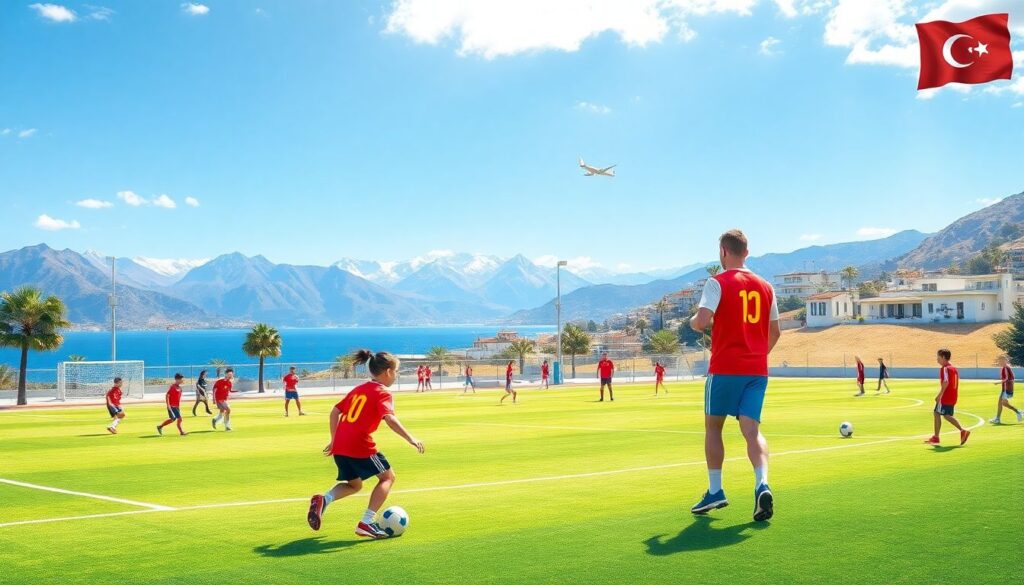
Turkey’s geography and climate give it an edge. Winter is mild on the Mediterranean and Aegean coasts, pitches are available year‑round, and the country is a short flight from most of Europe and the Middle East. That’s why football training camps in turkey for kids have become a seasonal industry: local clubs, private academies and foreign teams all flock to the same resort towns for mid‑season or pre‑season programs. For Turkish youth players, this means friendly matches against diverse opponents and exposure to different styles. Some academies also invite overseas prospects for trial periods, mixing squads. That cross‑pollination challenges entrenched habits, from tempo of play to communication on the pitch.
Professional academies and the global market
The growth of professional soccer academies in turkey for international students is still in its early phase but accelerating. A few Istanbul‑based private academies now offer English‑language schooling plus full‑time football, targeting families from the Gulf, North Africa and Central Asia. The model borrows from Portugal and Spain: students pay tuition, receive high‑level coaching, and hope either to sign locally or use Turkey as a stepping stone to Europe. Established clubs are cautious — they don’t want to dilute minutes for domestic talent — but partnerships are emerging, where private academies feed into club youth teams. In economic terms, this imports tuition revenue while exporting football expertise, diversifying club incomes beyond broadcasting and ticket sales.
Sports science, analytics and the new Turkish coach
Another under‑the‑radar change is the profile of academy coaches. Many are in their 30s, with UEFA‑A or Pro licenses, degrees in sports science, and strong English. They attend international conferences, absorb research on growth spurts, relative age effect and training load management, then apply it at grassroots level. GPS tracking and heart‑rate monitoring are standard at elite academies; internal data is used to individualise work for late‑maturing players who, in the past, would have been discarded as “too small.” Injury data suggests reduced soft‑tissue problems in older age groups, meaning more consistent training weeks. That continuity is crucial when you’re trying to refine tactical habits rather than simply chasing fitness.
Case study 3: The late bloomer saved by data
Consider an anonymised example drawn from several clubs’ experiences: a 16‑year‑old winger, technically gifted but physically behind his peers, used to be the classic cut candidate. At one Anatolian academy, GPS data showed he covered more high‑intensity distance per minute than the squad average, even if total volume was lower. Coaches adjusted his schedule, replacing some gym work with coordination and decision‑making drills while carefully ramping strength. Within 18 months, post‑growth‑spurt, he went from fringe player to U19 starter and signed a pro deal at 18. Cases like this are becoming more common as Turkish academies shift from intuition‑only to evidence‑informed decisions, preserving talent that would previously have slipped through the net.
Forecasts: what the next decade of Turkish academies may look like
Looking ahead, several trends are likely to define Turkish youth development. First, stricter club licensing rules and UEFA incentives will keep pushing investment toward structured academies rather than last‑minute transfers. Second, outbound transfers of U21 players to Europe should continue to rise as scouting networks deepen and agents target Turkey as a value market. If current growth holds, we can expect a noticeable increase in Turkish‑trained players in mid‑table Bundesliga and Serie A sides by 2030. Third, digital scouting — online databases, remote video analysis — will shrink the advantage of big‑city clubs, allowing well‑run provincial academies to compete for the same 12‑year‑old prodigies once monopolised by Istanbul.
Risks and pressure points
The progress is real, but not guaranteed. Economic instability can tempt boards to raid academies for short‑term sales, disrupting cohorts before they mature. Over‑professionalisation is another risk: turning every training session into a high‑stakes audition can lead to burnout, particularly when social media amplifies hype around 14‑year‑olds. There’s also the issue of coaching continuity. When first‑team managers change every six months, academy philosophies sometimes shift too, confusing teenagers who are told one year to play out from the back and the next to “clear it long.” The challenge over the next decade will be to insulate youth development from senior‑team turbulence, treating the academy as a long‑cycle project rather than a quick fix.
Impact on the wider industry and national team
In the bigger picture, stronger academies reshape not just clubs but the entire Turkish football ecosystem. Agent behaviour changes: instead of focusing solely on established foreign imports, intermediaries scout U17 games, aware that European clubs now pay real fees for well‑coached teenagers. Domestic lower‑league sides benefit from loaned youngsters trained to higher standards, raising competitive levels. For the national team, a broader, better‑educated talent pool means more tactical variety; coaches can select centre‑backs comfortable in build‑up, full‑backs who invert into midfield, and forwards drilled in pressing structures, not just individual flair. Over time, that tactical flexibility can narrow the gap to European heavyweights in tournament play.
What this means for kids and families
From the outside, the system might look clinical, but for families the experience is personal and messy. A 12‑year‑old travelling three times a week from a satellite town to an Istanbul academy sits at the intersection of ambition, sacrifice and risk. The best setups now employ education coordinators to keep school performance on track and psychologists to manage expectations, especially when kids are released. Parents, increasingly aware of both opportunities and pitfalls, ask sharper questions about pathways, minutes and coaching quality. If Turkish academies manage to balance competitiveness with genuine care — offering exit routes through education and semi‑pro football — they are more likely to sustain social legitimacy as well as sporting success.
Conclusion: from promise to predictable production
Turkish youth academies have moved from hopeful experiments to structured systems with clear economic and sporting logic. The combination of large talent base, improving coaching, favourable geography and growing integration into European markets puts Turkey on the verge of becoming a consistent exporter of high‑level players rather than an occasional surprise. The real test in the coming years will be predictability: can clubs turn isolated success stories into a steady conveyor belt of professionals who thrive at home and abroad? If they can, what’s happening inside those training grounds today may reshape not only Turkish football, but also the player supply chain of Europe’s top leagues.