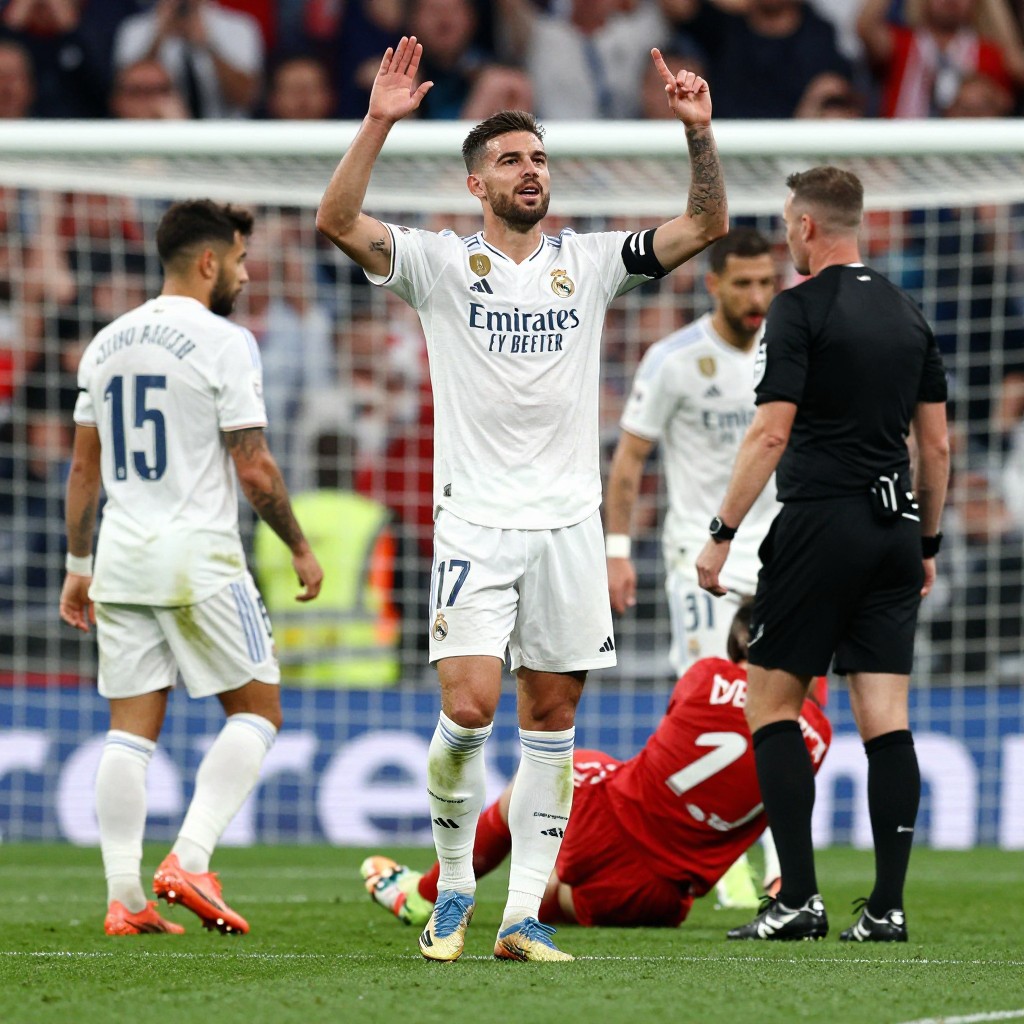
VAR Controversy as Arda Güler Scores in Real Madrid’s 4-1 Win Over Sevilla
Arda Güler avoided a possible red card during Real Madrid’s 4-1 victory over Sevilla, then scored the opening goal just eight minutes after the disputed incident. The episode occurred at the Santiago Bernabéu with the match still level, raising questions about why the officials did not review the contact.
In the 22nd minute, the 21-year-old Turkish international appeared to swing an arm backwards and make contact with Sevilla midfielder Peque away from the main action. Sevilla players immediately appealed to referee Mateo Busquets Ferrer, arguing that Güler should be sent off for violent conduct. The referee allowed play to continue, and no on-field review followed.
Why VAR did not intervene
The incident took place away from the ball, while the broadcast cameras were focused on the central passage of play. As a result, the VAR team did not have a clear, close-up angle showing precisely what happened.
That missing visual evidence mattered. Former Spanish referee Eduardo Iturralde González has explained that a deliberate strike to an opponent’s face could warrant a red card, while contact to the chest without excessive force would generally call for a yellow card. In this case, the available footage did not establish the exact point of contact or how forceful the movement was.
VAR is not intended to re-referee every controversial moment. Under RFEF guidelines, officials can recommend an on-field review only when video provides clear and obvious evidence of a serious error. With the images inconclusive, the threshold for intervention was not met, and Güler remained on the pitch without a booking.
Güler turns the reprieve into a goal
Eight minutes after the incident, Güler put Real Madrid ahead. He met a pass from Yan Diomande and struck the ball first time from around 16 metres, curling it into the far top corner.
The goal helped set Madrid on course for a 4-1 win. It also sharpened the debate surrounding the earlier challenge: had the Turkish midfielder been dismissed, he would not have been available to score or contribute for the remainder of the match.
What a red card could have meant
A sending-off for violent conduct could have carried a suspension of at least three domestic matches. That would potentially have ruled Güler out of the following Sunday’s El Clásico against Barcelona at Camp Nou, as well as other important fixtures.
Instead, he remains eligible for selection during a demanding stretch of European and domestic football. His availability gives Madrid another option in the midfield channels, where his passing, movement and ability to arrive in scoring positions can influence games.
Why incidents away from the ball are difficult to assess
Off-the-ball clashes can be harder for refereeing teams to judge than incidents around the ball. Main broadcast cameras typically follow the attack, while a separate camera may not capture a brief movement clearly enough to determine whether contact occurred, where it landed or how much force was used.
This is one reason appeals from players alone do not automatically trigger a VAR review. The officials need usable footage that supports a clear conclusion. When angles are obstructed or incomplete, the referee’s original decision is more likely to stand.
What the controversy does-and does not-establish
The absence of a review does not prove that the contact was harmless, nor does it confirm that Güler committed a red-card offence. It means the available video was not considered conclusive enough to justify changing the decision on the field.
That distinction is central to understanding the episode. The debate concerns both the apparent action and the limitations of the review process: even when players immediately demand a dismissal, VAR cannot act on certainty that the footage does not provide.
Madrid left the match with a convincing result and Güler on the scoresheet, but the incident is likely to remain part of the discussion around officiating. It illustrated how camera coverage, the standard of evidence and the timing of an incident can shape a major decision-and potentially affect a player’s availability for the matches that follow.