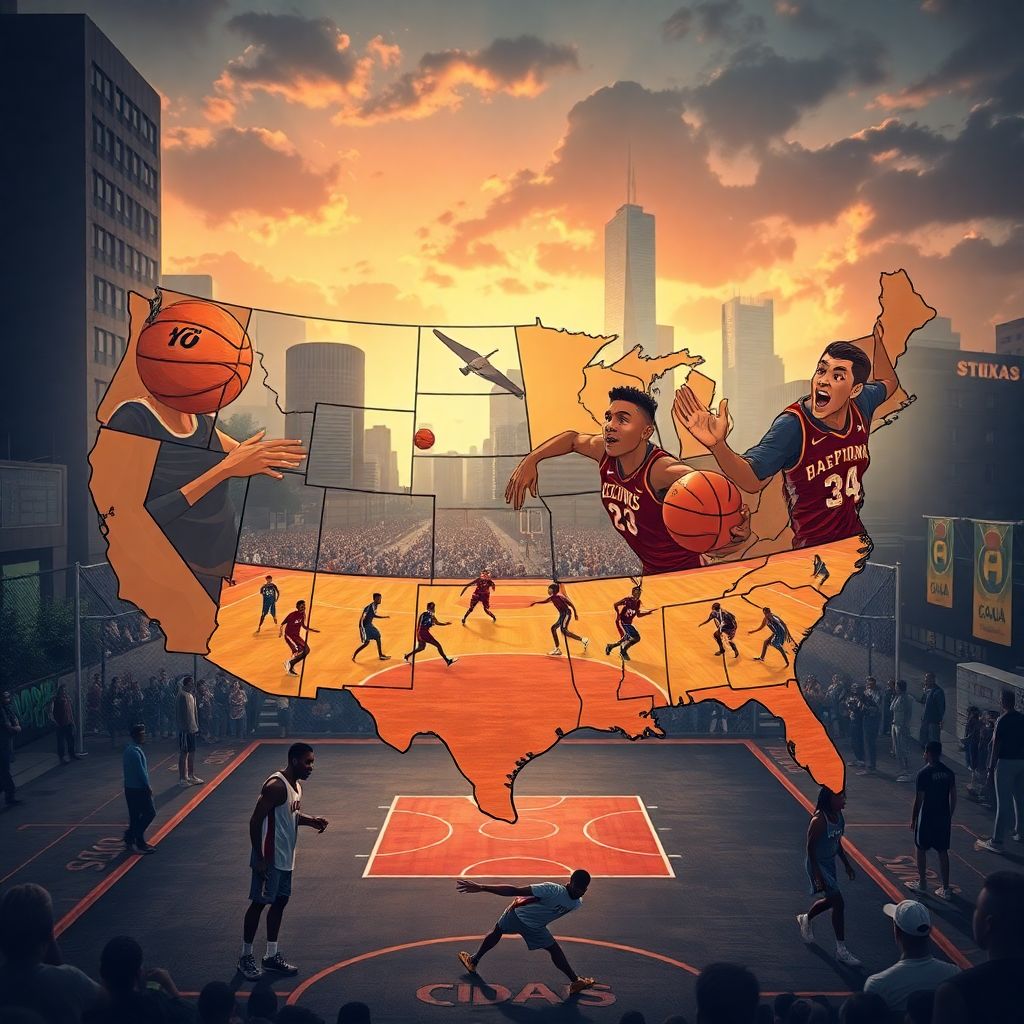
The American states that raised basketball royalty
Some corners of the United States do more than just play basketball—they live it. Certain states have fed the NBA and ABA for decades, turning local kids into global icons and neighborhood courts into mythic arenas. New York’s asphalt battlegrounds, California’s sun-soaked runs, and Illinois’s gritty Midwestern gyms don’t just host games; they shape identities, styles, and legacies.
This piece explores which states stand out as cradles of basketball royalty, why they keep producing elite talent, and how culture, infrastructure, and community pride combine to make them basketball hotbeds.
—
Where basketball royalty begins: states that produce the most NBA talent
Look at the history of the NBA and ABA, and patterns start to emerge. A small cluster of states repeatedly show up as the birthplace of stars, All-Stars, and Hall of Famers. New York, California, and Illinois are always near the top of any list of player origins, but they’re joined by other heavy hitters like Texas, North Carolina, and Indiana.
On the surface, large populations help. More kids generally mean more potential players. But raw numbers don’t tell the whole story. Some states punch far above their weight because basketball there is more than a pastime—it’s a priority. Courts are everywhere, youth leagues are structured and competitive, and local legends create an unwritten standard that the next generation feels compelled to meet.
These states combine:
– Deep basketball traditions
– Competitive high school and AAU structures
– Rich streetball or playground cultures
– Strong college programs that keep the pipeline flowing
Put together, they create ecosystems where dreaming of the NBA isn’t unrealistic—it feels like the natural next step.
—
What makes a basketball hotbed different?
A true basketball hotbed isn’t defined only by how many pros it produces. It’s defined by how the game saturates daily life. Several ingredients show up again and again in the states that routinely produce basketball royalty.
1. Urban courts and streetball traditions
In dense cities like New York, Chicago, or Los Angeles, public courts are more than recreational spaces; they are proving grounds. Games are high-intensity and unforgiving. The competition is constant, and reputations are made or broken fast.
This environment:
– Forces players to handle pressure early
– Rewards creativity and flair
– Toughens younger kids who play against older, stronger opponents
– Turns every run into an audition in front of peers and neighborhood elders
Streetball culture doesn’t just sharpen skills. It shapes persona—confidence, swagger, resilience. Those traits often carry straight into high school gyms and eventually into professional arenas.
2. High school and AAU powerhouses
States that consistently produce top-tier players typically have:
– Strong high school leagues with fierce rivalries
– Elite prep programs that travel nationally
– Robust AAU circuits that give kids exposure to top competition
In places like Illinois and California, a talented teenager might face multiple future pros in a single tournament or playoff run. That level of opposition raises the bar and accelerates development. Coaches in these systems are used to working with high-level prospects and understand how to refine raw ability into a complete game.
3. Community investment and local heroes
Money matters, but so does pride. States with rich basketball lineages often have communities that pour energy into keeping courts clean, organizing leagues, and funding school programs. Volunteer coaches, former players, and local business owners all play a role.
Just as important are the role models. When kids can point to someone from their neighborhood who made it to the NBA, the dream becomes concrete. Local heroes come back to run camps, donate facilities, or simply show up to games. Their presence sends a powerful message: “Someone from here did it. You can, too.”
—
New York: from asphalt legends to NBA icons
Few places on earth are as synonymous with basketball as New York. The city’s outdoor courts—spread across all five boroughs—have produced countless legends, some who made it to the NBA and others whose names live on primarily through word of mouth and highlight tales.
Key characteristics of New York’s basketball culture:
– Playground royalty: Iconic parks serve as the heart of the scene. Summer runs draw crowds, and reputations built there can be as respected as anything done indoors.
– Guard-heavy style: Tight spaces and physical games have birthed generations of skilled ballhandlers and creative playmakers, known for their handles, footwork, and fearlessness.
– Year-round competition: Indoor school gyms in winter and outdoor courts in summer mean the game never really stops.
This environment forges players who are comfortable in chaos, unafraid of the moment, and adept at improvisation. Many of the league’s most charismatic and mentally tough guards and wings trace their origins back to New York’s unforgiving asphalt.
—
California: West Coast flair, versatility, and year-round runs
California brings a different flavor to basketball royalty. With its vast geography and diverse population, the state offers multiple styles and pathways to the pros.
What sets California apart:
– Outdoor lifestyle: Mild weather allows for nonstop outdoor play. Pick-up games on playgrounds and beaches blend with indoor school and club ball to create endless opportunities to hoop.
– Versatile skill sets: Many California players develop all-around games—ballhandling, shooting, and athleticism—reflecting a culture that prizes creativity and offensive skill.
– Strong high school and AAU programs: From big-city powerhouses to suburban academies, the state’s prep scene is packed with elite talent. High-profile tournaments regularly showcase future pros in front of scouts and coaches.
The result is a steady stream of players with polished offensive arsenals, relaxed confidence, and the ability to fit into modern, positionless basketball.
—
Illinois: Midwestern grit and high school pressure cookers
Illinois, and especially the Chicago area, has a basketball identity rooted in toughness and competition. Gyms across the state are filled with kids trying to fight their way out of difficult circumstances, and that urgency often shows in their style of play.
Key traits of Illinois basketball:
– Physicality and toughness: The game is intense and often defensive-minded. Players learn early how to handle contact and grind through adversity.
– High school rivalries: Packed gyms, passionate fan bases, and intense local matchups turn teenage games into high-pressure showcases.
– Strong coaching culture: Many Illinois coaches have deep basketball knowledge and experience, contributing to well-schooled, fundamentally sound players.
Illinois consistently turns out guards and wings known for their competitive fire, as well as big men shaped by the physical demands of the local game.
—
Beyond the big three: other states rising to prominence
While New York, California, and Illinois loom large in basketball history, they are far from alone. Several other states have quietly—or not so quietly—built their own reputations as talent factories.
Texas
Texas has surged in recent decades thanks to:
– Rapid population growth
– Major cities with strong AAU and high school infrastructures
– A growing emphasis on basketball alongside football
Modern Texas stars often combine size, athleticism, and guard skills, reflecting the state’s embrace of contemporary, dynamic basketball.
North Carolina
Long known as a college basketball haven, North Carolina’s youth and high school systems benefit from proximity to historic NCAA programs. Kids grow up in a culture where basketball is studied, discussed, and revered. The line between a high school gym and a storied college arena feels short, motivating young players to aim high.
Indiana
Indiana’s love affair with basketball runs deep. Small-town gyms fill to the rafters, and high school games can feel like professional events. The state is famous for producing fundamentally sound players who understand spacing, shooting, and team concepts at a high level.
—
How the talent pipeline evolves over time
No state stays on top forever. Demographic shifts, economic changes, and evolving interests can reshape where talent emerges.
– Urban change: Gentrification, facility closures, or new investments in community centers can either shrink or strengthen local basketball scenes.
– School funding and priorities: Budget cuts or new initiatives directly affect access to quality coaching and safe playing spaces.
– Competing sports and activities: In some regions, football or other sports can overshadow basketball, pulling potential talent away from the hardwood.
Yet even as the landscape shifts, core hotbeds tend to adapt rather than disappear. They evolve their infrastructures, embrace new training methods, and keep building on legacy.
—
The digital age: social media, scouting, and exposure
Modern technology has transformed how basketball royalty is discovered and developed. In earlier eras, a player’s reputation might be confined to a city or region. Today, a standout performance can be broadcast worldwide overnight.
Digital tools have reshaped the pipeline by:
– Making highlight reels and game footage easy to share with scouts and coaches
– Allowing prospects from smaller towns or lesser-known states to gain national attention
– Accelerating the spread of new moves, drills, and training philosophies
This broader exposure has helped emerging states enter the conversation, but it has also reinforced the dominance of established hotbeds. When scouts visit traditional power states, they often discover even more hidden gems while already tracking the big names.
—
Diversity and the global game: how states fit into the bigger picture
As the NBA has become more international, the role of American states in producing elite talent has shifted, but not diminished. Instead, they now exist as part of a broader, global ecosystem.
Key dynamics:
– Cultural melting pots: States like New York, California, and Texas bring together players from widely varying backgrounds. That diversity fuels stylistic innovation and creative play.
– International influence: Immigrant communities import distinct basketball philosophies and techniques, blending them with local traditions.
– Competition with global talent: American prospects now measure themselves not only against other states, but against rising stars from Europe, Africa, Asia, and Latin America.
Even in this global context, the American states that built basketball royalty still set benchmarks in intensity, creativity, and competitiveness.
—
Why some states produce stars—and others don’t
When you strip it down, a few core factors often separate true hotbeds from regions that only occasionally send a player to the pros:
1. Access to courts and equipment: If kids can play easily—indoors or outdoors—they will. Limited access kills potential before it starts.
2. Quality coaching: Youth coaches who understand player development, fundamentals, and modern systems are crucial.
3. Sustained competition: Facing strong opponents regularly forces growth. Talent can’t flourish in isolation.
4. Visible success stories: When former local players succeed at college or in the pros, they create a cycle of belief and guidance.
5. Community support: Whether through funding, fan turnout, or mentorship, communities that prioritize basketball build stronger pipelines.
States that consistently check all these boxes inevitably find themselves on the map as factories of basketball royalty.
—
The evolving future of basketball hotbeds
Looking ahead, the map of basketball power states will likely continue to change. Several trends will shape that evolution:
– Training science: States or regions that quickly adopt evidence-based training, recovery, and skill development will gain an edge.
– Women’s basketball growth: As the women’s professional game continues to expand, more states will invest in developing female talent, creating parallel pipelines of royalty.
– Early specialization vs. multi-sport participation: How different regions balance these philosophies will affect both talent quality and longevity.
– Public vs. private pathways: The growth of prep academies and specialized schools could shift where elite prospects play their high school ball—even if their home states remain proud of their roots.
Even with these changes, one thing is clear: the states that combine culture, structure, and opportunity will keep producing players who redefine what’s possible.
—
Conclusion: the enduring legacy of state-born basketball royalty
From New York’s unforgiving playgrounds to California’s creative flair and Illinois’s high-pressure gyms, certain American states have stamped their identities onto the global game. They are more than places on a map; they are engines of ambition and laboratories of style.
These regions prove that basketball greatness doesn’t appear out of thin air. It grows in specific environments—shaped by neighborhood courts, school programs, local heroes, and a shared belief that the next legend might be lacing up right down the street.
As the sport continues to globalize and evolve, the states that raised basketball royalty will remain foundational chapters in the game’s story—and will almost certainly keep writing new ones.