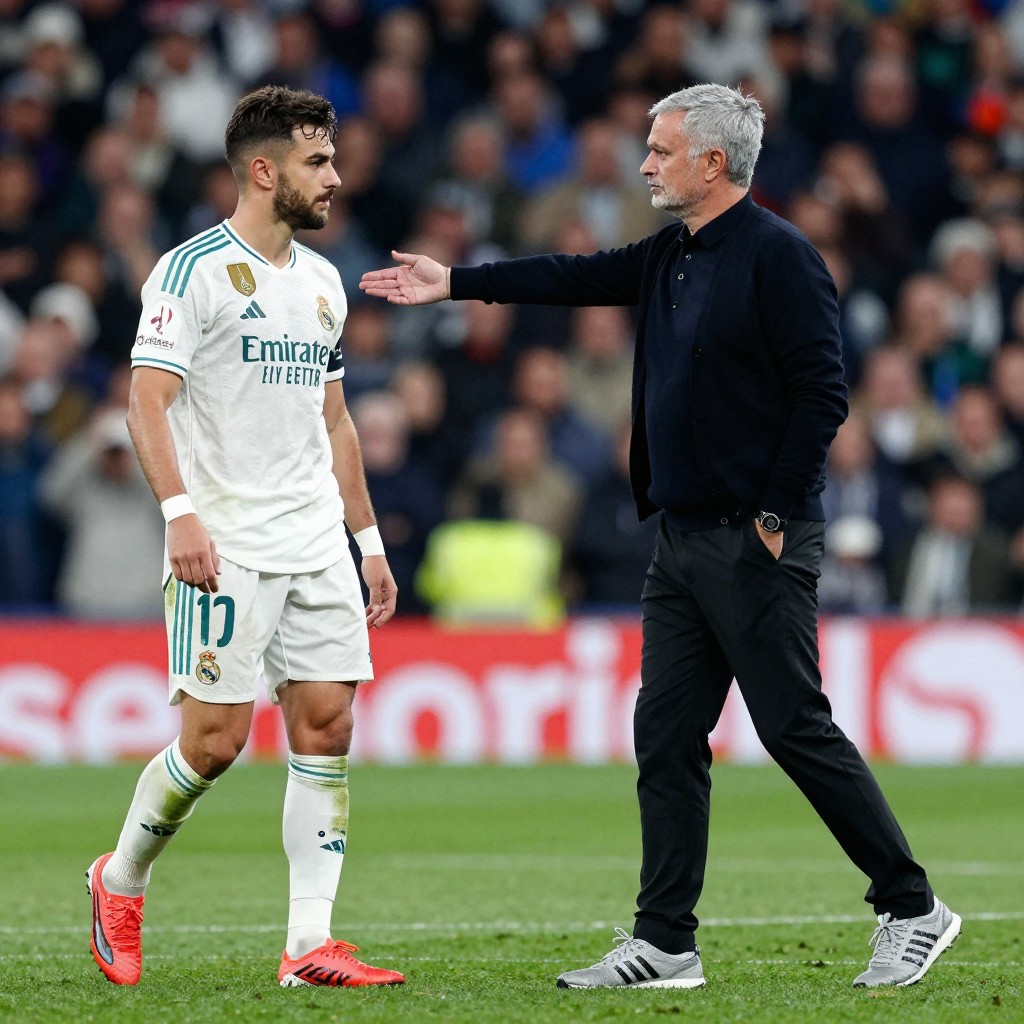
“No One Is Indispensable”: Mourinho Challenges MVP Arda Güler to Raise His Level After Elche Thriller
Arda Güler delivered one of the most influential performances in Real Madrid’s dramatic 3-2 victory over Elche, earning the official Man of the Match award. Yet the Turkish midfielder did not leave the Estadio Manuel Martínez Valero with nothing but praise. José Mourinho used his post-match comments to underline the demanding standards required to become a permanent fixture in Madrid’s midfield.
The 21-year-old Turkey international was outstanding during the opening stages of the contest. Operating in a central attacking role, Güler regularly dropped between the lines, helped circulate possession and provided the creativity Real Madrid needed to break through Elche’s defensive structure.
His decisive contribution came from a set piece. Güler delivered a curling free-kick that caused confusion in the penalty area and ultimately forced goalkeeper Matías Dituro into an own goal. The moment gave Madrid the lead and illustrated the quality of the midfielder’s left foot, which remains one of his most dangerous weapons.
Güler continued to influence the game after that breakthrough. He linked midfield with the attack, looked for passes behind the defensive line and helped Madrid maintain pressure. By the time he was replaced in the 68th minute, Real Madrid held a 2-0 advantage and appeared to be in control.
Mourinho, however, had already sensed that the balance of the match was beginning to shift. Jude Bellingham replaced Güler, while Brahim Díaz was also introduced as the Madrid manager attempted to restore energy and authority in the middle of the pitch.
The substitutions did not immediately solve the problem. Elche took advantage of Real Madrid’s decline in intensity and scored twice to level the contest. Only a late intervention from Madrid’s attacking players prevented the visitors from dropping points. Carlos Espí eventually scored the winning goal in the 91st minute, completing a chaotic finale.
Asked whether Güler had established himself as an untouchable starter in the center of the team, Mourinho rejected the idea without hesitation.
“No, he is not indispensable. No one is indispensable,” the Portuguese coach said, explaining that the changes were made because Real Madrid had started to lose control of the match.
Mourinho also praised Vinícius Júnior’s defensive contribution, noting that the Brazilian had maintained his position and worked effectively within the team’s defensive organization. However, the manager added that Vinícius eventually became tired, while Güler was also beginning to lose intensity in a role that required much more than attacking creativity.
According to Mourinho, Güler’s position may be described as a number 10, but the practical demands of the role stretch across the entire pitch. The player is expected to press, track runners, support the defensive block, participate in transitions and still have enough energy to create chances near the penalty area.
That assessment highlights the next stage of Güler’s development. His technical ability is already clear, and his passing range, set-piece quality and close control allow him to make a difference against compact opponents. The question is whether he can maintain that influence while handling the physical and tactical responsibilities of a complete midfielder.
For a player who has often been judged primarily by his attacking talent, Mourinho’s message represents a significant challenge. Real Madrid’s central positions require constant movement and discipline. A midfielder cannot simply produce a moment of brilliance before disappearing from the game; he must remain involved when the team has possession and when it is forced to defend.
Güler’s substitution should therefore not be interpreted as a punishment or a sign that his position is under immediate threat. Instead, it reflects the tactical reality of top-level football. Mourinho believed the match was slipping away and turned to fresh players who could provide greater intensity. Bellingham’s introduction was intended to strengthen both Madrid’s pressing and its ability to carry the ball through midfield.
The match also showed why competition for places remains so intense at Real Madrid. Bellingham, Brahim, Vinícius and several other attacking players can change the rhythm of a match. Even an excellent performance from Güler does not guarantee that he will remain on the field for the full 90 minutes if the team’s structure begins to weaken.
At the same time, the Turkish midfielder’s performance confirmed that he is becoming increasingly important to Madrid’s attacking plans. His contribution against Elche was not limited to the own goal. He helped control the tempo, occupied dangerous spaces and gave the team a reliable creative outlet.
The late drama provided a valuable lesson for the entire squad. A two-goal lead is not enough when concentration and defensive intensity fall away. Madrid’s response after Elche reached 2-2 showed the strength of its bench, but the collapse also demonstrated why Mourinho is demanding more from every player.
For Güler, the challenge is particularly clear: retain his imagination and attacking freedom while becoming more consistent without the ball. If he can improve his stamina, defensive positioning and ability to influence matches during difficult periods, he will strengthen his claim to a regular starting role.
Leaving Elche with the Man of the Match award was a major positive for the young midfielder. However, Mourinho’s comments made it clear that recognition is only part of the process. At Real Madrid, every strong performance raises expectations, and no player is protected from competition.
Güler now has the opportunity to turn an impressive individual display into a complete midfield performance. The talent is evident; the next step is proving that he can sustain it from the opening whistle to the final minute while meeting the tactical demands of one of football’s most demanding teams.