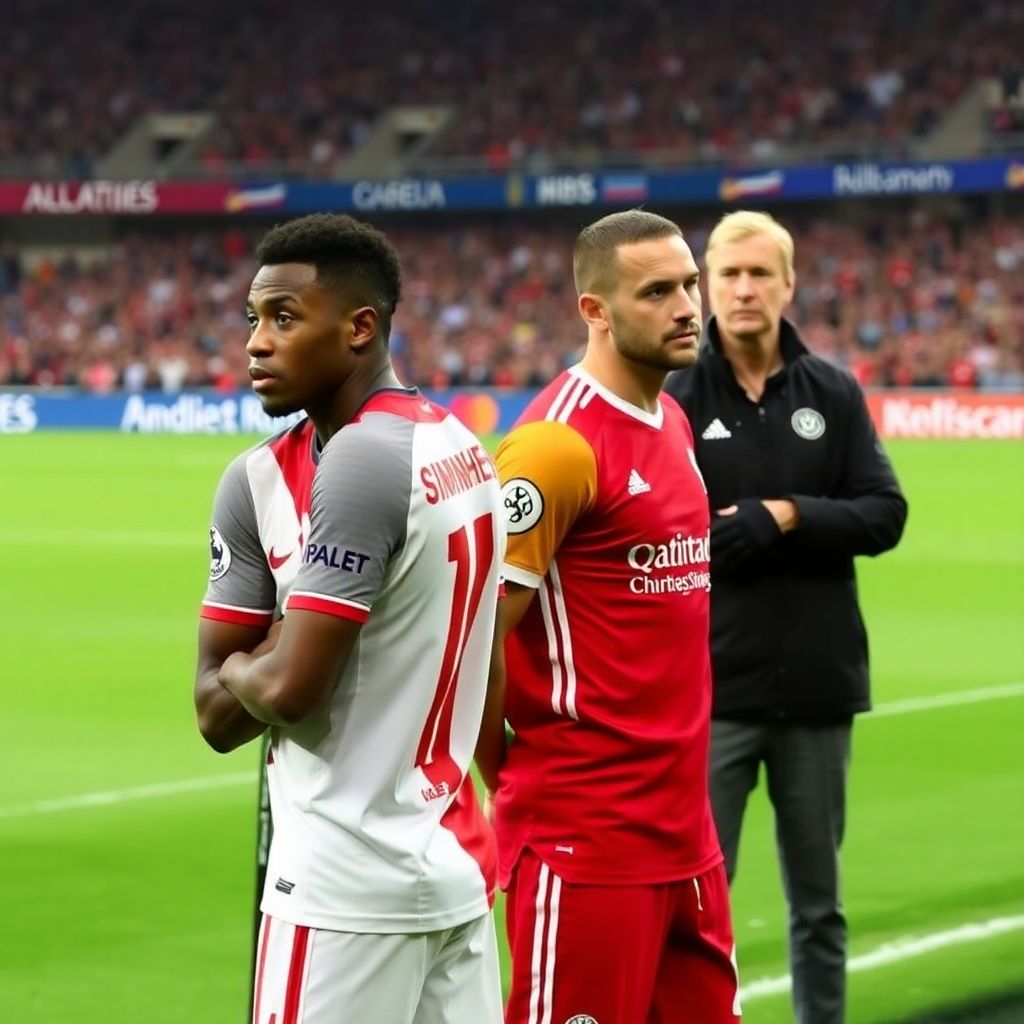
Inside Bayern’s Bold Succession Blueprint: Why Kompany Has Set His Sights on Osimhen at Galatasaray
Bayern Munich have quietly begun planning for life after Harry Kane, and at the centre of that long-term strategy stands one name: Victor Osimhen. The German champions are putting together a forward-looking “succession plan” for their attack, and Galatasaray’s Nigerian star has emerged as the preferred candidate to inherit Kane’s role at the Allianz Arena.
Kane’s performances since his arrival in Bavaria have been extraordinary. The England captain has produced an astonishing 45 goals in just 37 games this season, underlining his status as one of the most complete strikers of his generation. Yet, despite this relentless output, time is a factor Bayern cannot ignore. Kane is now 32, his contract runs until 2027, and there is growing internal recognition that a seamless transition must be prepared well before any decline or uncertainty sets in.
Vincent Kompany, recently installed on the Bayern bench, appears determined not to repeat the turbulence that followed Robert Lewandowski’s departure. Instead of scrambling for a replacement when a gap has already opened, the Belgian coach wants an elite No. 9 ready to step in the moment a vacancy appears. In that context, Osimhen is viewed not merely as an option, but as a centrepiece of Bayern’s medium- to long‑term planning.
Kompany’s Long-Term Admiration for Osimhen
Kompany’s interest in Osimhen is not a passing whim. According to previous reports, his fascination with the Nigerian striker dates back to Osimhen’s formative years in Belgium at Charleroi. Even then, the forward’s raw pace, work rate, and explosive presence in the box stood out to close observers of the league.
Since those days, Osimhen has developed into one of Europe’s most reliable goalscorers across several top divisions. Now 27, he combines the old-school traits of a penalty-box predator with modern attributes: relentless pressing, intelligent movement between the lines, and the ability to stretch defences with his runs in behind. For the Bayern hierarchy, this blend of power, athleticism, and refined finishing makes him a near-ideal heir to Kane for the next five years or more.
In a football landscape increasingly dominated by fluid forwards and false nines, Osimhen represents something rarer: a classic centre-forward with a contemporary edge. Bayern believe that such a profile fits perfectly with the club’s tradition of imposing No. 9s-from Gerd Müller to Mario Gomez, from Lewandowski to Kane-who serve as the attacking reference point around which the rest of the team is built.
The €150 Million Roadblock
Turning admiration into an actual transfer, however, is a completely different challenge. Galatasaray pulled off one of the most eye-catching moves of last summer by converting Osimhen’s loan into a permanent deal worth around €75 million. They secured him on a long contract running until June 2029, and that agreement has fundamentally changed the dynamics of any future negotiations.
The Turkish champions are not under financial stress, nor are they in a rush to cash in. On the contrary, club executives see Osimhen as the cornerstone of a project designed to keep Galatasaray at the top domestically and increasingly relevant in European competitions. As a result, insiders expect the Istanbul club to demand a fee in the region of €150 million, effectively doubling their investment and setting a price tag that only a handful of European giants can realistically contemplate.
For Bayern, that valuation is both a stumbling block and a test of how seriously they intend to commit to this succession plan. The club has traditionally been careful, even conservative, in the transfer market compared with some of its English, Spanish, and French counterparts. Kane’s arrival already pushed them into a new price bracket; going up another level for Osimhen would require internal alignment at board level, a clear sporting justification, and possibly player sales to partially offset the outlay.
Galatasaray’s Leverage and Ambition
From Galatasaray’s perspective, the situation is close to ideal. They have a fully committed star tied down to a long-term contract, a team built to maximize his strengths, and no pressing obligation to sell. Their public stance has been firm: Osimhen is central to their sporting project, and any departure would need to reflect both his importance on the pitch and the financial reality of his acquisition.
Given the size of the original transfer fee and the salary package that persuaded him to commit to Istanbul, the club is determined to secure what it sees as a “super-premium” fee if they are to relinquish their talisman. This is not merely a question of balance sheets; it is also about prestige, signalling that Galatasaray are no longer a club that can be easily raided by Western European heavyweights without adequate compensation.
Rivals Step Aside, Bayern Move to the Front
One factor working in Bayern’s favor is the apparent cooling of interest from some of Osimhen’s previously strongest suitors. In France, Paris Saint‑Germain have reportedly closed the door on a move. Manager Luis Enrique is believed to harbor doubts about how Osimhen would fit into his preferred tactical framework, which relies heavily on versatile attackers comfortable drifting into wider and deeper zones.
There is also the financial dimension: the striker’s wage demands-reported at around €20 million per season-are a significant hurdle, even for a club of PSG’s resources, at a time when they are attempting to restructure their salary bill and squad profile.
Interest from the Saudi Pro League remains real in financial terms, but far less compelling from a sporting perspective. Osimhen has, by all accounts, placed European football at the top of his priorities. The chance to challenge regularly for the Champions League and maintain visibility in the race for the Ballon d’Or outweighs the immediate riches on offer in the Middle East. This stance effectively narrows the field and brings Bayern into sharper focus as one of the few clubs that can offer both elite competition and a realistic pathway to silverware and individual accolades.
A Tactical Fit in Kompany’s Bayern
Kompany’s vision for Bayern is expected to be built around high intensity, vertical progression, and structured pressing. In such a setup, the centre-forward is not just a finisher but also the first defender and a key outlet for quick transitions. Osimhen’s skill set aligns closely with those demands.
His ability to run the channels offers a constant out-ball when Bayern break from deep. In settled possession, he pins centre-backs, creates space for attacking midfielders, and thrives on crosses and cut-backs from the flanks-something Bayern’s wide players, from traditional wingers to attacking full-backs, can provide in abundance.
Moreover, Osimhen’s aerial strength and aggression in duels could restore a dimension that has occasionally faded when Bayern face deep, compact defences. While Kane brings a world-class passing range and link-up play between the lines, Osimhen offers a more direct, explosive threat that can complement or eventually succeed the Englishman.
Managing the Transition from Kane to Osimhen
An important aspect of Bayern’s planning is timing. They do not intend to rush Kane out of the door, nor to sideline a player who remains at the peak of his powers. Instead, the club appears to be leaning toward an overlapping phase in which both Kane and Osimhen could theoretically coexist in the squad, if finances and squad structure allow.
Such a scenario could offer multiple tactical variants: Kane dropping deeper as a creator with Osimhen stretching the last line, or the Nigerian leading the line while Kane is rotated more frequently to preserve his fitness as he ages. This transition model is designed to avoid the abrupt drop-off in goal output that can occur when an established talisman departs without a ready-made successor in place.
Financial Fair Play and Squad Balancing
Any move of this magnitude will be assessed not only through a sporting lens but also in light of financial regulations. Bayern’s reputation has long been built on sustainable growth, wage discipline, and smart recruitment. The club will need to weigh the Osimhen operation against future contract renewals, potential exits, and the need to strengthen other areas of the squad.
One realistic scenario would see Bayern raise funds through the sale of fringe players or high-value assets who no longer fit Kompany’s system. This could help make room in both the squad and the wage bill for a marquee signing. Internal debates will likely revolve around whether investing around €150 million in a single player is the best way to maintain long-term competitiveness, or whether a more diversified recruitment approach is preferable.
What Osimhen Stands to Gain
From Osimhen’s standpoint, Bayern represent one of the few destinations that can offer an immediate step up while meeting his sporting ambitions. The Bundesliga’s attacking style, combined with Bayern’s domestic dominance and regular deep runs in Europe, provide a stage on which his profile could grow even further.
Sharing or eventually inheriting the No. 9 role from a player of Kane’s stature could also be a powerful narrative for his career. The opportunity to compete consistently for league titles, domestic cups, and the Champions League, all while leading the line for one of world football’s most storied institutions, would be hard to ignore for any forward at the peak of his prime.
A New Era of Proactive Planning in Bavaria
Bayern’s growing focus on Osimhen is emblematic of a broader shift in strategy. Rather than reacting to departures and market shifts, the club is increasingly intent on shaping its own future, identifying successors early and moving decisively when the right opportunity arises.
In this sense, the Nigerian striker is more than a transfer target: he symbolizes Bayern’s intention to remain at the forefront of European football for the next decade. The question is not whether Osimhen is good enough-few doubt his quality-but whether the financial, sporting, and political conditions can be aligned to make such a landmark deal possible.
If Bayern choose to formalize their interest and open talks with Galatasaray, the resulting negotiations are poised to dominate the agenda of the 2026 summer transfer window. It would be a saga that pits financial muscle against contractual leverage, long-term planning against present-day stability-and could ultimately define the next chapter of Bayern Munich’s attacking legacy.