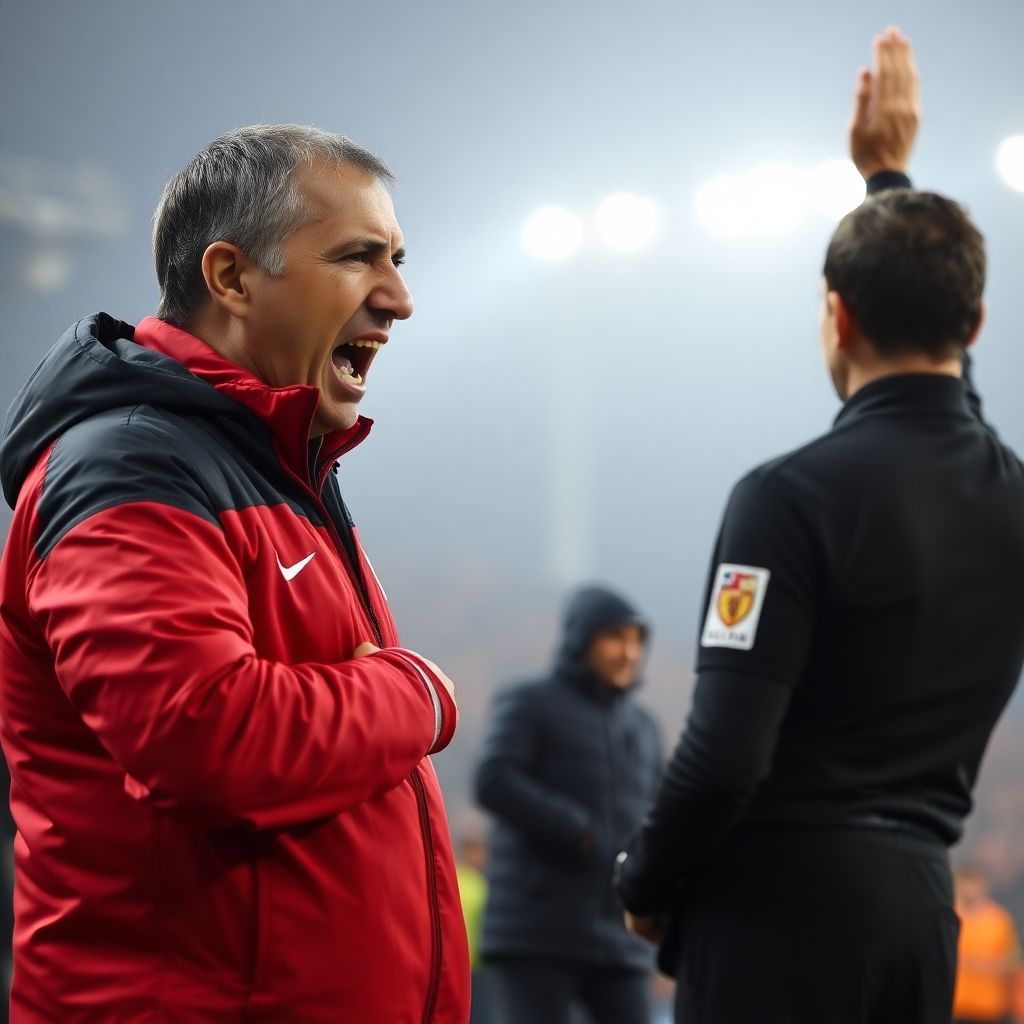
Buruk Under Fire as Galatasaray Boss Pins Anfield Humiliation on Referee
Okan Buruk has ignited a storm of criticism after Galatasaray’s heavy 4-0 defeat to Liverpool at Anfield, choosing to lay the blame at the feet of the referee rather than acknowledge his team’s shortcomings. The loss ended Galatasaray’s Champions League campaign in brutal fashion, yet in the aftermath, the Turkish coach focused far more on officiating decisions than on the gulf in intensity and quality on display.
Overrun for long stretches by a relentless Liverpool side, Galatasaray struggled to cope with the Premier League club’s pressing, speed and physicality. Nevertheless, Buruk used his post-match interviews to launch a fierce verbal assault on Polish referee Szymon Marciniak, a figure widely regarded as one of the elite officials in world football.
“One of the Worst”: Buruk’s Scathing Assessment
Speaking to Peter Schmeichel after the final whistle, Buruk delivered a stark verdict on Marciniak’s performance. He said he had expected a top-level referee capable of managing such a high-stakes clash, but instead, he claimed, Galatasaray had been let down.
“I was expecting one of the best referees in the world, but this was one of the worst,” the coach declared, his frustration evident. The remark was striking not only for its bluntness but also because it directly challenged the reputation of a referee trusted with some of the game’s biggest occasions.
Focus on Konaté vs Osimhen Duel
At the heart of Buruk’s ire was the physical battle between Liverpool defender Ibrahima Konaté and Galatasaray’s star forward Victor Osimhen. Buruk argued that Konaté repeatedly fouled the Nigerian striker but escaped appropriate punishment, giving Liverpool what he portrayed as a decisive edge.
“For example, against Osimhen, Konaté had a lot of fouls; he deserved a yellow card and was a free player,” Buruk complained. In his view, Marciniak’s reluctance to show a booking allowed Konaté to continue defending aggressively without fear of sanctions, tilting the game in Liverpool’s favour and disrupting Galatasaray’s attacking rhythm.
From Buruk’s standpoint, this imbalance stripped his side of a fair contest, as Osimhen had to contend not only with a powerful defender but also, in his opinion, a referee unwilling to intervene.
The Osimhen Injury and Tactical Disruption
Buruk also highlighted Osimhen’s injury as a key turning point in the match. The forward’s fitness issue forced Galatasaray into an early reshuffle that, according to the manager, broke their flow and undermined their game plan.
“After Osimhen’s injury, we lost maybe 30 minutes in the first half. He is very important to us,” Buruk said. He suggested that the team needed time to readjust, and that this period of uncertainty contributed to Liverpool gaining control of the contest.
Yet this narrative has not gone unchallenged. Neutral observers at Anfield pointed out that Galatasaray themselves contributed to the disjointed tempo, with frequent interruptions and players regularly hitting the turf. The Turkish champions appeared keen to slow the game, likely in an attempt to disrupt Liverpool’s rhythm and nullify their pressing.
Time-Wasting Claims and Touchline Frustration
Throughout the first half, Galatasaray’s approach was widely interpreted as an attempt to manage the pace, break up Liverpool’s momentum and drag the match into a stop-start affair. That strategy might have made sense on paper, but it also drew criticism.
Liverpool coach Arne Slot was visibly irritated on the touchline as his side were repeatedly forced to wait for restarts. The stop-start nature of the game fed into an increasingly tense atmosphere, with the home side eventually choosing to simply raise their intensity and overwhelm Galatasaray with sustained pressure once the second half began.
In that context, Buruk’s complaints about lost time and disrupted rhythm rang hollow for many observers, who argued that his team’s own tactics contributed significantly to the lack of flow.
Intensity Wins the Day
Away from the debate about refereeing, the consensus in Liverpool was that the hosts’ victory owed far more to their performance than to any controversial decisions. Once Liverpool found their stride, the match turned into a showcase of their trademark energy and aggression.
The Premier League side dominated the second half, repeatedly pinning Galatasaray back, forcing turnovers high up the pitch and capitalizing clinically on their chances. Dominik Szoboszlai later revealed that Liverpool felt particularly driven by Galatasaray’s exuberant scenes after the first-leg win in Istanbul, saying those celebrations gave the squad “extra motivation” to deliver a statement performance in the return fixture.
That psychological edge, combined with a clear tactical plan and superior physical conditioning, made the result feel inevitable long before the final whistle blew.
A Familiar Theme: Buruk and Referees
Buruk’s comments after the Anfield defeat did not emerge in a vacuum. Within Turkish football, the coach has already built a reputation for his outspoken stance on officiating. Over recent seasons, he has frequently voiced dissatisfaction with referees in domestic matches, often accusing them of bias or incompetence when results go against his side.
These repeated outbursts have drawn sharp responses from rival managers and pundits, who argue that constant focus on referees risks distracting from genuine footballing issues. Critics suggest that this pattern is resurfacing on the European stage, with Buruk again turning to refereeing as the primary explanation for a poor result.
For his supporters, Buruk is simply defending his team and fighting what he perceives as injustice. For detractors, he is avoiding accountability.
Pressure Mounts on Galatasaray’s Boss
The scale of the defeat at Anfield and the manner of the exit from the Champions League have inevitably placed Buruk under additional scrutiny. European competition is a key benchmark for any ambitious club, and a 4-0 loss on such a prominent stage is difficult to frame positively.
While Galatasaray’s domestic form may provide some protection, the board and fanbase will want reassurance that the team can compete at the highest level without collapsing under pressure. In that context, a focus on referees rather than tactical analysis or self-criticism may raise questions about how the club plans to evolve.
Inside the dressing room, players may also need a clearer message than simply blaming external factors. Modern footballers typically respond better to concrete solutions: improved defensive structure, better pressing triggers, or clearer attacking patterns against top opponents.
Tactical Questions Buruk Must Answer
Beyond refereeing debates, the Anfield defeat exposed several underlying problems. Galatasaray struggled to deal with Liverpool’s press, often losing the ball in dangerous areas when trying to build from the back. Their midfield looked overwhelmed at times, unable to impose control or slow down transitions.
Buruk now faces a tactical challenge: how to set up his team so they can withstand the intensity of European heavyweights. That could mean adjusting the defensive line, rethinking how the midfield supports the back four under pressure, or introducing more direct options when playing out from the goalkeeper proves too risky.
Another key issue is squad depth. The injury to Osimhen highlighted how reliant Galatasaray are on a small core of stars. If one key player goes down, the entire attacking structure appears to wobble. Strengthening options from the bench and developing flexible systems that do not collapse around a single individual will be crucial in future campaigns.
Mentality and Game Management in Europe
The psychological side of Galatasaray’s performance also demands attention. The team arrived in England with a narrow advantage from Istanbul and, by some accounts, celebrated the first-leg result as though the tie were effectively settled. Liverpool, a club with vast European experience, used that perception as fuel.
For Galatasaray, this episode serves as a reminder that European knockout football is not decided over 90 minutes but 180. Managing the emotional highs and lows, staying humble after victories, and maintaining focus across both legs are all part of progressing deep into the competition.
Game management, too, must improve. Excessive time-wasting or overreliance on breaking up the rhythm can backfire against elite opponents, who are capable of flipping the switch and punishing any lapse in concentration once the tempo inevitably rises.
What Comes Next for Buruk and Galatasaray
Looking ahead, Buruk has two parallel tasks. Publicly, he may continue to defend his players and emphasize the role of refereeing in the Anfield defeat. Privately, however, he must conduct a hard, detailed review of where his tactics and preparation fell short.
Galatasaray will need to refine their approach if they want to avoid similar humiliations. That means better planning for away legs in hostile environments, more adaptable game plans that do not fall apart due to one injury, and greater emphasis on coping with high pressing teams.
How Buruk reacts in the coming weeks will be crucial. If he keeps returning to the narrative of poor officiating, frustration among critics and neutrals is likely to grow. If, instead, he balances his complaints with concrete evidence of learning and tactical evolution, he can still present this painful night at Anfield as a turning point rather than a dead end.
A Defeat That Demands Self-Reflection
Ultimately, the 4-0 loss to Liverpool will be remembered as a defining moment in Galatasaray’s recent European history. It exposed weaknesses in structure, mentality and depth that cannot be brushed aside with references to missed yellow cards.
Referees will always be part of the story, especially in high-tension knockout ties. Yet for a club with Galatasaray’s ambitions, progress depends less on the whistle and more on confronting uncomfortable truths. Whether Okan Buruk is willing to move beyond his habitual focus on officiating and lead that process of self-reflection may determine both his future and the club’s prospects on the continental stage.