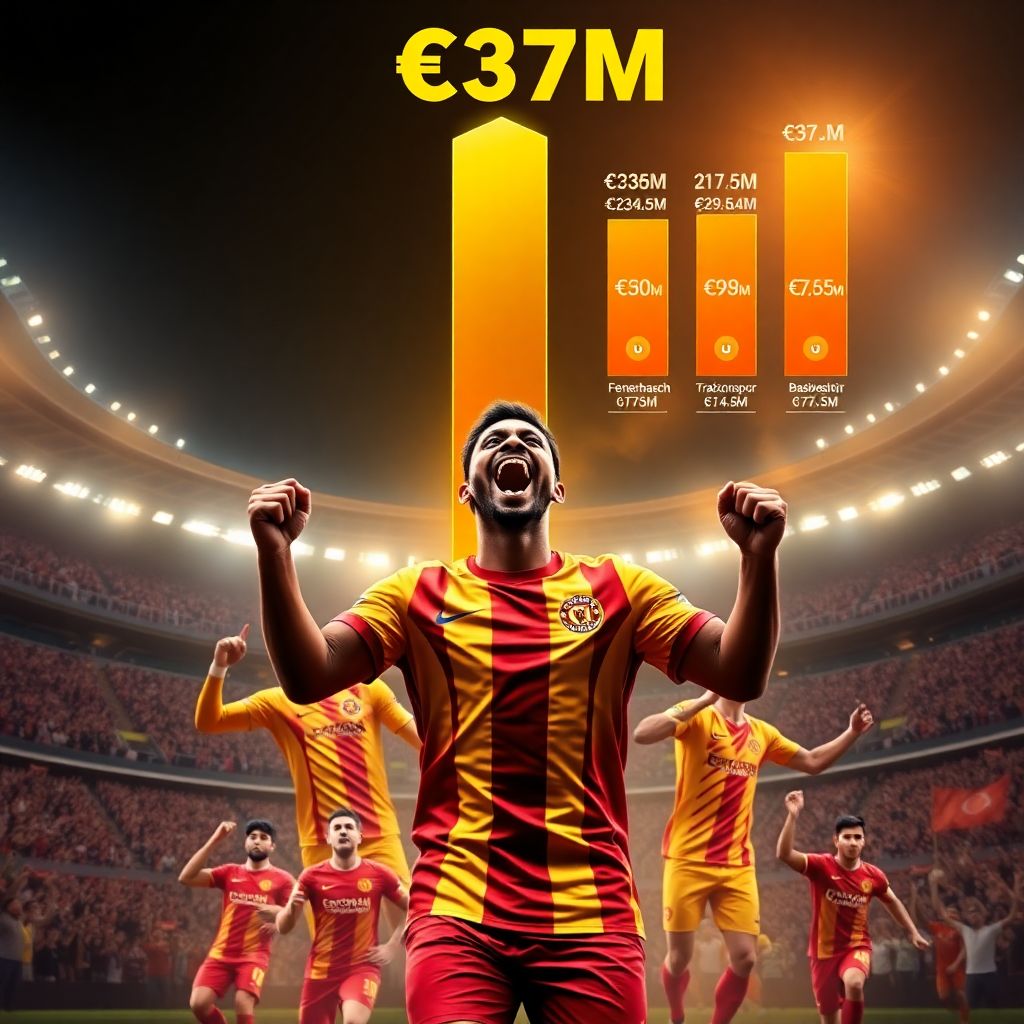
Galatasaray Become First Turkish Club to Smash €330M Valuation Barrier
Galatasaray have set a new benchmark in Turkish football economics, emerging as the most valuable squad ever assembled in the Süper Lig. Recent market assessments place the reigning champions’ squad at an eye‑watering €337 million, making them the first Turkish club in history to surpass the €330 million valuation threshold.
This record figure crowns a period of sustained and deliberate squad building, driven by an ambitious transfer policy across both the summer and winter windows of the 2025/26 season. Since the start of the campaign, Galatasaray’s overall market value has climbed by close to €30 million, underlining how aggressively the club has moved to strengthen its roster and increase its international profile.
A New Financial Hierarchy in Turkish Football
The jump in valuation has not only rewritten the club’s own history, it has fundamentally reshaped the financial landscape of the Süper Lig. Galatasaray now sit comfortably ahead of their main domestic rivals, creating a sizeable economic chasm at the top of the table.
Current estimated squad values among the leading Turkish clubs illustrate the scale of the gap:
– Galatasaray: €337M
– Fenerbahçe: €236.5M
– Beşiktaş: €178.5M
– Trabzonspor: €99.4M
– Başakşehir: €71.65M
The difference of more than €100 million between Galatasaray and their closest challenger, Fenerbahçe, speaks volumes about the club’s financial muscle and transfer-market pull. While the traditional “Big Four” still dominate the domestic scene, Galatasaray have clearly moved into a tier of their own in terms of squad valuation.
At the other end of the table, Fatih Karagümrük remain the league’s most modest outfit, with a squad valued at just €15.68 million. That figure is roughly 21 times lower than Galatasaray’s, highlighting the extreme disparity between the top and bottom of the division.
Spending Concentrated at the Top
The overall financial activity in the Süper Lig this season has been significant. Total spending across all clubs has reached approximately €475 million. Yet the distribution of that money is far from even. The country’s four traditional heavyweights—Galatasaray, Fenerbahçe, Beşiktaş, and Trabzonspor—are responsible for roughly €450 million of that outlay, leaving the remainder of the clubs to operate with far leaner budgets.
Broken down by club, the investment levels paint a clear picture:
– Galatasaray: €157M
– Beşiktaş: €129M
– Fenerbahçe: €124M
– Trabzonspor: €38M
Galatasaray not only top the valuation charts but also lead the league in total transfer expenditure. Their spending far outweighs most other clubs in the country and rivals mid‑tier European sides in both ambition and scale. Beşiktaş and Fenerbahçe have also pushed hard to stay competitive, but even their significant investments have not been enough to match the Lions’ overall market value.
This concentration of spending raises questions about long‑term competitive balance within the Süper Lig. While big‑money moves generate global attention and can lift the international standing of Turkish football, they also risk turning the title race into a closed shop dominated by a handful of wealthy contenders.
The Osimhen Transfer That Changed Everything
The single most influential move behind Galatasaray’s record valuation is the blockbuster arrival of Victor Osimhen. The Nigerian striker joined the club for a colossal €75 million fee, instantly becoming the most expensive signing in Turkish football history.
Osimhen’s transfer alone accounts for nearly half of Galatasaray’s seasonal outlay. His market value, status as a proven elite forward, and potential resale value have dramatically boosted the club’s overall squad worth. Beyond the financial figures, the signing represents a powerful statement of intent: Galatasaray can now attract players who, until recently, would have been expected to remain in Europe’s top five leagues or move only to the wealthiest clubs.
The Osimhen deal also sends a signal to sponsors, broadcasters, and international audiences that the Süper Lig is capable of staging marquee transfers. In an era where global visibility is crucial, securing a player with Osimhen’s profile can reshape how both the club and the league are perceived abroad.
High-Profile Reinforcements Across the League
Osimhen may be the headline act, but he is far from the only costly addition to the league this season. Several other major signings have contributed to the rising valuations and growing prestige of Turkish football:
– Wilfried Singo (Galatasaray): €30M
– Uğurcan Çakır (Galatasaray): €27.5M
– Mattéo Guendouzi (Fenerbahçe): €28M
For Galatasaray, bringing in Singo and Çakır further solidified key positions and added both athleticism and quality to the spine of the team. Uğurcan Çakır, long regarded as one of Turkey’s best goalkeepers, arriving at a valuation close to €30 million is a strong indicator of how the domestic market has evolved.
Fenerbahçe’s acquisition of Guendouzi reflects a similar strategy: securing players with European experience and high resale potential, in hopes of closing the gap to Galatasaray while maintaining their own push for trophies.
These transfers have collectively elevated the Süper Lig’s profile, making it more attractive to foreign audiences and potentially more lucrative in terms of future broadcast deals and commercial partnerships.
On-Field Success Mirrors Financial Power
Crucially, Galatasaray’s investment is not just visible on balance sheets—it is being reflected in results on the pitch. The club currently sits at the top of the Süper Lig table with 52 points, confirming that the record spending is delivering immediate domestic returns.
Osimhen’s goals, combined with the impact of other new arrivals, have turned Galatasaray into one of the most formidable sides in the region. Their blend of established stars and rising talents has given the coaching staff a deeper, more versatile squad than in previous seasons, allowing the club to compete across multiple competitions without a significant drop‑off in quality.
This alignment of financial might and sporting success is precisely what club executives envisioned when they authorized such bold transfer activity. For now, the strategy appears justified: record valuations, record signings, and a team firmly in control of the title race.
Implications for the Süper Lig’s Competitive Balance
While Galatasaray’s rise is a source of pride for their supporters and a showcase for Turkish football, the widening valuation gap raises deeper strategic questions for the league. When one club stands more than €100 million ahead of its nearest rival and more than twenty times above the lowest‑valued squad, maintaining a truly competitive environment becomes challenging.
Smaller clubs increasingly have to rely on youth development, clever scouting, and loan deals rather than direct competition in the transfer market. Many will look to identify undervalued talents, polish them, and then sell for profit—effectively turning into feeder clubs for the giants.
This divide is not unique to Turkey; it mirrors trends seen in other European leagues where a handful of financially dominant clubs routinely contest the title. However, if the Süper Lig wishes to market itself as an unpredictable and exciting competition, league authorities and clubs alike may eventually need to explore mechanisms that encourage more balanced competition, whether through financial regulations, improved revenue sharing, or targeted support for smaller teams.
Financial Risk, Sustainability, and Regulations
Galatasaray’s enormous valuation and spending also raise the issue of sustainability. Significant outlays can be justified when they lead to trophies, increased prize money, and enhanced commercial revenue. But heavy investment naturally raises pressure to succeed every season. Failure to qualify for European competitions or a sudden drop in form could expose the club to financial strain.
In this context, monitoring wage structures, amortization of transfer fees, and compliance with financial regulations becomes critical. Clubs operating at this scale must be meticulous about balancing short‑term sporting ambition with long‑term financial health. Galatasaray’s leadership will be judged not only on the trophies they win, but also on whether they can maintain this model without facing sanctions or being forced into rapid squad downsizing in future seasons.
For the Süper Lig as a whole, having a flagship club with a €337 million valuation can be beneficial, drawing attention and improving the league’s overall profile. At the same time, it increases scrutiny from governing bodies and may accelerate the introduction or tightening of financial controls if spending spirals further.
European Ambitions and Global Branding
Breaking the €330 million valuation barrier is not just a domestic milestone; it is also a statement directed at Europe and beyond. With such a valuable squad, Galatasaray will inevitably be judged by how they perform in continental competitions. Deep runs in elite tournaments would not only validate the club’s spending strategy, but also further boost player values and commercial income.
High‑profile signings like Osimhen help the club expand its fan base internationally, enhance merchandise sales, and attract global sponsors. A more valuable squad often leads to better television exposure and more lucrative pre‑season tours, feeding a cycle in which sporting success and commercial growth reinforce one another.
In this sense, Galatasaray are positioning themselves as more than just Turkish champions. They are attempting to carve out a stable place among Europe’s most recognized and respected clubs, using a mix of financial firepower and ambitious sporting goals.
Impact on Domestic Talent and Player Pathways
Another important consequence of Galatasaray’s new status is its effect on Turkish players and youth development. When a club can afford to surround rising local talents with elite international teammates, it can dramatically accelerate their growth and visibility. Training and competing alongside players of Osimhen’s calibre can raise standards within the squad and create an environment in which young prospects are pushed to reach higher levels.
At the same time, high transfer fees and wages for foreign stars can limit opportunities for academy graduates if not managed carefully. For Galatasaray—and for their rivals—the challenge will be to strike a balance between importing ready‑made quality and nurturing the next generation of Turkish footballers.
Should the club manage that balance successfully, the national team could benefit as well. A domestic league that combines strong financial power with a clear pathway for local talents can become a launchpad for players who then shine on the international stage.
What This Milestone Means for the Future
Galatasaray’s ascent to a €337 million valuation marks a turning point in the economic history of Turkish football. It reflects years of strategic planning, bold investment decisions, and an increasingly global outlook. The club have moved decisively into a new financial era, one in which they are not only aiming to dominate the Süper Lig but also to be taken seriously among the continent’s heavyweights.
However, this achievement comes with expectations and responsibility. Maintaining such a high‑value squad will require continued sporting success, careful financial stewardship, and smart long‑term planning. For now, though, the message is clear: Galatasaray have redrawn the map of Turkish football, setting a standard that every other club in the country will be measured against in the years to come.