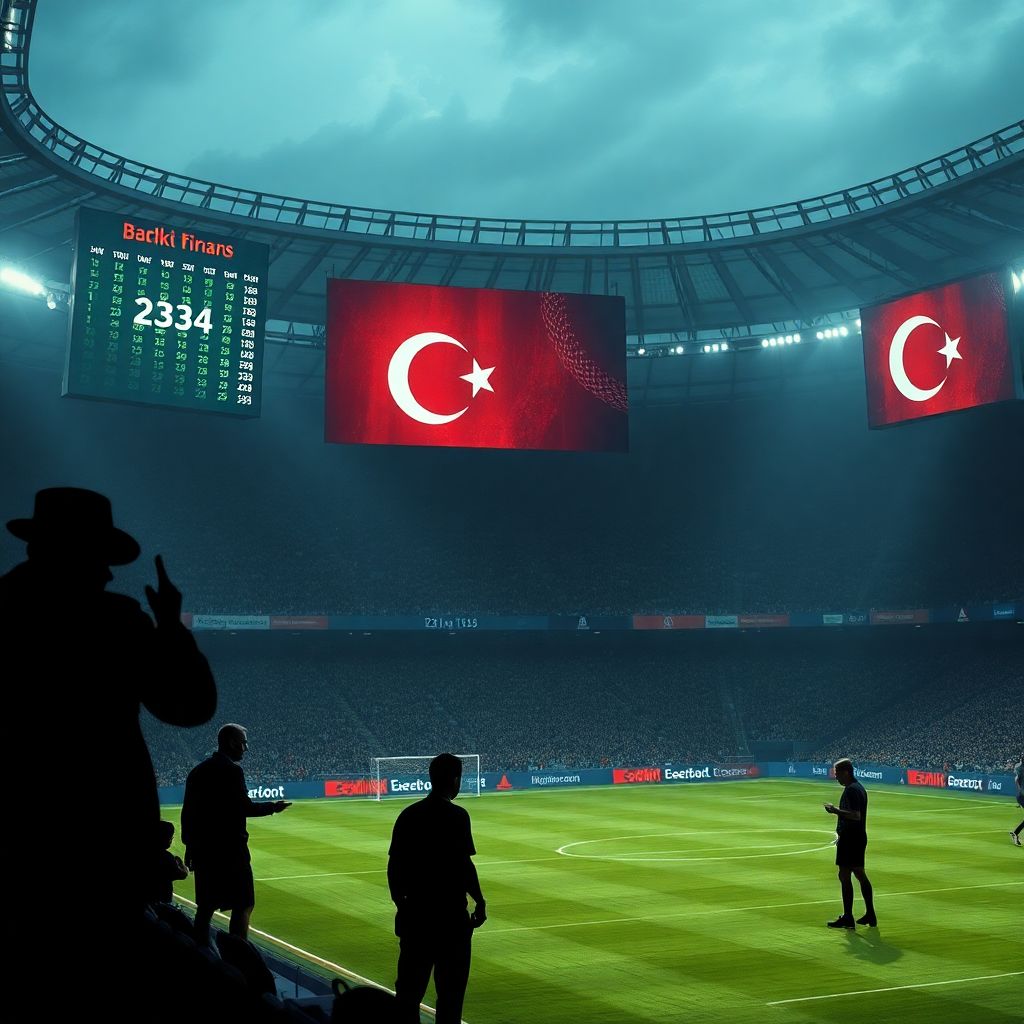
Turkish Football Gambling Sponsorships in 2026: Laws, Corruption Networks, and the Battle for Integrity
The Turkish football ecosystem in 2026 is barely recognizable. What began as a series of “isolated anomalies” has evolved into a full-scale integrity meltdown that has hollowed out the domestic game. The Turkish Football Federation (TFF) is struggling to function, the national refereeing structure has almost collapsed, and entire squads have been decimated by suspensions.
This is not just a sports story; it is the visible surface of a vast, underground betting economy worth an estimated sixty billion dollars. A rigid state monopoly on gambling, designed to protect the public and secure tax revenues, has instead fuelled a sprawling illicit marketplace that now threatens the very existence of professional football in the country.
A Sixty-Billion-Dollar Shadow Market
According to state officials, the illegal betting sector connected to Turkish football alone may be worth up to 60 billion dollars. Officially, all legal gambling is concentrated in the hands of a single state-backed operator, Spor Toto. Private betting companies are locked out of the domestic market, denied licenses, and excluded from formal sponsorship deals.
But vast sums of money do not simply disappear because the law says they cannot flow. They move elsewhere. What was meant to be a tight regulatory fortress has, in practice, created a booming offshore and underground betting ecosystem. Criminal networks and foreign operators stepped into the vacuum, offering wagers, instant payouts, and anonymity, while using Turkish football as their primary vehicle for profit and manipulation.
The result is a dual reality: a tightly policed official market and an even larger, chaotic parallel universe operating just out of reach of domestic regulators. This unregulated economy has burrowed into clubs, dressing rooms, referees’ associations, and boardrooms.
Harsh Laws on Paper, Loopholes in Practice
On the statute books, Turkish regulation appears uncompromising.
– Law No. 7258 classifies unauthorized sports betting facilitation as a serious felony, with organizers and key facilitators risking up to twelve years in prison.
– Law No. 6222 targets match manipulation, imposing mandatory custodial sentences and heavy fines. Sentence suspensions and deferments are explicitly forbidden for these crimes.
– The TFF formally prohibits anyone involved in football-players, referees, coaches, executives-from opening or using betting accounts.
On paper, the system is airtight. In reality, it has been riddled with practical and technological loopholes. Enforcement has lagged behind the innovation and resourcefulness of illegal betting operators, who exploit everything from shell companies and crypto payments to foreign hosting and complex sponsorship structures.
The result: a legal framework that punishes those who are caught but fails to properly insulate the sport from external financial pressure and covert influence.
Proxy Sponsorships: The Trojan Horses of Illegal Betting
One of the most effective tools used by offshore betting syndicates has been the so‑called “proxy sponsorship.” Instead of appearing openly as bookmakers or casinos, entities present themselves as news sites, data platforms, or generic entertainment brands.
A defining case exploded in September 2024, when Galatasaray signed a 14 million dollar back-of-shirt deal with “Meritking.news.” Officially, it was a sports news aggregator. In practice, insiders knew it was a disguised front for an illegal Cyprus-based casino operation, piggybacking on the prestige of the historic “Merit” tourism brand owned by Net Holding.
The outrage was immediate. Hande Tibuk, linked to the legitimate Merit brand, launched intense public and legal action against the club. Under mounting social and media pressure, Galatasaray tore up the contract. Yet the episode had already sent a clear signal to syndicates: Turkish football could be infiltrated through corporate camouflage. If one dummy company could reach the shirt of a national giant, others could spread across the league.
From that moment, the strategy was refined rather than abandoned. Smaller clubs, desperate for revenue and less concerned about reputational risk, became prime targets for similar deals under more discreet labels and more complex ownership chains.
Foreign Broadcasters and the Offshore Avalanche
The monetization of Turkish football fans is not the exclusive domain of domestic or Cyprus-based outfits. European broadcasters and foreign clubs have aggressively capitalized on the lucrative Turkish betting demographic.
Premier League and La Liga teams frequently ink “regional betting partnerships” deliberately aimed at Turkish audiences. These agreements allow offshore bookmakers to plaster their brands across LED boards, digital overlays, and targeted online advertising during broadcasts, all without ever obtaining a local license or going through Spor Toto’s framework.
The Turkish state attempts to counter this with digital geoblocks and firewalls, blocking access to certain domains and ad creatives. These efforts are easily undone by fans who use VPNs to circumvent restrictions. In effect, the government is trying to plug a waterfall with its bare hands, while enormous streams of betting revenue flow offshore with minimal oversight and zero domestic tax benefit.
The Match with Zero Shots: The Moment the System Cracked
The full scale of the crisis began to surface not in glamorous top-tier clashes but in the lower leagues. In April 2025, Ankaraspor faced Nazillispor in a Second League encounter that would become infamous: a 0-0 draw in which neither team took a single shot across ninety minutes.
State monitoring systems immediately flagged abnormal betting activity. Huge volumes of wagers had been placed on that specific unlikely outcome. The pattern was too blatant to ignore. Soon, politicians were openly denouncing the situation. At a rally in October, Özgür Özel highlighted a 5.5 million lira offshore bet placed exclusively on a particular Süper Lig red card, a detail that could hardly be coincidental.
The political embarrassment and public anger forced the Federation’s hand. The TFF could no longer present the integrity issue as a cluster of minor infractions-it had clearly become systemic.
The Great Referee Purge
Under intense scrutiny, TFF president İbrahim Hacıosmanoğlu ordered a sweeping digital audit of the country’s officiating corps in late 2025. Investigators reviewed online footprints, financial transactions, and betting platform data for 571 active referees.
The findings were catastrophic:
– 371 referees were discovered with active betting accounts.
– 152 had actually placed bets, many on domestic matches.
– Zorbay Küçük, a prominent Süper Lig official, was arrested during coordinated November raids.
Within days, the Federation suspended 149 referees. Overnight, Turkey’s already strained refereeing infrastructure was reduced to a skeleton. Lower divisions struggled to find qualified officials, while top-flight games were overseen by overworked and hastily promoted referees. Appointments became chaotic, and the perceived credibility of officiating took another severe blow.
Players Under Suspicion and the Collapse of Squads
The next wave of revelations hit the dressing rooms. By November, the TFF disciplinary arm had suspended more than a thousand professional players across various tiers of the pyramid. Some clubs in the lower leagues simply could not field legal starting elevens, scrambling to promote youth players and semi-professionals to avoid forfeits.
High-profile names were not spared. Ersin Destanoğlu, Metehan Baltacı, Alassane Ndao, and Uğur Kaan Yıldız all appeared on the sanction lists. Investigators disclosed that twenty-seven Süper Lig players had placed bets on their own teams’ matches, with a subset wagering against their clubs or on highly specific in-game events like cards and penalties.
This was perceived as the ultimate betrayal: footballers not just passively tolerating corruption but actively monetizing their own performances and results. Dressing-room trust disintegrated, and fans began to question every mis-hit shot, every late tackle, every inexplicable tactical choice.
Coaches and Technical Staff Drawn into the Net
The wave did not stop at players and referees. Coaches and backroom staff were dragged into what commentators began calling the “great purge.” The TFF ethics board referred 155 managers for gambling-related violations. Among those ensnared were well-known figures such as Serdar Topraktepe and Mehmet Altıparmak.
For years, betting syndicates had recognized that coaches could be even more valuable assets than players. A minor tactical tweak, a suspicious substitution, a weakened line‑up in a critical match-these are decisions that can be framed as “footballing choices” while carrying enormous betting implications. As investigators uncovered communication trails between coaching staff and offshore operators, it became clear that manipulation was often choreographed at the tactical board level, not just executed on the pitch.
Boardroom Syndicates and the Money-Laundering Engine
Perhaps the most disturbing revelations came from the club offices. In February 2026, police carried out synchronized raids across ten provinces, targeting the headquarters of multiple professional teams. Thirty-two senior club executives were detained.
These were not mere gamblers placing side bets. They were, in many cases, architects of criminal enterprises:
– Some club presidents placed enormous bets against their own teams, profiting from engineered defeats.
– Executives pressured or blackmailed players into conceding penalties or underperforming to cover mounting club debts.
– Club funds, sponsorship deals, and transfer payments were used to wash illicit money tied to illegal betting sites.
Fevzi İlhanlı, while running Diyarbekirspor, was identified as operating an illegal betting platform, blurring the line between club management and organized crime.
The Financial Crimes Investigation Board (MASAK) responded by freezing 5.1 billion lira in suspicious transactions linked to betting flows, sponsorship deals, and opaque consultancy arrangements. The sheer scale of movement suggested that match-fixing and gambling-related manipulation were not side effects-they were core business models for some entities at the top of Turkish football.
Regulatory Paradox: Monopoly as a Catalyst for Corruption
The crisis exposes a painful paradox. The state’s strict monopoly via Spor Toto was supposed to shield citizens from the dangers of unrestricted betting and ensure that gambling profits benefited public finances. Instead, by shutting the door on any regulated private competition, it inadvertently created a perfect breeding ground for black-market operators and offshore platforms.
With legal options tightly controlled and heavily taxed, players and fans gravitated toward platforms promising better odds, anonymity, and access to exotic markets. Criminal groups exploited that demand, while clubs starved of revenue looked to gray-area sponsorships and under-the-table arrangements to stay afloat.
A system designed around control and prohibition has thus become a catalyst for the very corruption it intended to prevent.
The Human Cost: Fans, Young Players, and Local Communities
Beyond the headlines and legal battles lies a quieter, more tragic dimension. Fans, who invest emotionally and financially in their clubs, find themselves betrayed by those who were supposed to protect the badge. Stadium attendances in some regions have declined as spectators lose faith in the authenticity of results.
For young players, the environment has become deeply distorted. Instead of seeing football solely as a pathway of sporting excellence, many are exposed early to “easy money” narratives around spot-fixing, betting tips, and manipulated outcomes. Agents and intermediaries, some tied to syndicates, hover around academies looking for vulnerable or financially desperate talent.
Local communities that rely on football for a sense of identity and cohesion are left with hollowed-out clubs, crippled finances, and squads decimated by bans. The damage is not just institutional; it is social and generational.
Technology’s Double-Edged Sword
Digital technology has both created and exposed the crisis. On one hand, online platforms, cryptocurrencies, and VPNs have made it trivial to place unregulated bets from any smartphone and to route money through complex, cross-border networks. This has empowered illegal operators and made detection harder.
On the other hand, the same digital traces-transaction logs, IP data, device fingerprints, encrypted chat metadata-have given investigators the tools to map out corruption networks with forensic precision. The mass referee audit, for example, was only possible because betting accounts, even when registered under aliases, left patterns that could be matched against known identities and movement data.
The future of integrity enforcement in Turkish football will hinge on how effectively regulators can leverage data analytics, AI-driven anomaly detection, and real-time monitoring to spot suspicious patterns before matches are irreparably compromised.
Possible Paths Forward: Reform or Ruin
The situation in 2026 has forced a national conversation about what must change if Turkish football is to survive as a credible competition. Several reform avenues are being debated:
1. Partial Liberalization of the Betting Market
Allowing strictly regulated private operators into the legal framework could redirect a portion of the shadow economy back into transparent channels. Licensing, taxation, and robust compliance requirements might weaken the allure of offshore platforms while generating legitimate revenue streams for clubs.
2. Independent Integrity Units
Many analysts argue the TFF cannot police itself effectively. They call for an independent integrity body with investigative powers, separate from both the Federation and club structures, to oversee match-fixing inquiries, betting-related violations, and conflict-of-interest cases.
3. Transparency in Sponsorship and Ownership
Mandatory disclosure of beneficial ownership for all sponsors and investors could make it far more difficult for dummy corporations and proxy brands to infiltrate the sport. Clubs would be required to conduct due diligence and face severe penalties for turning a blind eye.
4. Education and Whistleblower Protection
Players, referees, and staff need systematic education about how syndicates operate, the risks involved, and the legal consequences. At the same time, secure reporting channels and strong whistleblower protections could encourage insiders to come forward before manipulation spreads.
5. International Cooperation
Because so much of the betting infrastructure is offshore, Turkey cannot clean up its game in isolation. Information-sharing agreements with foreign regulators, financial intelligence units, and betting integrity bodies are essential to disrupt networks that extend across borders.
The Future of Sports Integrity in Turkey
The events leading up to 2026 represent the deepest integrity crisis Turkish football has faced since the scandals of 2011, but on a far more complex and globalized scale. The sport now stands at a crossroads. One path leads to continued denial, piecemeal punishments, and steady erosion of public trust. The other demands a painful but necessary reconstruction of the system from the ground up-regulatory reform, structural transparency, and a cultural shift away from normalization of betting-driven manipulation.
Whether Turkish football emerges from this period as a cautionary tale or a model of recovery will depend on decisions taken in the next few years. What is clear is that the old model-rigid state monopoly on paper, uncontrolled shadow economy in practice-is unsustainable.
If integrity is to have a future in Turkish football, the sport must confront the reality of the sixty‑billion‑dollar shadow economy, dismantle the networks that have corrupted it from within, and design a framework where the result on the pitch is determined by players and coaches, not by offshore betting slips and clandestine boardroom deals.