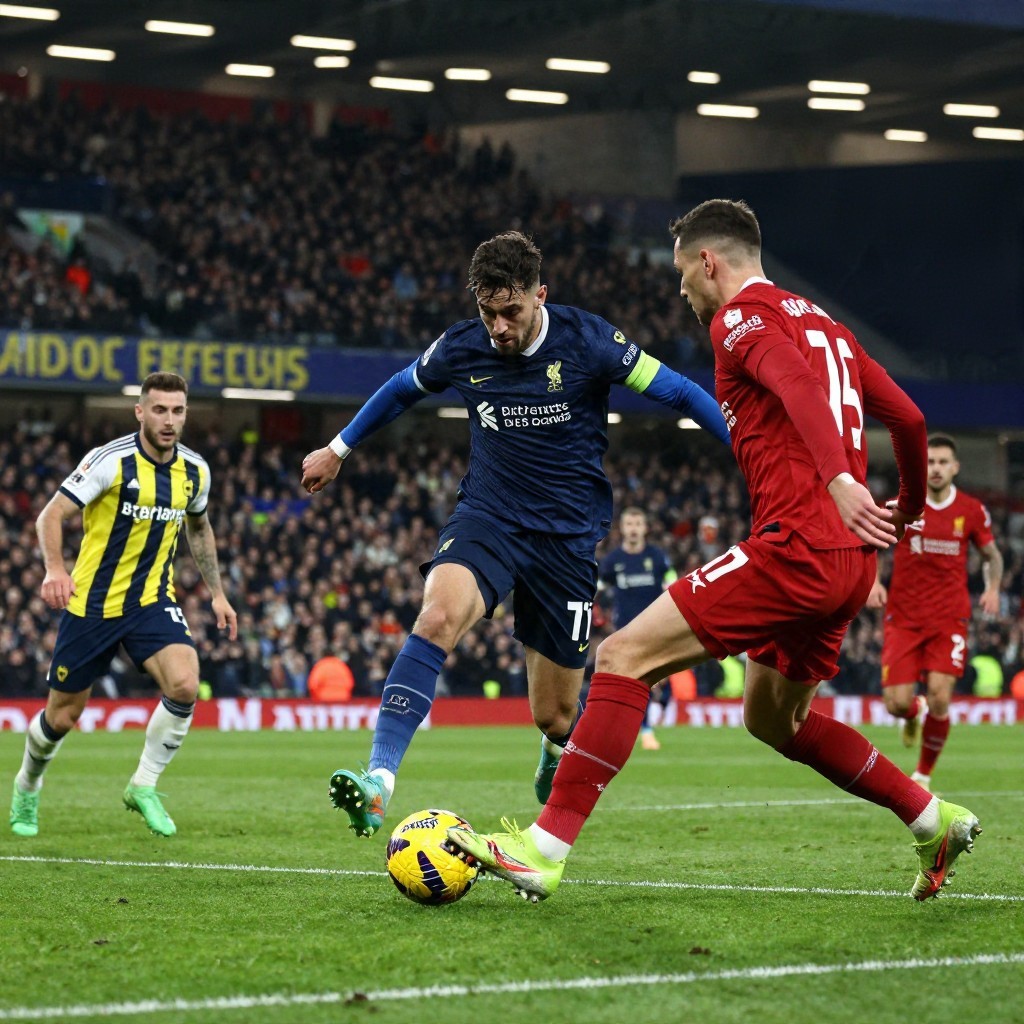
Iraola Blames Liverpool’s Set-Piece Defending for Istanbul Defeat
Andoni Iraola identified Liverpool’s failure to defend dead-ball situations as the decisive factor in their 3-2 Champions League loss to Fenerbahçe in Istanbul. The result ended the Reds’ unbeaten run in the competition, despite the visitors taking the lead twice in a hostile atmosphere at Kadıköy.
Liverpool’s first advantage came through 19-year-old Trey Nyoni. Alexander Isak, introduced after the break, later put them ahead again. But three defensive lapses from set pieces turned the match around: Mason Greenwood’s free-kick took a deflection on its way in, Archie Brown scored after a scramble following a corner, and Vedat Muriqi rose to head home from a long-throw routine late in the game.
For Iraola, the pattern of the goals left little doubt about where the match had been lost.
“The main reason I can find for why we lost is that we conceded from three set-pieces,” he said after the final whistle. He added that Liverpool had defended such situations well in domestic matches and had performed reasonably strongly in the Champions League before facing Fenerbahçe. The Turkish side, however, made the most of one of its recognised strengths.
Iraola described the goals as “cheap” and “messy”, while acknowledging the difficulty of organising the defence amid the noise inside the stadium. He said it had been almost impossible to communicate clearly from the touchline, and that players struggled to hear one another during the dead-ball moments.
The manager specifically referred to communication between Alisson and Cody Gakpo, but did not present the atmosphere as an excuse. Liverpool, he said, still needed to defend those situations better. The visitors’ inability to settle the ball, track runners and deal with second phases proved costly each time Fenerbahçe delivered into the penalty area.
Rotation was not the main issue, says Iraola
Iraola also faced questions about making five changes to his starting line-up. Bradley Barcola began in a central role, supported by Victor Muñoz and Rio Ngumoha, while Isak was held back for a second-half appearance.
Barcola offered pace on the counter-attack, but Liverpool appeared more dangerous after Isak and Gakpo came on. Iraola accepted that the substitutes improved the side’s attacking threat, yet rejected the idea that rotation was the principal cause of the defeat.
With a demanding schedule to manage, he said, it was not realistic to field the same starting eleven every time. Iraola expressed confidence in the depth of his squad and argued that the key issue was not the selection policy, but the way Liverpool conceded and their failure to turn their control into a winning performance.
The loss leaves Liverpool on nine points in the Champions League league phase. Their immediate task is to restore defensive order before returning to domestic competition, with set pieces likely to be a central focus in training.
Why set-piece details mattered in Istanbul
Dead-ball situations can quickly reshape a match because they give the attacking team time to position players and target specific weaknesses. Fenerbahçe used several different delivery types: a free-kick, a corner and a long throw. Liverpool therefore had to cope with varied threats rather than a single repeated routine.
The goals also highlighted the importance of what happens after the first contact. A team may initially clear a cross or block a shot, but the danger is not over until the ball is fully removed from the area. Brown’s goal followed a corner scramble, illustrating how quickly a loose ball can become a scoring opportunity when defenders lose their assignments.
Communication is another essential part of defending in a loud stadium. Players need to know who is marking opponents, who is attacking the ball and who is responsible for covering the space around the goalkeeper. When instructions cannot be heard, those responsibilities must be agreed in advance and reinforced through clear signals.
Liverpool will also need to review their organisation on long throws. These deliveries can function much like corners, with attackers crowding the six-yard area and attempting to create confusion. Defenders must anticipate the first ball, protect the space around the goalkeeper and remain alert to runners arriving behind them.
The defeat does not erase the attacking contributions that gave Liverpool the lead twice, but it underlined how fragile an advantage can be when basic defensive duties are neglected. Iraola’s assessment was direct: the team had to improve its set-piece work, rather than blame the result on rotation or the intimidating conditions in Istanbul.