
Mental toughness sounds like something only Olympic champions are born with.
In reality, it’s a set of skills you can train—just like speed, strength, or technique.
Below we’ll borrow real stories from top Turkish and world athletes and turn them into a practical, step‑by‑step guide you can actually use at practice tomorrow (or even at tonight’s game).
—
Why Mental Toughness Matters More Than Talent
Stories from Turkish Athletes: Pressure as a Daily Habit
Think about the Turkish women’s national volleyball team, now one of the strongest in the world. Players like Eda Erdem didn’t wake up fearless; they learned to treat pressure almost like a training partner. In interviews, they often describe how playing in hostile arenas in Italy, Serbia, or China became a normal experience—not an exception. That wasn’t an accident. Coaches intentionally scheduled tough away matches and high‑stress qualifiers, so the athletes’ brains got used to noise, bad calls, and momentum swings.
That’s mental toughness in its simplest form: repeated exposure to stress with a controlled response.
Naim Süleymanoğlu, the legendary weightlifter, offers another powerful example. On the Olympic platform, the entire attempt takes just a few seconds. Yet he used visualization for hours: lifting the bar in his mind, feeling the chalk, hearing the crowd, even anticipating the judge’s signal. By the time he stepped up for a real lift, his nervous system had already “been there” dozens of times that day.
He didn’t aim to feel zero fear; he aimed to perform well *with* fear.
You don’t need an Olympic platform or a full arena to copy this approach. You just need a system.
—
Stories from Global Icons: Same Skills, Bigger Stage
Michael Jordan, Serena Williams, Novak Djokovic, and many other global stars talk about confidence, focus, and composure as trainable skills, not gifts. Serena often mentions how she resets after errors: one gesture, one deep breath, and a clear mental command—“Next point.” That tiny mental reset routine keeps bad moments from turning into bad matches.
Novak Djokovic openly credits mental work—breathing, meditation, visualization—for his ability to come back from two sets down in Grand Slams.
He treats his mind like a muscle: train it, stress it, recover it.
What matters for you is this: the gap between you and them is mostly scale, not type. The same tools they use are available to you in simpler versions.
—
Necessary Tools for Building Mental Toughness
Inner Tools: The Stuff You Carry into Every Game
You don’t need fancy equipment to start. But you *do* need a few mental tools you can rely on under pressure:
– A simple breathing pattern you can use anywhere
– A short, clear pre‑performance routine
– A small set of cue words or phrases
– A basic visualization script
Start by picking just one tool from this list and making it automatic. Trying to use five new tricks in the middle of a high‑pressure moment usually backfires.
For example, choose a breathing pattern like “4–2–6”: inhale for 4 seconds, hold 2, exhale 6. Practice it in the car, at home, during warm‑up. Your goal is for your body to associate this pattern with “calm and ready,” so when the pressure appears, your nervous system knows what to do.
—
Outer Tools: People, Programs, and Resources
Once you have a couple of inner tools, you can add outer support, just like you would with strength or tactics.
A good sports psychologist for athletes functions like a mental skills coach: they design drills for focus, confidence, and emotional control. This isn’t only for pros dealing with a crisis; it’s for anyone who wants the mind to stop sabotaging the body on game day.
Beyond 1‑to‑1 help, look for:
– Local or online sports performance coaching programs that mix mental, physical, and tactical work
– Short sports psychology courses online to learn basics like goal‑setting, imagery, and self‑talk
– A couple of best sports psychology books for athletes that you actually read and apply, not just leave on a shelf
Don’t worry about finding the “perfect” resource. Pick one, commit for 4–6 weeks, squeeze value out of it, then upgrade as needed.
—
Step-by-Step Process: Turn Stories into Daily Habits
Step 1: Define Your Pressure Moments
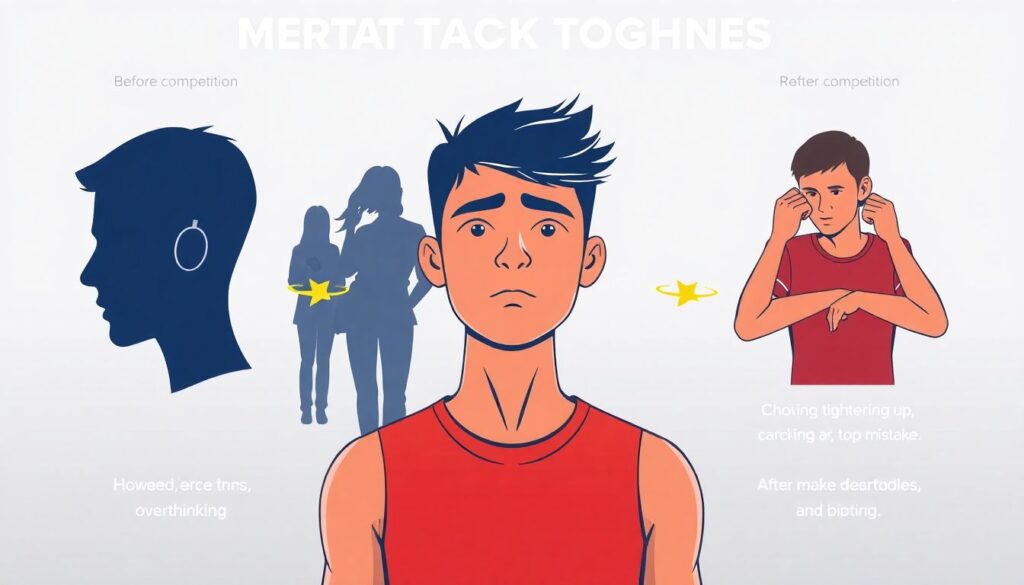
Mental toughness becomes relevant at specific times, not all the time. Identify those exact moments.
Ask yourself:
– When do I usually choke, tense up, or disconnect?
– Is it before the competition, during, or after mistakes?
– Does it happen more in front of certain people—coach, parents, top rivals?
Write down 3–5 “pressure snapshots,” such as:
– “Penalty kicks in the last 10 minutes”
– “Serving at 23–23 in volleyball”
– “Starting a race after a false start”
This list is your personal training plan. You can’t train what you haven’t named.
—
Step 2: Build a Pre-Performance Routine
Watch videos of top footballers, tennis players, or lifters and you’ll notice fascinating rituals: bouncing the ball, adjusting the shirt, closing the eyes briefly, repeating the same steps before each serve or attempt. These aren’t superstitions; they’re mini‑programs for the brain.
Create a simple routine for yourself, lasting 10–30 seconds:
1. Body reset – one deep breath or quick shake of arms and shoulders
2. Visual target – look at a spot related to the task: the corner of the goal, the line you’ll run, the rim
3. Cue phrase – a short command like “Strong and smooth”, “Attack”, or “One ball”
4. Commit – once you’ve done the routine, no more thinking, just execute
Practice this when the stakes are low—training drills, friendlies, solo practice—so it’s automatic in big moments.
If you only use your routine when you’re panicking, your brain will link it with panic, not calm.
—
Step 3: Train Attention and Self-Talk
Your attention is like a spotlight. Under stress, it tends to jump to the wrong place: the crowd, the score, the coach’s face. Mental toughness training for athletes is mostly about learning where to point that spotlight and what to say inside your own head.
Try this simple practice during training:
– Before each rep or drill, decide: “What will I focus on for the next 10–20 seconds?” (example: “my arm swing,” “my first step,” “my exhale”)
– After the rep, quickly rate your focus 1–10: “How well did I actually stay with that focus?”
This builds awareness. Once you can see your attention wandering, you can guide it.
For self‑talk, steal a page from elite athletes and build a small “mental playlist”:
– 3 “reset” phrases for after mistakes: “Next play”, “Reset”, “New ball”
– 3 “attack” phrases for courage: “Go first”, “Trust it”, “All in”
– 3 “calm” phrases: “Easy power”, “Breathe and flow”, “Steady”
Short beats clever. Under pressure, your brain can handle three words; it can’t handle a full motivational speech.
—
Step 4: Practice Playing Uncomfortable
The Turkish volleyball team didn’t become mentally tough by playing only safe matches close to home. They deliberately scheduled games where everything felt hostile—crowd, refs, travel—so that by the time major championships arrived, nothing felt new.
You can copy that concept at your own level.
Once or twice a week, add a “discomfort drill”:
– Start a scrimmage already down 0–2 or 0–3
– Do conditioning *before* a technical drill so you must execute while tired
– Let the losing side in a drill do pushups so there’s a real consequence
– Invite people to watch a drill that usually makes you nervous
The key: while doing these, use your breathing, routines, and cue phrases. Otherwise you’re just suffering, not training.
Stress + skills = growth. Stress alone = burnout.
—
Step 5: Review and Reset After Every Performance
Top athletes rarely leave games “unprocessed.” They review, but they do it in a structured way.
Try a 5‑minute post‑competition review:
1. 3 things that worked – focus on specific behaviors, not results
2. 1–2 things to improve – choose controllable actions (e.g., “start routine earlier,” not “be more confident”)
3. 1 mental skill goal for next time – such as “use my breathing pattern at every timeout”
Write it down in a small notebook or app. Over a season, this becomes your personal sports psychology journal.
Patterns will appear: maybe you lose focus in the middle of sets, or your self‑talk gets toxic after one mistake. That’s your roadmap for the next month of mental training.
—
Troubleshooting: When Mental Toughness Work Isn’t Working
Common Problems You’ll Likely Meet
Even world‑class athletes hit mental walls. You will too. That’s normal.
Here are typical issues:
– “I practice mental skills but forget them in competition.”
– “I feel even *more* tense when I try to use breathing or routines.”
– “I understand the concepts but nothing changes on the field.”
– “I’m fine in training, but my mind collapses in real games.”
These are not signs you’re weak. They’re signals that your process needs adjustment.
—
Fixes and Adjustments You Can Make
Use these practical tweaks:
– Shrink the skill. If you can’t run a full 30‑second routine, use a 5‑second version: one breath + one cue word.
– Lower the expectations. Aim to remember your mental skill 3 times in a match, not every time. Then build up.
– Change the trigger. Link skills to a specific event: every time you touch your shoelaces, you breathe; every time the whistle blows, you re‑focus.
– Rehearse under small stress. First use your tools in slightly stressful drills before expecting them to work in a final.
If you feel worse when trying mental techniques, it often means you’re judging yourself too harshly—“I’m doing this wrong,” “I should be calm by now.” Switch the goal from “feel calm” to “stick to my process.”
Performance tends to follow the process, not the other way around.
—
When to Bring in Professional Help
Sometimes self‑coaching isn’t enough. That’s when bringing in a professional can accelerate everything.
Look for a licensed or certified expert in your country who works as a sports psychologist for athletes, not just a general therapist. Ask about their approach: do they give you practical drills, or is it only talking? Ideally, you want someone who will design mental skills sessions the same way a strength coach designs gym work.
You can also support yourself between sessions with structured sports performance coaching programs or targeted sports psychology courses online. Combine that with reading a couple of the best sports psychology books for athletes, and you’ll have both guidance and depth.
If you notice signs like constant anxiety, sleep problems before competitions, panic attacks, or loss of joy in your sport, don’t wait. Involving a pro early is a sign of seriousness, not weakness.
—
Putting It All Together: Your Next 7 Days
To make this real, here’s a simple one‑week plan you can start now:
– Day 1–2: Write your pressure moments, choose one breathing pattern, and test it 3–5 times in practice.
– Day 3–4: Build and practice a short pre‑performance routine in low‑stress drills.
– Day 5: Add one discomfort drill to practice and use your breathing + cue phrase deliberately.
– Day 6: Play or scrimmage with one mental goal only (for example: “Use my routine before every serve/shot”).
– Day 7: Do a 5‑minute written review and choose one adjustment for next week.
Mental toughness isn’t about never feeling fear or doubt. It’s the skill of doing what matters *while* you feel fear or doubt—exactly what Turkish legends and global stars have been modeling for years.
Use their stories as inspiration, but build your own toolbox. One breath, one phrase, one routine at a time.