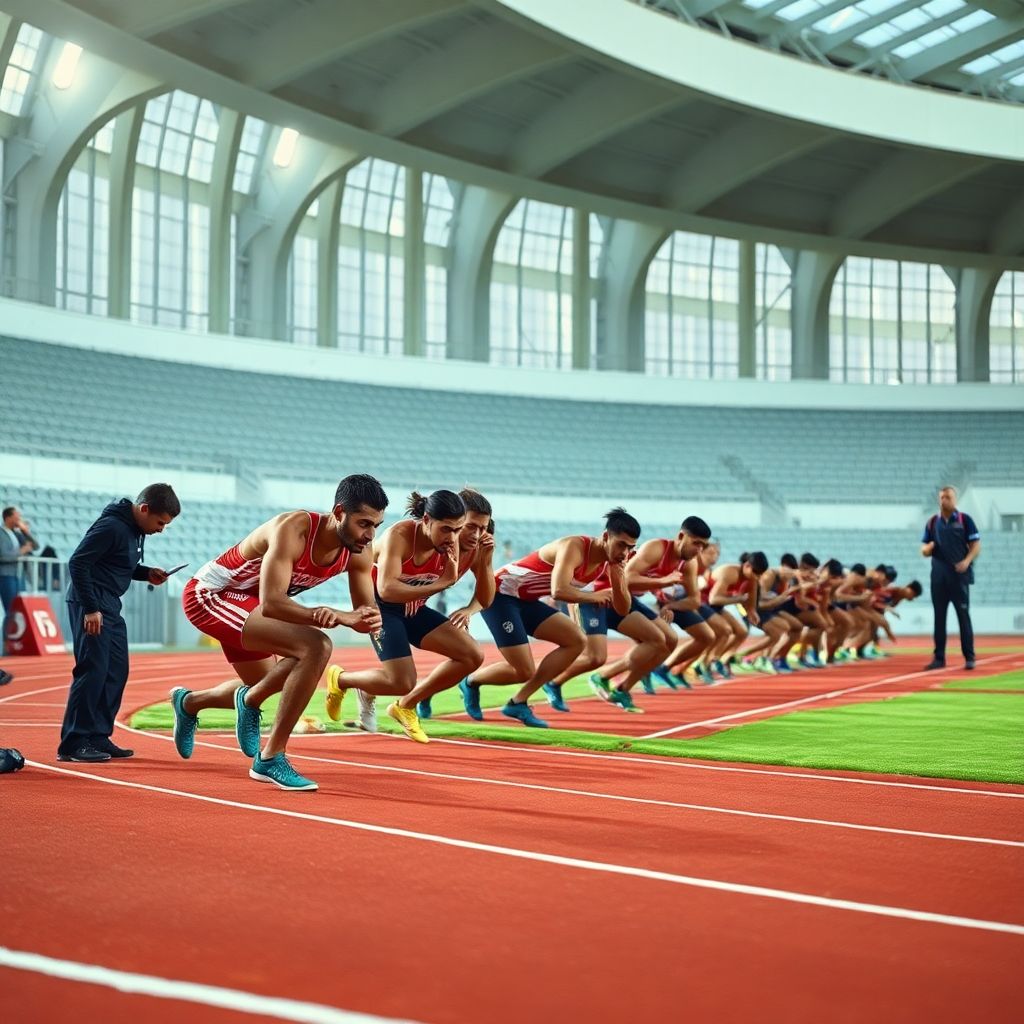
Elite Turkish sprinters are faster because they combine advantageous fast‑twitch muscle profiles, very specific sprint strength and power training, refined biomechanics, and disciplined recovery within structured long‑term development systems. When these pieces are supported by quality coaching, facilities and testing in Turkey, athletes consistently generate higher force in less time and maintain speed under fatigue.
Core Mechanisms Behind Turkish Sprinting Success
- High proportion and efficient recruitment of fast‑twitch muscle fibres in the prime sprinting muscles (glutes, hamstrings, quadriceps).
- Well‑designed turkish sprint training program structures that blend acceleration, max‑velocity and speed‑endurance work.
- Biomechanically efficient stride: optimal stride length and frequency with short ground contact times.
- Powerful neuromuscular coordination allowing rapid force production in specific sprint angles.
- Recovery routines and load monitoring that prevent overtraining but keep speed qualities sharp.
- Data‑driven talent identification and progression systems used by clubs, academies and federations in Turkey.
Fast Practical Tips for Turkish Sprint Coaches and Sprinters
- Prioritise 3-5 high‑quality sprint sessions per week instead of many slow interval days; keep reps short and fast.
- Time every acceleration over 20-30 m; if times slow more than about 3-4%, stop that set.
- Use stiff, well‑fitted sprinting shoes for elite sprinters on the track; keep them for racing and key speed sessions only.
- Record simple video from the side at max speed: look for tall posture, relaxed shoulders and minimal vertical bounce.
- Schedule heavy lower‑body lifting (squats, pulls) at least 48 hours before major speed tests or races.
- For 100 m focus more on block work and first 40 m; for 200 m add extra curve running and speed‑endurance reps.
Muscle Physiology and Fiber Composition in Elite Sprinters
Muscle physiology in sprinting is mainly about how fast and how powerfully muscles can contract in very short time frames. Elite sprinters typically rely heavily on fast‑twitch (Type II) fibres, which can generate high force quickly but fatigue faster than slow‑twitch fibres used more in distance running.
In Turkish elite sprinters, the biggest power producers are the gluteus maximus, hamstrings (especially biceps femoris), quadriceps and calf muscles. These muscle groups not only need a high percentage of Type II fibres; they also must be trained to fire in the right sequence and at the right joint angles during each phase of the sprint.
Strength and conditioning in a modern turkish sprint training program aims to shift the functional profile of these muscles toward greater rate of force development. That includes heavy, low‑rep lifts to increase maximal strength and explosive lifts, jumps and sprints to teach muscles to apply that strength in milliseconds.
For coaches in Turkey, the key definition boundary is this: hypertrophy (muscle size) only helps if it supports faster force production without adding unnecessary mass that the athlete must carry down the track. Extra muscle that does not contribute to faster ground force application can actually reduce sprint performance.
Training Methodologies: From Ankara Tracks to International Podiums
Training methodology explains how Turkish coaches structure sessions and weeks so the physiology described above becomes real performance. Well‑designed systems in Ankara, Istanbul and other centres typically combine technical track work, gym sessions and recovery in carefully managed volumes.
- Acceleration development blocks – Short sprints (10-40 m) from blocks or various starts, focusing on body angle, powerful first steps and pushing mechanics. For 100 m this is a major weekly focus; for 200 m it is still crucial but balanced with more speed‑endurance.
- Max‑velocity training – Flying sprints (for example, 20 m build‑up + 20-30 m at top speed) to improve stride frequency and stiffness. Athletes aim for very short ground contact times, strong hip projection and relaxed upper bodies.
- Speed‑endurance sessions – Longer reps such as 80-150 m for 100 m sprinters and 120-250 m for 200 m specialists. The goal is to maintain high speed under fatigue, not just survive the distance. Recoveries are long enough to keep quality high.
- Strength and power training – 2-3 weekly gym sessions with squats, deadlifts or pulls, plus Olympic‑style lifts and jumps. The emphasis is on moving heavy and moderate loads fast, with clean technique, not on bodybuilding volume.
- Technical and mobility work – Drills, A/B skips, wall drills, hurdle mobility and core strengthening ensure positions are efficient and muscles have the range of motion to hit proper sprint angles without strain.
- Planning across the year – Turkish performance programs sequence these elements: more general strength and technique in early phases, increasing specificity and intensity as the national and international competition season approaches.
- Environment and coaching quality – Access to an elite sprint coach in turkey, modern tracks, and structured groups allows consistent feedback and progression, which is often the hidden reason behind steady performance gains.
Biomechanics: Stride Mechanics, Ground Contact Time and Force Production
Biomechanics in sprinting describes how the body moves and how forces are applied to the track. Two measurable variables are stride length and stride frequency; the fastest Turkish sprinters optimise both instead of chasing just “longer strides” or “faster legs” in isolation.
Ground contact time at top speed is extremely short, typically well under a tenth of a second for elite athletes. Within this window, the athlete must apply large vertical and horizontal forces through a stiff ankle and strong hip drive. Efficient mechanics minimise braking forces and convert more of each contact into forward speed.
Posture and limb positions are equally important. Elite athletes exhibit a tall, stable torso, slight forward lean in acceleration that transitions to upright at max speed, and a powerful but relaxed arm swing that balances leg action. Small changes in torso angle or foot placement can strongly affect force direction.
Common application scenarios for biomechanics knowledge in Turkey include:
- Block start optimisation – Adjusting block spacing and angles for 100 m sprinters in national finals to improve first 10 m times and reduce wasted vertical movement.
- Curve running for 200 m – Teaching athletes to maintain posture and foot placement on the bend, especially in indoor halls in Istanbul where lane radius is tight.
- Injury‑risk management – Using video analysis to detect over‑striding or excessive heel recovery that may overload hamstrings, then correcting through drills and strength exercises.
- Footwear selection – Choosing sprint spikes with appropriate plate stiffness and pin configuration for the specific Turkish track surface so force transfer is maximised without increasing injury risk.
- Performance testing – In collaboration with sports performance labs turkey sprint testing, measuring split times and contact characteristics to guide technique changes.
Mini‑scenario: in a regional meet, a young 100 m sprinter is consistently losing speed between 40-70 m. Video from the side shows excessive vertical bounce and long ground contacts. Coach cues a “quiet, fast foot” and more aggressive downward strike under the hip during several weeks of flying sprints. Measured 60 m time improves as contact times shorten and stride becomes more horizontal.
Neuromuscular Coordination and Sprint-Specific Power Development
Neuromuscular coordination is the nervous system’s ability to recruit the right muscles, in the right order, at the right intensity and speed for sprinting. Sprint‑specific power is the product of this coordination with strength: how much force can be delivered quickly in sprint‑relevant positions and angles.
Advantages of focused neuromuscular and power training
- Improves rate of force development so athletes can reach high speeds earlier in the race, especially vital for 60 m and 100 m events.
- Enhances inter‑muscular coordination (glute-hamstring-calf chain), reducing energy leaks and making each stride more efficient.
- Supports better stiffness of ankle and knee joints, which helps maintain very short ground contact times at max velocity.
- Allows 200 m specialists to maintain form and power in the final 50-80 m, where neuromuscular fatigue usually degrades mechanics.
Limitations and risks of neuromuscular and power approaches
- High‑intensity plyometrics and heavy explosive lifting impose significant stress; without progressive loading and good technique, injury risk rises.
- Too much power work with insufficient technical sprinting can create strong but poorly coordinated athletes who do not actually run faster.
- Young athletes in Turkey who chase weight‑room numbers too early may sacrifice long‑term speed potential by gaining non‑functional mass.
- Neuromuscular gains are highly specific; drills that do not mimic sprint joint angles and velocities transfer poorly to actual race performance.
Nutrition, Recovery and Load Monitoring for Sustained Speed
Speed is not only created on the track and in the gym; it is preserved by intelligent nutrition, recovery and load control. Many sprinters in Turkey undermine months of training by repeating the same misconceptions in these areas.
- Myth: “Sprinters do not need to worry about daily nutrition” – In reality, consistent protein and energy intake is essential to repair muscle damage from heavy strength and sprint sessions.
- Mistake: Training speed hard on back‑to‑back days year‑round – High‑intensity neural work needs spacing; stacking max‑velocity days without recovery leads to stagnation or injury.
- Myth: “More volume equals better conditioning for 200 m” – Adding many slow, long runs often dulls pure speed; 200 m success comes mostly from quality speed‑endurance at high intensities.
- Mistake: Ignoring simple sleep hygiene – Late‑night screen use and irregular sleep schedules blunt adaptation, even in otherwise well‑designed programs in Turkish clubs.
- Myth: “Only supplements or special drinks make the difference” – Basics like water, regular meals and timing carbs around training usually matter more than advanced products.
- Mistake: Never tracking load – Without at least basic logs of sessions, soreness and performance, coaches cannot adjust the turkish sprint training program before problems appear.
Talent Identification and Long-Term Athlete Development in Turkey
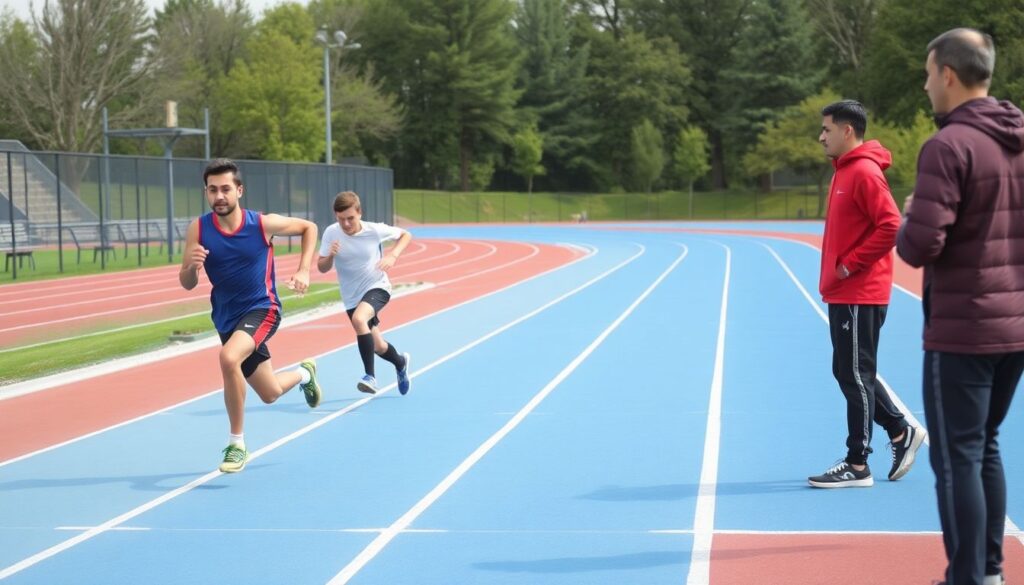
Long‑term success in Turkish sprinting depends on identifying promising young athletes early and guiding them through age‑appropriate stages. Rather than pushing for early peak times, effective systems in Turkey focus on layering technique, strength and competitive experience over many years.
Practical mini‑case: a regional club in Izmir scouts local school competitions and identifies a 13‑year‑old girl with outstanding acceleration over 30 m and good coordination in jumps. Instead of immediately loading her with maximal strength work, the club enrols her in one of the speed training camps in turkey during school holidays, where she practises basic sprint drills, bodyweight strength and short technical sprints.
Over the next seasons, an elite sprint coach in turkey progressively adds structured gym work, gradually increases yearly sprint volumes and introduces her to both 100 m and 200 m race environments. Periodic visits to sports performance labs turkey sprint testing help track changes in power and mechanics. By late teens, she has a resilient technical foundation, strong but not excessive musculature and clear race specialisation, rather than being burned out from early over‑competition.
Practical Clarifications for Coaches and Athletes
How should a weekly schedule differ for 100 m and 200 m Turkish sprinters?
Both need acceleration and max‑velocity sessions, but 200 m sprinters add more high‑intensity speed‑endurance and curve work. In practice, 100 m specialists may emphasise block starts and 30-60 m sprints, while 200 m athletes perform more 120-180 m reps at strong but controlled speeds.
How often should elite Turkish sprinters lift weights in season?
Most can maintain strength with 2 carefully planned gym sessions per week, focusing on quality rather than volume. These sessions are usually placed after lighter track days to avoid interfering with key speed workouts or competitions.
What basic metrics can a club without advanced technology track reliably?
Simple hand‑timed 30 m accelerations, 60 m sprints and key lifting numbers already give valuable information. Combined with notes on perceived effort and soreness, this allows a coach to see trends and adjust training loads.
Are general running shoes acceptable for serious sprint training?

For warm‑ups and some tempo runs, yes, but dedicated sprint spikes are strongly recommended for maximal speed sessions. Properly chosen sprinting shoes for elite sprinters improve force transfer and mechanics when used on appropriate track surfaces.
When should young Turkish athletes begin using sprint spikes and blocks?
Once basic coordination, strength and movement quality are present, usually in early to mid‑teens. Introduction should be gradual: short reps, clear technical cues and plenty of general drills to avoid overload.
Do Turkish sprinters need altitude or overseas camps to be competitive?
Not necessarily. Well‑run domestic camps with quality coaching, consistent speed work and good recovery can produce high‑level performances. International camps add value mainly through competition exposure and training variety, not magic conditions.
How can small clubs benefit from national‑level knowledge and resources?
They can study published federation materials, attend seminars, and seek partnerships with larger centres or universities. Periodic joint sessions or testing days help align local training with current best practices in Turkish sprinting.