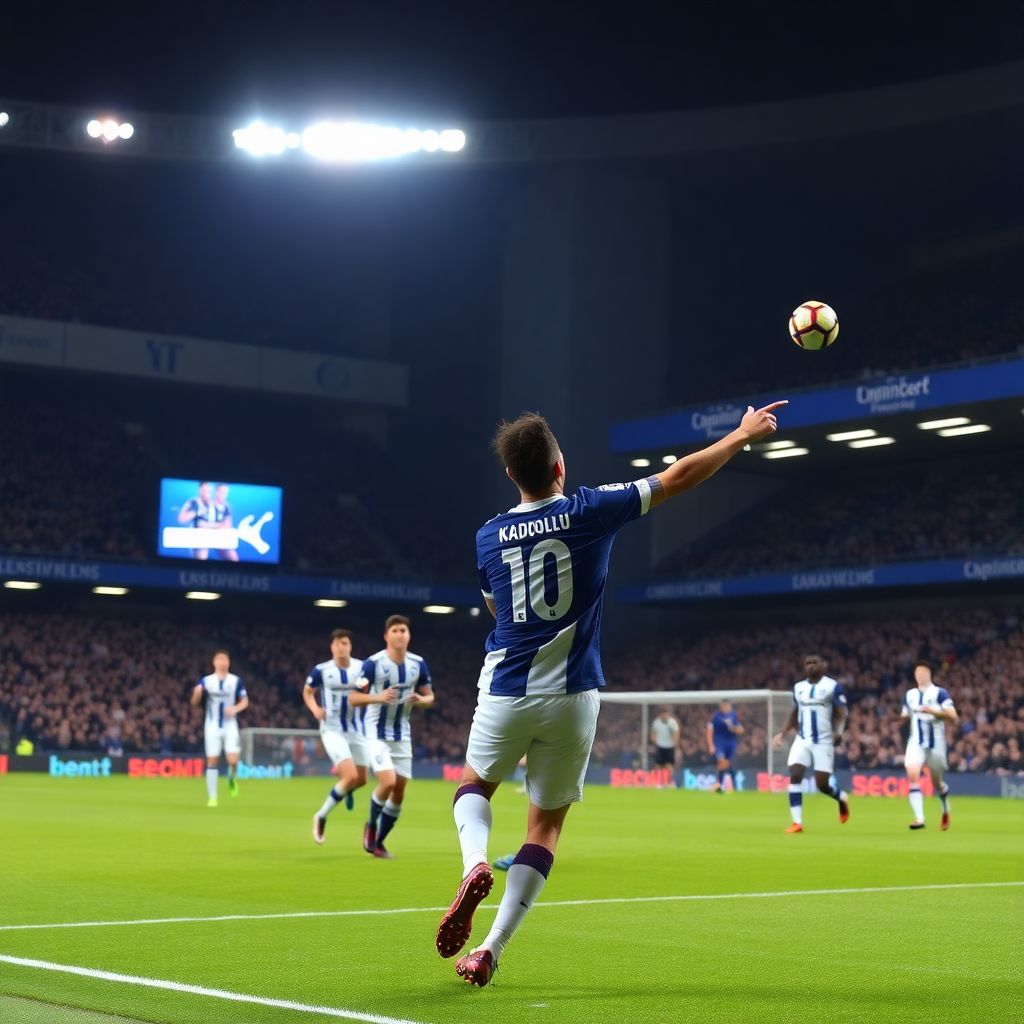
Ferdi Kadıoğlu strikes as ruthless Brighton dismantle Chelsea and plunge Rosenior into deeper turmoil
Brighton & Hove Albion took another decisive step toward European football with a commanding 3-1 win over a faltering Chelsea side on Wednesday night, a result that intensified the pressure on Blues boss Liam Rosenior and ultimately cost him his job.
At a rocking Amex Stadium, Turkish international Ferdi Kadıoğlu delivered the standout moment of the match, capping a complete performance with a stunning long‑range goal that symbolized the contrasting trajectories of the two clubs: Brighton rising with clarity and conviction, Chelsea sinking under confusion and underperformance.
Seagulls soar into top-four contention
The victory propelled Brighton firmly into the battle for a top‑four finish, placing them in an ideal position to secure European qualification. Fabian Hürzeler’s team, already praised this season for their high‑energy pressing and fluid positional play, again looked like a side fully aligned with their manager’s demands.
Chelsea, by stark contrast, remain stranded in mid‑table, their expensive squad failing to translate potential into performances. The defeat not only deepens doubts about the club’s short‑term prospects but also raises fundamental questions about recruitment, tactical identity, and the broader project that Rosenior had been entrusted to lead.
Kadıoğlu’s Premier League evolution
Since swapping Fenerbahçe for the Premier League, Kadıoğlu has quietly – and now emphatically – established himself as one of the division’s most complete wide players. Deployed primarily on the left flank against Chelsea, the 26‑year‑old was involved in almost every phase of Brighton’s play.
His goal, a thunderous 20‑yard drive that flew past a motionless goalkeeper, was his fifth of the league campaign. It encapsulated his growing confidence: receiving the ball in space, driving forward with purpose, and striking with conviction and precision. But to reduce his contribution to a single highlight would be to ignore the breadth of his influence.
Kadıoğlu repeatedly dropped deep to help initiate build‑up, tracked back relentlessly to stifle Chelsea’s rare attempts to break, and offered constant width in attack. His seamless transitions from defensive diligence to attacking aggression are exactly why he has earned the nickname “Swiss Army Knife” among Turkish supporters.
The backbone of Hürzeler’s system
Hürzeler’s tactical blueprint relies on players who can interpret multiple roles within a single match, and Kadıoğlu has become the prime example of that philosophy. At times he operated like a traditional left‑back, staying compact and helping to shut down Chelsea’s right‑sided attacks. At other times, he drifted into midfield pockets, acting almost as an auxiliary playmaker, linking with the central trio and switching the ball to the opposite flank.
Brighton’s high press, one of the most coordinated in the league, depends on wide players who know exactly when to jump, when to sit, and when to trigger a collective press. Kadıoğlu’s timing off the ball has visibly improved since his move from Turkey; against Chelsea, he repeatedly forced rushed clearances and misplaced passes, pinning the visitors deep in their own half.
This blend of tactical intelligence, work rate, and technical quality has turned him from a promising import into a cornerstone of Brighton’s ambitions.
Chelsea unravel under the spotlight
For Chelsea, the night was another addition to a growing catalogue of frustrations. Despite a squad assembled at enormous cost, the team once again looked disjointed – a collection of talented individuals rather than a coherent unit. Passing sequences broke down under moderate pressure, the midfield failed to control tempo, and the attack struggled to create clear‑cut chances.
The defeat was described inside the club as a “new low” under Rosenior, who was dismissed after the final whistle. The decision did not come as a surprise: results have been inconsistent, performances flat, and there has been little visible progress in solving recurring issues such as defensive frailty and a lack of creativity in the final third.
Brighton’s organization ruthlessly exposed those weaknesses. The hosts repeatedly exploited gaps between Chelsea’s lines, dragging defenders out of position and creating overloads on the flanks. When Chelsea tried to push higher, Brighton simply played through or around them, with Kadıoğlu frequently the outlet that turned defence into attack in a matter of seconds.
Rosenior’s project grinds to a halt
Rosenior’s appointment had initially been framed as the start of a modern, long‑term rebuild. His emphasis on structured possession and building from the back was meant to give Chelsea a clear identity after years of rapid managerial turnover. Yet, as the season progressed, the gap between theory and execution became increasingly visible.
In matches like this one, that gap turned into a chasm. The players appeared unsure when to press and when to drop off, and the distances between units were consistently wrong, giving Brighton generous space to exploit. The lack of a focal point in attack – and the absence of a reliable goalscorer in key moments – compounded the problem.
Rosenior’s dismissal after the Brighton defeat feels like the culmination of months of undercurrents rather than a reaction to a single match. The challenge now for Chelsea is less about finding the next coach and more about finally defining a coherent footballing direction that can survive more than one bad run of form.
Kadıoğlu’s numbers tell the story
From Kadıoğlu’s perspective, this game was yet another data point in a season that is fast becoming the best of his career. With 12 goal involvements across all competitions, he is not only matching but surpassing expectations that came with his move from Fenerbahçe to England.
Statistically, he has grown into a player who impacts both ends of the pitch:
– Goals and assists that consistently decide matches
– High volume of ball recoveries and interceptions in wide areas
– Progressive carries that break opposition lines
– A passing range that allows him to switch play and stretch defences
These qualities make him extremely difficult to game‑plan against. Opponents who try to pin him back defensively soon discover that he can escape pressure and launch counters; those who allow him space to attack are quickly punished by his crossing or shooting.
A pillar for Turkey’s 2026 World Cup ambitions
Kadıoğlu’s rise is being closely monitored in Turkey, where national team coach Vincenzo Montella is preparing for a demanding 2026 World Cup campaign. Drawn in a group with the USA, Australia, and Paraguay, Turkey will rely heavily on players who are both tactically adaptable and accustomed to high‑intensity football.
In that context, Kadıoğlu is invaluable. His ability to play as a full‑back, wing‑back, or advanced wide midfielder gives Montella the freedom to shift between back‑three and back‑four systems without disruptive substitutions. His improved decision‑making in one‑on‑one situations and his composure under pressure are precisely the qualities needed in tournament football, where margins are small and moments of individual clarity can decide entire group stages.
For Turkish fans, watching him dominate in one of the world’s toughest leagues is not just a source of pride; it is a reassuring sign that the national team will arrive at the World Cup with a genuine difference‑maker on the left side.
Brighton’s European dream gains credibility
While Chelsea return to London searching for answers, Brighton leave the encounter with reinforced belief that they can compete with – and beat – any side in the division. This is no longer a surprise package punching above its weight: under Hürzeler, Brighton have become an organized, brave, and tactically sophisticated team capable of controlling big games.
Champions League football, once a distant fantasy for the club, now feels like a realistic objective rather than a marketing slogan. Key to that dream is maintaining the form of players like Kadıoğlu, whose consistency in high‑pressure matches has turned him into one of the faces of this new Brighton era.
If he continues at this level, Brighton not only strengthen their case for a top‑four finish but also position themselves as a genuine long‑term force in English football – a club where emerging stars are not merely showcased, but developed into complete, elite‑level performers.
What comes next for Chelsea and Kadıoğlu
For Chelsea, the immediate future will revolve around appointing a new manager and stabilizing a dressing room that has gone through yet another jarring change. Any successor will inherit a talented, but imbalanced, squad and a fan base running out of patience with short‑term fixes. Whoever takes over will likely look at games like this one as a clear reference point for what needs to change: structure, discipline, and a defined playing style.
For Kadıoğlu and Brighton, the focus is more straightforward: maintain standards and embrace the pressure of a club now expected to win, not just compete. As the fixtures pile up and the season enters its decisive months, the challenge will be to sustain intensity without sacrificing freshness.
What is already clear is that Ferdi Kadıoğlu has stepped firmly into the spotlight. Once viewed as a versatile squad option, he is now a central figure in both Brighton’s European chase and Turkey’s World Cup ambitions. His strike against Chelsea was more than just a goal; it was a statement that his time among the game’s elite has truly begun.