
Video Assistant Referee (VAR) and related technologies use synchronized cameras, replay software and sensor-based systems to help match officials correct clear errors in key incidents such as goals, penalties and red cards. They also feed coaching analytics, broadcasting replays and betting data, reshaping how football is played, watched and commercially exploited.
Essential Impacts of VAR and Related Technologies on Contemporary Football
- Referee decisions on goals, penalties and red cards become more accurate and more transparent.
- Offside and goal-line calls shift from human perception to calibrated, frame-based and sensor-based judgments.
- Coaches adjust tactics, pressing and defensive lines to VAR-era interpretations of contact and offside.
- Broadcasters and digital platforms build richer live football streaming with VAR replay features.
- Data-driven markets, including sports betting platforms with advanced VAR statistics, evolve around stoppages and reviews.
- Clubs and stadiums invest in integrated football VAR technology systems for stadiums instead of isolated tools.
How VAR Operates: Protocols, Communication and Decision Pathways
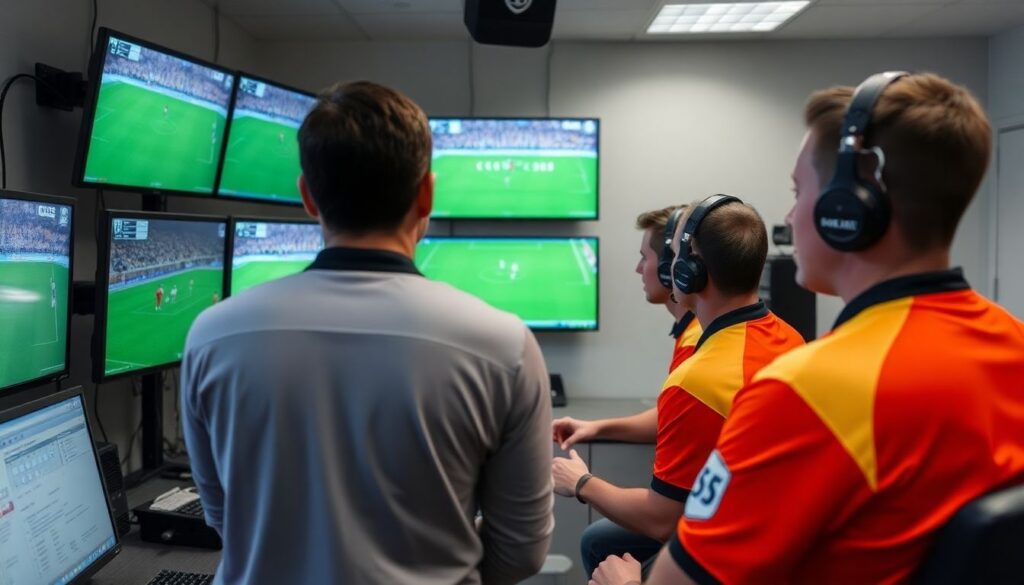
VAR is a match official team working off the pitch, using calibrated broadcast feeds and dedicated replay software to review specific categories of incidents: goal situations, penalty incidents, direct red cards and mistaken identity. They do not re-referee the game; they intervene only when there is a clear and obvious error or a serious missed incident.
The on-field referee remains the final decision-maker. The VAR recommends either a factual correction (for example, offside or ball in/out) based on camera evidence, or an on-field review where the referee watches pitch-side replays to reassess subjective judgments such as fouls or handball. Communication flows through a closed radio system with standardized phrases and confirmation loops.
In an elite Turkish league match example, a goal initially given was later overturned after VAR detected a tight offside using crosshair and line-drawing tools. The referee received the factual information and announced the decision without needing a pitch-side monitor review, illustrating the difference between factual and subjective checks.
Quick Practical Tips for Using VAR Outputs Effectively
- Clarify internally which incidents you will clip and review at half-time or full-time (penalties, red cards, offsides).
- For clubs evaluating best video assistant referee software for football clubs, demand seamless integration with your existing analysis platform.
- Ensure coaching staff understand VAR protocols so touchline reactions do not mislead players or fans.
- Design simple graphics or scripts so stadium screens explain outcomes clearly without revealing internal communications.
Operational Checklist for VAR Processes
- Define clear escalation paths from VAR to on-field referee for factual versus subjective incidents.
- Verify synchronization of all camera feeds and clock before kick-off.
- Standardize communication phrases for check in progress, review and final decision.
- Run post-match debriefs on at least all VAR interventions and silent checks.
Goal-Line Systems and Ball-Tracking: From Sensors to 3D Trajectories
Goal-line technology (GLT) determines whether the whole ball has crossed the goal line. Depending on the system, multiple high-speed cameras or magnetic fields around the goal track the ball. When the software confirms a goal, it sends an instant, encrypted signal to the referee’s watch or earpiece.
Ball-tracking for offsides and incident reconstruction uses multiple synchronized cameras to generate a 3D model of the pitch. Algorithms locate player body parts and the ball in each frame, build 3D trajectories and align them with a calibrated offside line. This allows VAR to freeze the exact frame of the pass and check offside more precisely than the naked eye.
In a high-level European match, a clearance on the line triggered a GLT alert, confirming a goal within a second, while a later offside decision required a longer 3D reconstruction by the VAR team. This contrast shows why GLT is almost instant while complex offside checks can take longer.
- GLT typically:
- Uses multiple high-speed cameras or goal-mounted sensors.
- Tracks the ball’s position in 3D space around the goal line.
- Compares ball coordinates to the goal plane and triggers a signal if fully crossed.
- Ball-tracking for offsides usually:
- Relies on calibrated cameras covering the full pitch.
- Generates 3D models of player positions and ball trajectory.
- Detects the exact kick-point using frame-by-frame analysis.
- Draws a virtual offside line perpendicular to the goal line.
Checklist for GLT and Ball-Tracking Reliability
- Confirm camera calibration at the start of each competition round and after any stadium changes.
- Ensure camera locations in football VAR technology systems for stadiums are protected from obstruction by banners or equipment.
- Align broadcast graphics strictly with the underlying tracking data to avoid misleading viewers.
- Regularly test alert devices (watches, buzzers) used by referees before kick-off.
Match Officials and Technology: Shifts in Roles, Accountability and Training
Technology reshapes how match officials work, not just in elite competitions but in domestic leagues across regions such as Türkiye. The referee team now includes the on-field referee, assistant referees, fourth official, VAR and at least one AVAR (assistant VAR). Each role has specific tasks during checks and reviews.
Typical application scenarios include: checking every goal for fouls, offsides and ball out of play; reviewing penalty awards or non-awards; assessing serious foul play or violent conduct; and correcting cases of mistaken identity in yellow or red cards. Technology also exposes decisions to more post-match scrutiny through replay archives and referee performance reports.
In a domestic cup match, a potential red card tackle was upgraded from yellow to red after the referee saw slow-motion and real-speed replays at the monitor. The formal process ensured that the final decision remained with the referee, while the VAR team provided the best available angles and playback speeds.
Checklist for Referee and VAR Team Preparedness
- Include technology modules in referee education: VAR protocol, offside calibration, communication discipline.
- Run joint simulations with full referee crews, using realistic match footage and time pressure.
- Define clear leadership inside the VAR room so final recommendations are coherent, not chaotic.
- Agree in advance on the preferred angles and speeds for each type of incident (serious foul, handball, offside).
Tactical and Strategic Consequences: Coaching, Player Behavior and Set Pieces
VAR and ball-tracking change how coaches design tactics and how players behave, especially in penalty areas and during set pieces. Defences often hold higher lines, trusting offside calibration to catch late runs, while attackers look for contact that meets the modern threshold for penalties observed on slow-motion replays.
Coaching staffs increasingly demand integrated football analytics and VAR integration services so they can study how referees interpret handball, grappling at corners and offside positioning. Over time, clubs adjust scouting profiles to favour players who can operate effectively in this data-rich and scrutiny-heavy environment.
For instance, a Turkish Super Lig side might alter corner routines after a series of VAR-reviewed penalties against them, reducing grappling and focusing on blocks that appear clearly legal on replay. Similarly, pressing strategies can adjust when teams notice that late tackles are far more likely to be upgraded to bookings or reds under replay.
Advantages of VAR-Era Tactical Adjustments
- Defensive lines can be braver, trusting calibrated offside decisions rather than relying solely on assistant referees.
- Set-piece routines can avoid obvious fouls, reducing penalty risk when replays are scrutinized.
- Coaches gain cleaner video data to analyze refereeing trends and adjust match plans accordingly.
- Players learn to control emotional reactions, knowing that dissent and simulation are easily reviewed.
Limitations and Risks for Teams and Players
- Over-focusing on refereeing trends can distract from core tactical and technical work.
- Players may exaggerate contact hoping for VAR penalties, creating disciplinary and reputation risks.
- Frequent stoppages for reviews can break pressing rhythm and momentum for high-tempo teams.
- Smaller clubs may struggle to access the same level of football analytics and VAR integration services as big clubs.
Checklist for Coaching Staff in the VAR Era
- Regularly review VAR incidents from your own matches and your league to spot clear patterns.
- Train defenders on body positioning in the box to avoid clear, replay-detectable fouls.
- Design set-piece routines that minimize shirt-pulling and holds that stand out on camera.
- Brief players pre-match on the specific VAR tendencies of that day’s refereeing crew.
Practical Constraints: Costs, Deployment Variability and Broadcast Integration
Technology roll-out is uneven. Top leagues and international tournaments operate full VAR setups with multiple camera angles, while lower divisions may not have the budget or infrastructure. This creates differences in how rules feel between competitions, even when the Laws of the Game are the same.
Common misconceptions include the idea that more cameras always guarantee perfect decisions, or that VAR can be copied cheaply without skilled technicians and rigorous testing. In reality, football VAR technology systems for stadiums require careful design: power redundancy, network stability, camera placement and integration with domestic broadcasters.
At the same time, modern broadcasting relies on VAR-related content: replays, offside lines, and sometimes live audio between officials. Streaming platforms build packages around this, combining live football streaming with VAR replay features and enriched timelines, but they must still respect local regulations on what can be aired.
Widespread Myths and Typical Implementation Pitfalls
- Myth: VAR eliminates all mistakes. Reality: it reduces clear errors but still depends on human judgment.
- Myth: any stadium can add VAR with a few cameras. Reality: robust infrastructure and specialist staff are essential.
- Myth: copying graphics from TV means you have full VAR. Reality: visuals must be linked to certified tracking and replay systems.
- Pitfall: ignoring coordination with broadcasters, leading to desynchronized replays and confusing fan experiences.
- Pitfall: underinvesting in training for operators and referees, even when hardware is high-end.
Checklist for Realistic Technology Planning
- Audit stadium infrastructure (power, cabling, camera positions) before choosing any VAR-related system.
- Engage broadcasters and league officials early to define shared standards and workflows.
- Separate must-have functions (GLT, offside) from nice-to-have features (graphical overlays, fan screens).
- Budget not only for hardware but also for long-term training and maintenance.
Evaluating Success: Metrics for Accuracy, Fairness and Match Flow
Assessing VAR and football technology means looking beyond single controversial incidents to overall patterns: are clear errors reduced, is disciplinary control improved, and does the game remain watchable? Leagues and clubs can track decision outcomes, review times and downstream effects on tactics and player behaviour.
Digital ecosystems also assess success differently. Broadcasters monitor viewer engagement when VAR replays are shown, while sports betting platforms with advanced VAR statistics analyze how stoppages and reversals affect in-play markets. Clubs track whether analytics derived from VAR feeds actually change performance and discipline over a season.
Imagine a league that logs every VAR intervention in a season: incident type, original decision, final decision, review duration and any subsequent disciplinary changes. Over time, they can compare matches with and without interventions, review whether correction patterns match expert panel evaluations and adjust protocols to keep review times reasonable while preserving fairness.
Checklist for Monitoring VAR and Technology Performance
- Define core indicators: number of clear error corrections, average review time, and distribution by incident type.
- Track how often VAR confirmations support referees versus overturns, and discuss trends in referee coaching.
- Review whether tactical or disciplinary patterns shift in ways consistent with fairer enforcement.
- Include feedback from broadcasters, clubs, players and supporters when revising protocols.
Implementation Self-Check for Clubs and Organizers
- Have you mapped how VAR decisions, GLT and ball-tracking feed into your coaching and analysis workflows?
- Do your selected or planned systems integrate cleanly with existing video, data and betting partners where relevant?
- Are referees, operators and analysts trained together, using realistic match simulations?
- Have you established transparent communication and replay policies for fans in the stadium and on broadcast platforms?
- Do you regularly review VAR and technology outcomes and refine procedures based on evidence, not headlines?
Common Practitioner Questions on Applying VAR and Football Technologies
How should a club choose between different VAR and replay platforms?
Start from your competition’s regulations, then evaluate compatibility with your analysis tools, stadium infrastructure and broadcasters. Look for best video assistant referee software for football clubs that offers robust logging, fast clip export and clear support for your league’s official VAR provider.
Can smaller stadiums implement partial VAR or only goal-line technology?
Yes, but only if allowed by competition rules. Some leagues approve goal-line only, while others require a full VAR package. Any partial setup must still meet minimum standards for camera quality, calibration and operator training.
How can broadcasters add value around VAR incidents without confusing viewers?
Use consistent on-screen language and graphics, clearly marking check in progress and decision. Synchronize replays with the referee’s timeline, and where permitted, show calibrated offside lines and key angles instead of speculative shots.
What is the best way for coaches to integrate VAR data into post-match analysis?
Tag every VAR check and intervention as specific events in your analysis software. Link these moments to tactical context, player behaviour and disciplinary outcomes, turning each incident into a clear teaching point for future training sessions.
Do VAR and tracking systems change how data is used in sports betting?
Yes, because the timing and nature of reviews affect in-play odds and market suspensions. Sports betting platforms with advanced VAR statistics model the likelihood and impact of reviews, but this sits outside sporting integrity frameworks and must comply with local regulation.
What services do clubs typically need beyond the core VAR installation?
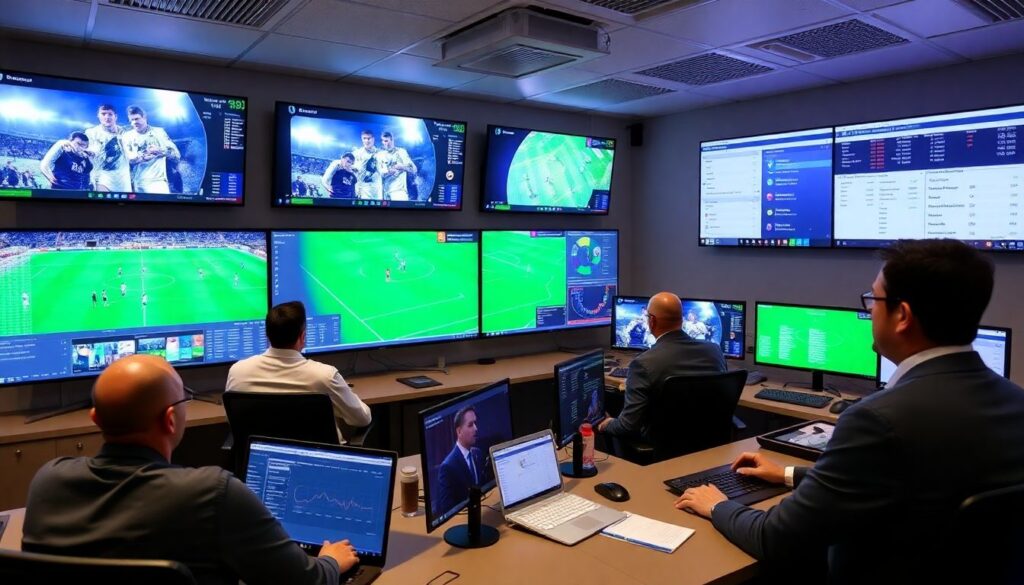
Clubs often need football analytics and VAR integration services that connect official feeds to internal scouting, performance and medical platforms. This may include custom data pipelines, tagging standards and training for analysts and media staff.
How can fan experience improve when VAR is introduced in a league?
Clear stadium announcements, concise replays on big screens where permitted, and consistent terminology help. Integrating VAR explanations into live football streaming with VAR replay features also reduces frustration for remote viewers.