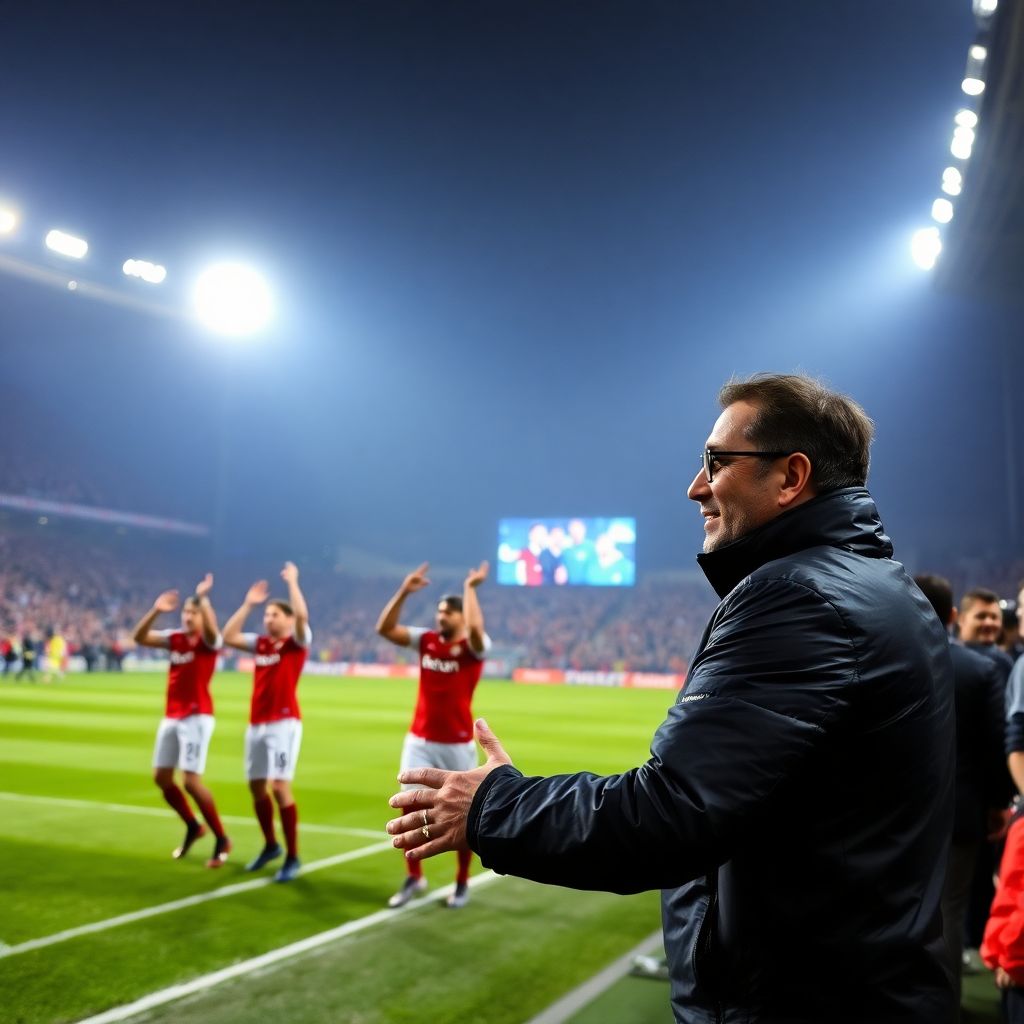
“Identity Reborn”: Pereira Ignites Instant Revolution as Nottingham Forest Conquer Istanbul
In the aftermath of a commanding 3-0 win over Fenerbahçe, the mood surrounding Nottingham Forest has flipped almost overnight. What just days ago felt like a club drifting without direction now looks and sounds like a team with a clear plan, renewed belief, and a manager who has wasted no time in imposing his ideas.
Only four days into Vítor Pereira’s tenure, Forest delivered a display in Istanbul that combined organisation, confidence and attacking expression. In one of the loudest and most hostile stadiums in Europe, the “Tricky Trees” played as if they had been working under the Portuguese coach for months, not days, hinting that a dormant giant may finally have been stirred.
Pereira’s First Statement Performance
Pereira’s side didn’t just win; they controlled the occasion. Forest were compact without the ball, ruthless in transition and courageous in possession, repeatedly carving open a Fenerbahçe team more accustomed to dictating the tempo at home.
After the match, a visibly energised Pereira highlighted the technical quality and mental bravery his players showed under pressure. He stressed that his message before kick-off was simple: trust your ability and express it. The players responded emphatically, not only scoring three but creating enough danger to suggest the scoreline could have been even more emphatic.
From the technical area, Pereira cut a figure of constant instruction but never panic. His team mirrored that composure, defending in numbers when needed, then springing forward with purpose. It was the kind of balanced, modern European performance Forest fans have long craved – pragmatic yet ambitious.
A Manager Focused on Minds as Much as Tactics
Since stepping into a club struggling for rhythm under the previous regime, Pereira has consistently underlined that his job is not purely about systems and formations. To him, the psychological reset is just as critical.
He has spoken of recognising the raw quality already in the squad, but also of sensing a group weighed down by frustration and inconsistent results. His early priority has been to restore enjoyment and clarity: if players relish the way they play, he argues, their level naturally rises. The Istanbul win was a public demonstration of that belief – an organised team, yes, but also one playing with freedom and conviction.
According to Pereira, structure and confidence are the twin pillars of his approach. Organisation gives players a safety net; belief allows them to take risks in the right moments. In Istanbul, Forest finally looked like a side that trusted both the plan and themselves.
The Captain’s Verdict: An Identity Rediscovered
No one embodied Forest’s renaissance more than captain Morgan Gibbs-White. With a goal, an assist and a tireless all-round display, he was the beating heart of everything positive his side produced.
Speaking after the final whistle, Gibbs-White focused less on his personal numbers and more on a bigger shift: Forest, he said, finally looked like a team that knew exactly who they were and how they wanted to play. He praised the side’s defensive resilience and abundance of attacking chances, pointing out that the score might easily have been higher.
For the captain, the clean sheet felt just as significant as the three goals. In recent weeks, Forest’s attacking promise had often been undermined by fragility at the back. In Istanbul, that narrative flipped: a solid defensive platform gave their creative talents the freedom to shine.
Gibbs-White also stressed that the job is only half done. The tie is not over, and the message from the new manager is clear: this is not a one-off performance, but the starting point for a sustained identity – a way of playing and defending that everyone in the squad has already bought into.
Tactical Clarity in Record Time
One of the most striking aspects of Forest’s performance was how quickly Pereira’s principles were visible on the pitch. The pressing triggers were coordinated rather than chaotic, the mid-block was compact, and the transitions from defence to attack had a clear pattern rather than relying on improvisation.
Off the ball, Forest stayed narrow, denying Fenerbahçe space between the lines and forcing them into crowded areas. On the ball, they switched play intelligently, stretching the hosts and isolating defenders in uncomfortable situations. Full-backs offered width, midfielders recycled possession with patience, and the front line combined fluid movement with relentless work rate.
This tactical discipline was especially impressive given the short preparation time. It suggests Pereira did not overwhelm his players with complexity; instead, he distilled his demands into a few clear, repeatable principles that instantly made the team more coherent.
Psychological Turning Point in a Hostile Arena
Winning 3-0 is impressive in any context, but doing it in Istanbul carries extra weight. Turkish stadiums are notorious for their intensity, and Fenerbahçe’s home ground is among the most intimidating in Europe. Many visiting sides crumble under the noise and emotional sway of the crowd. Forest did the opposite: they silenced it.
That experience could prove invaluable for a squad that has often looked fragile away from home. To go into such a cauldron, execute the game plan with calm authority, and emerge with a commanding advantage sends a powerful message internally. It tells the players they can trust not only their new manager but also themselves under extreme pressure.
For a club battling to stabilise in the Premier League and assert itself in Europe, such a psychological milestone may be as transformative as any tactical tweak.
A Squad Asked to Embrace Responsibility
Pereira has made it clear that he expects everyone in the dressing room to be ready to contribute. With a demanding run of fixtures ahead, he has warned that rotation will not be a luxury but a necessity. The performance in Istanbul therefore doubles as a challenge: those who played set the standard; those waiting for their chance must match it.
This approach shifts the internal culture away from a reliance on a fixed core of starters. Instead, the message is about collective responsibility: the badge comes before any individual, and each player must be mentally and physically prepared to step in without the level dropping.
For fringe players, this is an opportunity; for established names, a reminder that nobody is guaranteed a place. Competition, if managed well, can be a powerful driver of consistency.
A Defining Month on the Horizon
The timing of this European statement could hardly be more important. Forest now return to domestic duty with a high-stakes Premier League clash against Liverpool, followed by the second leg at the City Ground on February 26.
This run will test every aspect of Pereira’s early work: the physical conditioning of the squad, the adaptability of his tactics, and the mental resilience he is so eager to build. Facing one of England’s most relentless attacking sides and then protecting (or adding to) a European lead in front of their own fans will reveal how sustainable this “instant revolution” really is.
If Forest can carry the Istanbul intensity into their league fixtures, they may begin to climb the table as well as progress in Europe. If not, the Fenerbahçe win will risk being remembered as a remarkable night rather than a genuine turning point.
The City Ground Awaits a New Era
Back in Nottingham, anticipation is already building. Supporters have long wanted to see a team that not only fights but also plays with a clear identity – a side whose style is recognisable from week to week, regardless of the opponent.
The second leg against Fenerbahçe offers a chance for the City Ground to experience, firsthand, the tactical evolution glimpsed in Istanbul. A strong performance at home would further cement the belief that this is not a temporary surge of form, but the beginning of a sustained shift in culture and playing philosophy.
For a club steeped in European history, from its legendary nights of the past to its more turbulent recent years, the idea of re-establishing itself with a modern, confident, and tactically mature approach carries immense emotional weight.
What “Identity Restored” Really Means
When players and coaches talk about “identity,” it can sound abstract. In Forest’s case under Pereira, it is already taking concrete form. It means a team that defends collectively, presses with purpose rather than panic, and attacks with structure rather than relying on moments of individual brilliance alone.
It means midfielders comfortable receiving under pressure, defenders willing to step into space rather than simply clearing their lines, and forwards combining hard work off the ball with decisive actions in the final third. It also means a shared understanding of how Forest react when they concede, when they lead, and when the momentum swings.
The Istanbul performance suggested that, for the first time in a while, Forest players are not just reacting to events on the pitch – they are actively shaping them according to a plan.
From Instant Impact to Lasting Change
One outstanding performance does not guarantee a transformation, and Pereira himself has been quick to say that this is only “half-time” in more ways than one. The tie remains open, the schedule is unforgiving, and opponents will quickly study Forest’s new patterns.
The real test is whether the standards set in Istanbul become the baseline rather than the exception. That will require constant reinforcement of principles on the training ground, smart rotation to manage fatigue, and continued psychological work to keep the group united when results inevitably fluctuate.
Yet, if this is how Nottingham Forest look after four days under Vítor Pereira, it is difficult to avoid the feeling that something significant has shifted. The identity that seemed blurred and uncertain only a week ago now appears sharper, more confident and unmistakably modern.
For the players, it is a chance to redefine their careers. For the fans, it is a glimpse of a future where European nights and high-level performances are not romantic memories but a lived, regular reality. And for Pereira, Istanbul may be remembered as the night he didn’t just start a new job – he launched a new era.