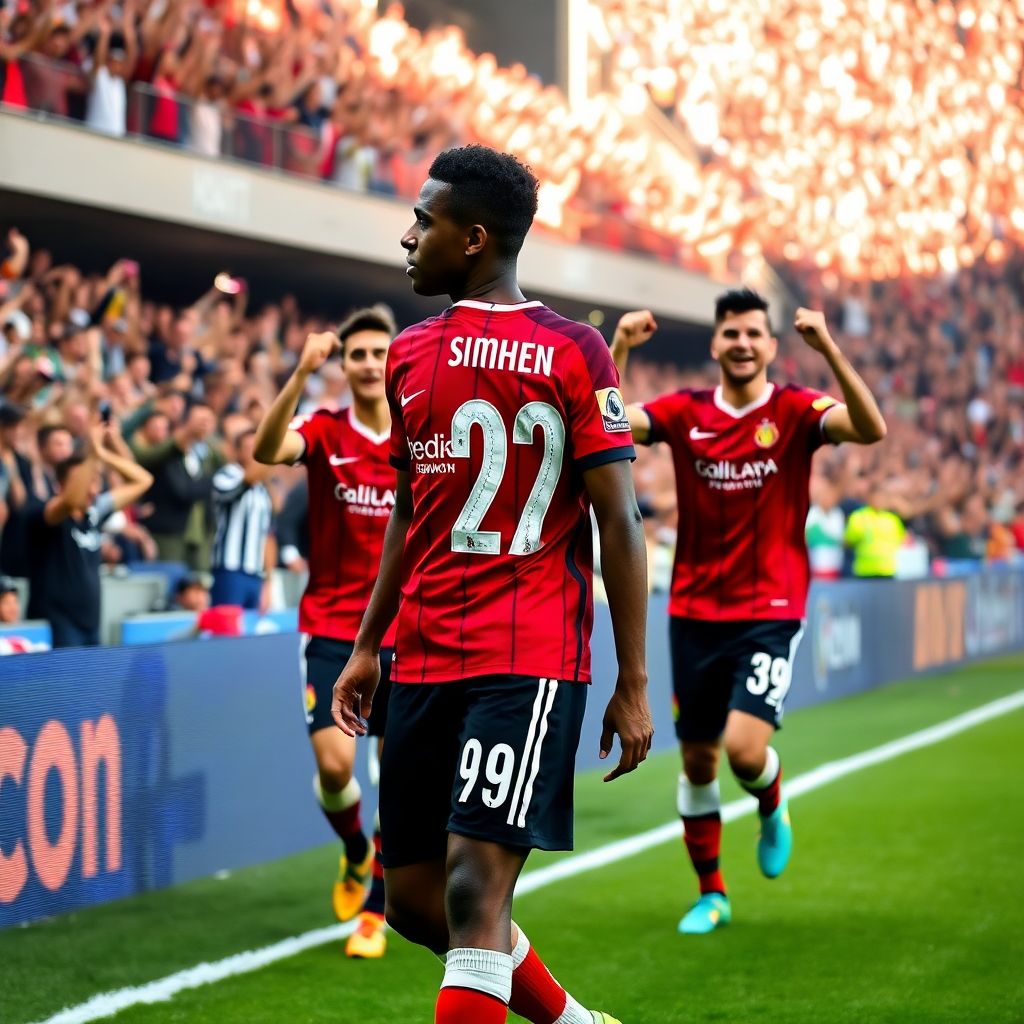
Respect over Rapture: Why Victor Osimhen Stayed Silent After Scoring Against Juventus
Even deciding a Champions League knockout tie with a crucial goal could not draw a celebration from Victor Osimhen. On a tense night at the Allianz Stadium, the Galatasaray striker finally broke Juventus’ resistance, yet his response was a quiet, almost expressionless walk back to the centre circle. While the away end erupted and his teammates swarmed him, Osimhen’s face told a very different story.
Minutes later, when Baris Yilmaz added a late goal to kill off the contest, the contrast was stark. Yilmaz sprinted to the corner flag, roaring with joy, drenched in the emotion of a famous European victory. Osimhen, by comparison, remained subdued – a man who had done his job but refused to revel in it. For many watching, the question was simple: why?
A Surreal Night in Turin
The context made the scene even more dramatic. Galatasaray arrived in Turin with what looked like a near-insurmountable advantage, having dismantled Juventus 5-2 in Istanbul. A three-goal cushion in Europe usually signals a formality, but Juventus – and Luciano Spalletti in particular – had other ideas.
The Italians responded with a furious comeback, scoring three unanswered goals to level the tie 5-5 on aggregate. The Allianz roared back to life, and suddenly the Turkish champions were clinging on, not cruising.
To make matters worse for Juventus, they had to chase the game with ten men after Lloyd Kelly’s much-debated red card early in the second half. Even with the numerical disadvantage, Spalletti’s side refused to wilt. They dragged the match into extra time and forced Galatasaray to confront their own fragility.
Only in those added thirty minutes did the difference in energy and depth finally tell. Osimhen produced the decisive goal, clinically beating Mattia Perin to restore Galatasaray’s aggregate lead, before Yilmaz’s strike put the tie beyond doubt at 7-5. The job was done. The scoreboard said triumph. Osimhen’s reaction said something else.
“I Didn’t Need To”: A Goal Scored, A Celebration Denied
Speaking after the game, Osimhen made clear that his lack of emotion was no accident. It was a deliberate choice grounded in loyalty and self-criticism rather than in anger or indifference.
When asked why he had refused to celebrate, the Nigerian forward kept it simple: he did not feel the need. He pointed first to his respect for the opposing coach, Luciano Spalletti, describing him as someone he greatly admired and crediting him with a vital role in his development.
His second reason cut even deeper: he believed Galatasaray had underperformed. Despite playing with an extra man for a large spell, he felt the team’s display was unworthy of genuine jubilation. Advancing, yes; satisfied, no. Osimhen underlined that he is not the type of player to disguise his emotions merely because the result went in his favour.
The Napoli Bond That Never Quite Faded
Osimhen’s deference toward Spalletti is not some casual, post-match platitude. Their connection is rooted in one of the most important chapters of his career. At Napoli, player and coach combined to deliver a historic Scudetto in 2023, ending a decades-long wait for the club and transforming Osimhen into one of Europe’s most feared strikers.
Under Spalletti’s guidance, Osimhen refined his movement, his finishing, and his understanding of the game. The coach trusted him as the focal point of the attack and built a system that allowed his physicality and instincts to flourish. For a player who had battled injuries and inconsistency earlier in his career, that season represented both vindication and validation.
Yet success was followed by turbulence. Spalletti’s departure from Napoli marked the beginning of a gradual breakdown in Osimhen’s relationship with the club. Disagreements, off-pitch tensions, and shifting ambitions eventually pushed him toward a new chapter in Istanbul, where Galatasaray made him their attacking centrepiece in September 2024.
So when Osimhen looked across at the Juventus dugout and saw his former mentor, he was not just facing another opponent. He was looking at the man who had helped him reach the peak of his profession. Respect, in that moment, mattered more than a theatrical celebration.
Between Gratitude and Competition
Osimhen’s muted response encapsulates a modern football paradox: how do players balance the demands of fierce competition with the personal bonds that shape their careers? On the one hand, he is paid to score goals, to eliminate opponents, to push his current club as far as possible. On the other hand, the people standing in his way often include those who believed in him when others did not.
By choosing not to celebrate, Osimhen sent a quiet message that football is more than tribalism and rivalry. He showed that you can compete ruthlessly for ninety minutes yet still acknowledge the role others have played in your journey. The goal hurt Spalletti and Juventus; that was unavoidable. Adding a provocative celebration on top, in his mind, was not.
This was not a case of divided loyalty. There was no question that Osimhen wanted Galatasaray to go through. Instead, it was a subtle act of professional courtesy – a way of saying: “I have to do this, but I don’t have to enjoy hurting you publicly.”
A Harsh Self-Assessment Behind the Silence
There was another layer to his reaction: dissatisfaction with his own team’s display. Osimhen did not hide behind the aggregate scoreline. He called the performance weak, particularly in light of Juventus playing with ten men. That honesty suggests a squad – or at least a striker – thinking beyond the immediate euphoria of qualification.
From a top-level athlete’s perspective, scraping through a tie that should have been comfortable can feel more like a warning than a triumph. For Galatasaray, conceding three goals to a side with a numerical disadvantage raises tactical and mental alarms. For Osimhen, used to competing at the sharp end of European football, it was a reminder that such lapses will be punished more severely as the competition intensifies.
His refusal to celebrate, then, was partly a reflection of standards. Advancement alone was not enough. The way in which they advanced mattered just as much. It is the mindset of a player thinking about quarter-finals and semi-finals, not just tonight’s scoreboard.
The Psychology of Not Celebrating
In modern football, a goal celebration is more than a spontaneous reaction; it is also a performance. Players know they are on a global stage. Cameras, social media, and future narratives are all shaped in those few seconds after the ball hits the net. Choosing not to celebrate is therefore a powerful communicative act.
Osimhen’s silence carried multiple messages at once: gratitude to a former coach, criticism of his team’s level, and perhaps even an internal reminder to himself that he expects more. For younger players and fans, it offers a different model of what it means to be competitive. Intensity does not always require theatrics. Sometimes, restraint says more.
This kind of reaction also underscores how emotionally complex elite sport can be. From the outside, a winning goal in the Champions League looks like a pure high. From the inside, it can be mingled with nostalgia, discomfort, or frustration about the path taken to victory.
What It Means for Galatasaray Going Forward
For Galatasaray, Osimhen’s attitude could prove invaluable as the tournament progresses. A dressing room shaped by such high standards is less likely to be lulled into complacency by flattering results. Teammates see their star striker, the man who effectively carried them through a nerve-shredding night in Turin, refusing to bask in personal glory. The implicit challenge is clear: if he is not satisfied, why should they be?
Coaches often talk about wanting leaders who demand more when the team is winning, not just when it is losing. Osimhen’s reaction fits that mould. It signals ambition beyond a single round, a belief that Galatasaray should not merely be participants at this stage of the Champions League but serious contenders.
At the same time, his respect for Spalletti projects an image of maturity that reflects well on the club. They are represented by a player who understands history, loyalty, and nuance – someone who can separate the competitive from the personal without compromising either.
A Night of Victory, Marked by Complexity
On paper, the story from Turin is straightforward: Galatasaray survived a scare, edged past Juventus in a 7-5 thriller on aggregate, and booked their place in the next phase of Europe’s premier competition. But football is never just numbers on a page.
For Victor Osimhen, this was not simply a triumphant night. It was a collision of past and present: the coach who helped make him, the club that now depends on him, the performance that did not meet his own expectations, and the goal that decided it all. His uncelebrated strike encapsulated those tensions.
The victory stands and the bracket moves on, but the image that lingers is not of a knee slide or a choreographed dance. It is of a striker walking away from the scene of his own success, lost in thought – a reminder that behind every goal is a human story of respect, regret, ambition, and the complicated loyalties that define European football.