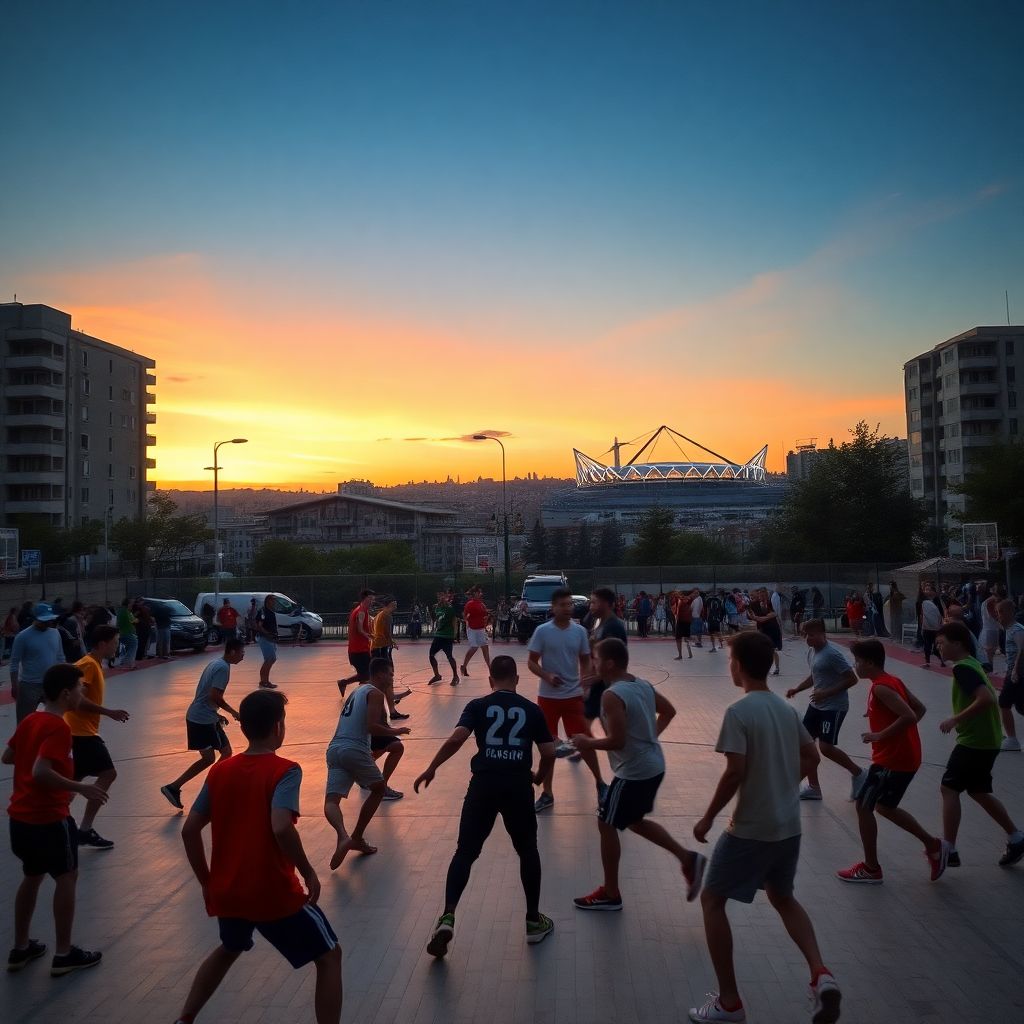
Urban basketball in Turkey is a living bridge between informal street hoops and professional basketball leagues in Turkey. It mixes neighborhood pride, improvised training, and highly competitive play on outdoor courts with structured development in clubs, basketball training academies in Turkey, and basketball camps in Turkey, creating diverse pathways with very different risks and access barriers.
Core themes in Turkey’s urban basketball culture
- Street courts in big cities like Istanbul, Ankara and Izmir act as free, always-on talent filters and social hubs.
- Informal peer coaching builds creativity and toughness but often lacks injury prevention and structured skill progression.
- Clubs, academies and camps offer organization, scouting visibility and safer workloads but can be expensive or selective.
- Social media, music and fashion turn local courts into stages, amplifying both opportunities and performance pressure.
- Infrastructure gaps and municipal policy heavily shape where the best places to play basketball in Turkey actually exist.
- Economic inequality strongly influences who can move from street hoops into semi-pro and professional pathways.
Roots and evolution: how street hoops grew in Turkish cities
Urban basketball in Turkey is best understood as a layered ecosystem: open neighborhood courts, semi-organized street tournaments, club youth systems, and finally professional basketball leagues in Turkey. Each layer has its own rules, gatekeepers and unwritten codes, but players constantly move between them.
From the 1990s onward, rapid urbanization and apartment-block construction created small leftover spaces in districts like Kadıköy, Beşiktaş, Bakırköy, Çankaya and Karşıyaka. Many of these turned into asphalt courts or simple hoops on schoolyards. These street basketball courts in Istanbul and other cities gave teenagers a cheap, unsupervised place to compete for hours.
At the same time, clubs such as Anadolu Efes, Fenerbahçe and Karşıyaka began investing more in youth systems and later in private basketball training academies in Turkey, which formalized paths from playground to professional. Urban hoops culture and federation structures started to interact instead of living in separate worlds.
Today, you can see three overlapping environments:
- Pure street hoops – pickup games, 3×3, and local night runs on public courts, usually with flexible rules and mixed age levels.
- Hybrid playground-club – kids train in clubs but test themselves on outdoor courts against older, tougher players.
- Organized development – club programs, academies and basketball camps in Turkey offering full schedules, strength work and clear competition calendars.
Conceptually, the key boundary is between open access (anyone can show up and play) and managed progression (selection, fees, and structured coaching). In practice, many successful Turkish players have used both: they learned resilience and creativity outside, then refined tactics and consistency in club or academy settings.
Neighborhood courts as social ecosystems and talent incubators
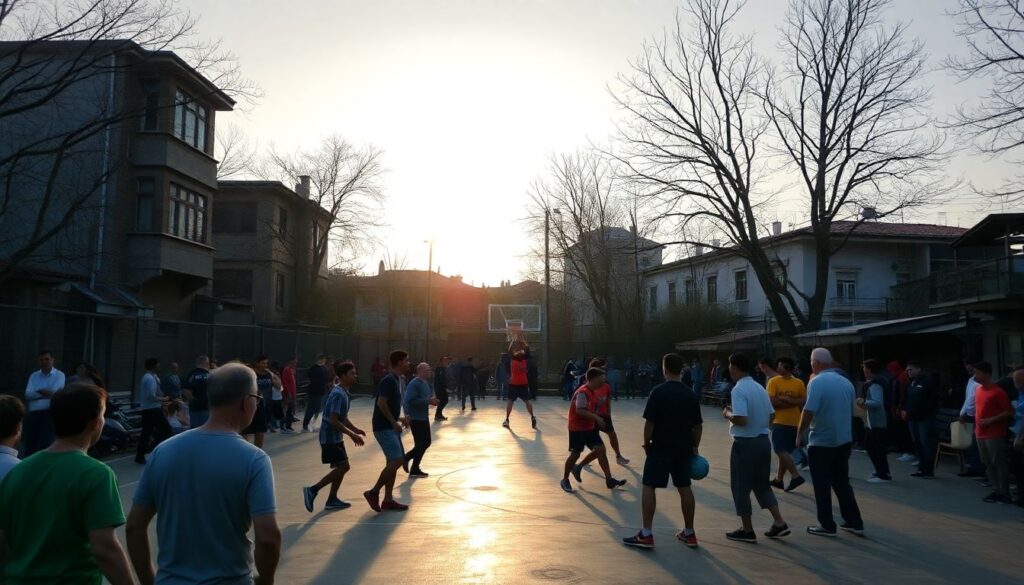
Neighborhood courts in Istanbul, Ankara, Izmir, Bursa and other cities operate as complex social systems that filter, shape and showcase talent long before any scout appears. Their mechanics are informal but remarkably consistent across districts.
- Self-organized hierarchy – Stronger players control who gets next, which side you play on, and how long you stay on the court. Reputation is based on winning, toughness and reliability, not on formal ranking systems.
- Continuous competition – On popular street basketball courts in Istanbul, for instance in densely populated districts, 3×3 or 4×4 runs can cycle every 10-15 minutes. This gives players many short, intense games with high stakes: lose and you sit.
- Role experimentation – Without coaches fixing positions, players freely test themselves as primary ball handlers, shooters or defenders. Tall players may learn guard skills, and shorter players develop advanced finishing just to survive among older opponents.
- Peer-enforced standards – Fouls, travels and unsportsmanlike behavior are policed by the group. Arguments are settled quickly because everyone wants to keep the run going; repeat offenders simply stop getting invited.
- Local mentoring – Older players informally coach younger ones, showing footwork, explaining late-game decisions, or introducing them to club coaches and basketball training academies in Turkey when they see real potential.
- Social glue – Courts connect kids from different schools, neighborhoods and income levels. Friendships, small rivalries and even future business relationships start here, making the court a de facto community center.
Implementation-wise, municipalities and NGOs that want to support grassroots development can:
- Maintain lighting and safe surfaces so evening runs remain active and inclusive.
- Schedule occasional free coaching days on busy courts, without taking away the court’s informal character.
- Post clear, simple codes of conduct near the courts to support peer-enforced fairness and safety.
Example scenario: a 13-year-old in Ümraniye starts by rebounding for older players. Within months, he gets occasional minutes in 3×3 runs, learns tougher finishes, then one older player takes him to a local club tryout. The court has functioned as both a filter and a recommendation system.
Playing language: common moves, training habits and peer coaching
The “language” of urban basketball in Turkey shows up in specific moves, routines and teaching methods developed outside formal structures. Understanding typical scenarios helps coaches and organizers connect with players and upgrade their habits instead of fighting them.
Scenario 1: Night runs with improvised skill work
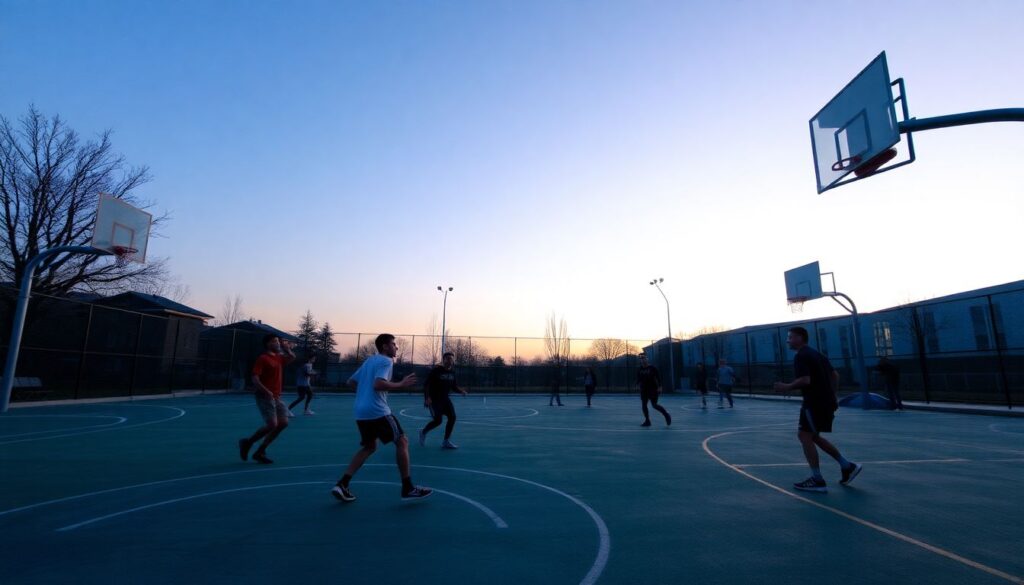
On outdoor courts in districts like Beşiktaş or Karşıyaka, players often arrive an hour early to shoot, dribble and play 1-on-1 before full games begin. They copy EuroLeague and NBA moves from YouTube: step-backs, side-steps, punch dribbles. This builds creativity but often ignores balance, shot selection and conditioning.
Scenario 2: Schoolyard lunch-break tournaments
In many public and private schools, informal tournaments during lunch or after class function as early “leagues.” Rules are simplified, games are short, and players rarely warm up. Kids learn competitiveness and basic spacing, but bad footwork and landing habits may become ingrained.
Scenario 3: Peer-coached micro-groups
A slightly older or more advanced player becomes the “coach” for 3-4 younger ones on the same neighborhood court. He runs cone drills, close-out exercises or finishing lines he has seen in club practice or basketball camps in Turkey. Quality varies, but motivation is high because of social closeness.
Scenario 4: Mixed-level weekend games in top public spots
Some of the best places to play basketball in Turkey are central coastal or park courts where semi-pros, ex-players and serious amateurs mix. Younger players learn physicality, screening angles and defensive communication just by trying to survive on the floor with them.
Scenario 5: Online move-sharing and challenge culture
Players film dunks, crossovers and trick shots for Instagram, TikTok and YouTube. They compete via “challenges” – who can hit more deep threes or more creative layups. This raises skill ceiling and engagement but can push risky landings and excessive volume without understanding load management.
To convert this playing language into safer, more efficient development, coaches and city programs can:
- Introduce simple warm-up and landing routines that fit into existing pick-up culture, taking only a few minutes.
- Use popular online clips as teaching material, breaking down decision-making and biomechanics rather than only aesthetics.
- Encourage peer mentors to focus on 2-3 fundamental cues (stance, balance, safe contact) while allowing creative moves to flourish.
Bridges to pro: scouts, academies, summer leagues and informal pathways
Moving from urban courts into semi-pro or professional basketball leagues in Turkey typically happens through four overlapping approaches, each with different convenience and risk levels. Comparing them helps players, parents and organizers design realistic and safer routes.
| Pathway | Convenience & access | Main risks & limitations |
|---|---|---|
| Street-scout route | Free, close to home; no registration; flexible schedule. | Depends on luck and visibility; no guaranteed load management or medical support. |
| Club youth systems | Regular training, official games, exposure to federation scouts. | Selection barriers; possible early specialization; travel and fee burdens. |
| Basketball training academies in Turkey | Individualized skill work; networked coaches and scouts; often year-round. | Cost; variable quality control; risk of overtraining without integration into competition. |
| Summer leagues & camps | Short, intense exposure; opportunity to impress many coaches at once. | High-intensity blocks; risk of injury or burnout; may favor already-identified talents. |
Upside profile of main approaches
- Street-scout route: Builds mental toughness, improvisation and “clutch” mentality. For players with limited financial resources, this is the most convenient first step and can still lead to contact with local club scouts who regularly check busy urban courts.
- Club youth systems: Provide periodized training, strength and conditioning, sports medicine and video analysis. They also connect players systematically to national competitions, improving tactical IQ and helping coaches benchmark them across regions.
- Basketball training academies in Turkey: Offer targeted skill upgrades (shooting mechanics, ball-handling, defensive footwork). They can fill gaps in club training and are especially helpful for late bloomers who need “catch-up” development.
- Summer leagues and basketball camps in Turkey: Concentrate competition and scouting in a short window, often including visiting coaches from abroad. They test how players perform under tournament pressure and unfamiliar systems.
Risk profile and constraints to manage
- Injury and overload: Players may combine street runs, club practice, academy sessions and school games without coordinated load management. Organizers should communicate and share basic weekly volume guidelines.
- Financial strain: Private academies and camps can stress family budgets. Scholarships, municipal subsidies and transparent fee structures reduce inequality in access.
- Early selection bias: Clubs and camps may focus only on early-maturing players. Coaches should track late developers and use objective metrics beyond current size and speed.
- Psychological burnout: Constant tryouts, social media pressure and unstable roles can drain motivation. Mentoring and realistic expectation-setting are essential parts of any pathway design.
A practical checklist for families navigating these options:
- Start with consistent play on safe neighborhood courts to test motivation and basic commitment.
- Join a local club team for structure and official competition once the player shows sustained interest.
- Add short academy blocks or camps to target specific weaknesses, not simply to accumulate certificates.
- Regularly review total time and cost spent versus clear development outcomes (skills, health, joy in the game).
Cultural vectors: music, fashion, social media and fan communities
Culture around the game can either support progression or distort it. In Turkish urban settings, hip-hop, Turkish rap, sneakers, jerseys and online fan culture strongly influence how players see themselves and their future. Several common mistakes and myths appear repeatedly.
- Myth: Style automatically equals substance – Young players may invest heavily in shoes and fashion but neglect sleep, nutrition and recovery. Coaches should reframe “looking like a pro” to include professional habits, not just gear.
- Myth: Viral highlights guarantee a contract – Social media clips from the best places to play basketball in Turkey can build recognition, but scouts still value consistency, decision-making and body language far more than one flashy crossover.
- Mistake: Imitating NBA spacing without context – Pickup games sometimes feature constant isolation and deep threes copied from NBA stars, without understanding FIBA rules, smaller courts, and different physical profiles. This can slow development of passing and team defense.
- Mistake: Disrespect for non-scoring roles – Culture often glorifies scorers. Urban players who naturally rebound, screen or defend may feel undervalued, even though Turkish clubs and pro teams constantly look for committed role players.
- Myth: “Real hoopers don’t need coaches” – Some talented street players view structure as limiting. In reality, urban creativity plus basic tactical discipline is what helps them succeed in higher-level leagues.
To harness culture instead of fighting it, programs can:
- Use music and street aesthetics in events and camps while keeping training content evidence-based.
- Highlight local role players and defenders as much as star scorers in social media storytelling.
- Partner with fan groups from professional basketball leagues in Turkey to mentor young players about realistic career paths.
Policy, infrastructure and economic barriers to professionalization
Urban basketball outcomes in Turkey depend heavily on decisions about land use, maintenance budgets and access pricing. Policy, not just talent, often determines which neighborhoods regularly produce club-level players and which do not.
Consider a simple mini-case:
A coastal park in Izmir has an old, cracked court with broken lights. It hosts occasional 3×3 games but remains underused after dark, especially by younger kids and girls. Meanwhile, a nearby private school runs a high-quality indoor gym that remains inaccessible to the wider community outside limited rental slots.
A municipality-club-school collaboration could follow a straightforward “pseudo-code” sequence:
identify_high_potential_courts()
  -> prioritize_safety_repairs()
  -> secure_basic_lighting()
  -> sign_shared_use_agreement_with_school_gym()
  -> schedule_free_open_hours_for_kids()
  -> add_low-cost_weekly_coaching_blocks()
  -> link_standout_players_to_local_clubs()
Compared with building new arenas, improving existing neighborhood courts is more convenient and less risky financially. However, typical barriers remain:
- Fragmented ownership – Courts may belong to different ministries, municipalities or private entities, slowing renovation and shared-use agreements.
- Unequal distribution – Wealthier districts may enjoy multiple quality facilities, while outer suburbs or smaller Anatolian cities rely on a single worn-out court.
- Hidden participation costs – Travel to distant gyms, equipment and club fees can quietly exclude lower-income families, even when technical “access” exists.
- Lack of monitoring – Many programs do not track usage patterns, injuries or dropout reasons, making it hard to adjust policy or funding priorities.
Policy-oriented recommendations:
- Map all urban courts and gyms and classify them by openness, safety and usage level to find real gaps.
- Adopt “open school gym” policies in off-hours where feasible, with minimal bureaucracy for neighborhood youths.
- Pair any new elite facility with mandatory grassroots access plans, ensuring pathways from playground to pro remain realistic, not symbolic.
Practical questions players, coaches and organizers ask
How can a player from a small neighborhood court get noticed by bigger clubs?
Compete regularly on busier courts or local tournaments where club coaches actually appear, then attend open tryouts or low-cost camps linked to those clubs. Consistency and coachability across several months say more than one spectacular game.
Are private academies always better than staying with a local club?
Not automatically. A solid local club with good coaching and regular official games can beat a flashy academy with weak structure. Use academies as a supplement for targeted skills, not a complete replacement unless the quality gap is clear and sustainable.
What is the safest way to combine street runs, club practice and school games?
Limit total high-intensity days to a few per week and protect at least one full rest day. Communicate schedules between coaches when possible, and reduce volume during exam periods or after injuries, even if players are eager to play everywhere.
Do social media highlight reels really help with recruitment?
They help scouts find and remember names but rarely decide selection alone. Reels should show game situations, defense and decision-making, not just trick shots. Attach basic information and club contact details to make follow-up easy.
Which are the best places to play basketball in Turkey for development, not just fun?
Look for courts or gyms that combine strong competition, safe surfaces, reliable lighting and some presence of coaches or older role models. Over time, places that regularly send players to club teams tend to be better development environments.
How can city officials support urban basketball without huge budgets?
Prioritize basic maintenance and lighting on existing courts, schedule regular cleaning and simple safety checks, and partner with local clubs or universities for free or low-cost coaching sessions. Visual codes of conduct and visible emergency contacts also improve safety at low cost.
What should parents watch for to avoid burnout and exploitation?
Monitor mood, school performance and sleep: if all drop while basketball volume rises, risk is high. Be skeptical of anyone promising guaranteed pro contracts, and always ask for written program details, refund policies and injury protocols.