
Turkish football evolved from rigid 4‑4‑2 blocks into flexible, high-pressing systems driven by better spacing, coordinated triggers and role redefinitions. Many teams still fail by copying shapes without coaching the details: distances, pressing cues, and rest-defense. Fixing these basics quickly upgrades intensity, stability and results in Turkish conditions.
Quick Tactical Corrections: Common Misconceptions About Turkish Systems
- Myth: Turkish football was always ultra-defensive; reality: it oscillated between direct, emotional football and compactness, not pure catenaccio.
- Myth: 4‑4‑2 blocks cannot press; reality: they can, if the front two and wingers are drilled in triggers and covers.
- Myth: Switching to a back three automatically modernises a team; reality: without pressing rules, it just adds confusion.
- Myth: High pressing is only for physically dominant squads; reality: synchronisation and spacing matter more than raw running power.
- Myth: Pressing equals constant sprinting; reality: it is about short, planned bursts from a compact structure.
- Myth: Analysis and data are “foreign luxuries”; reality: structured turkish football tactics analysis often exposes easy, low-cost fixes.
Myths vs Reality: Was Turkish Football Always Defensive
Labeling Turkish football as permanently defensive ignores long periods of high-tempo, end-to-end styles. Classic 4‑4‑2 in Turkey often meant deep lines and counter-attacks, but also brave, direct play with many players running ahead of the ball. The stereotype of permanent negativity hides this diversity.
In reality, the main constant was emotional, momentum-driven football rather than a consistent defensive or attacking identity. Coaches frequently adjusted between “block low and counter” and “play open and chase the game” based on pressure from media, boardrooms and fans, especially in the Süper Lig big clubs.
Modern pressing did not suddenly replace a purely defensive past; it organised the same energy into a repeatable structure. When you study any serious turkey super lig tactical analysis subscription or watch long-term trends, the shift is from individual initiative to coordinated collective movement, not from defense to attack.
For practitioners, the first quick correction is mental: stop framing your team as “defensive” or “attacking”, and instead define where and how you want to regain the ball. That change of language helps players understand pressing not as extra running, but as a shared plan.
Historical Foundations: The Rise and Fall of the 4-4-2 in Turkey
- Early adoption as a simple template: 4‑4‑2 spread because it was easy to diagram and explain: two banks of four with clear man-orientations, suitable for teams with limited preparation time and mixed tactical education.
- Compact mid-block as default: Many Turkish teams defended in a narrow mid-block, letting full-backs close wide areas late. The idea was to stay organised centrally and rely on last-ditch defending in the box.
- Direct wingers and target forward: Attacking patterns focused on early wide deliveries, second balls and the classic “big striker plus runner” partnership, with central midfielders more focused on duels than on progression or pressing traps.
- Pressing as chaos, not structure: Forwards pressed on emotion: a bad pass or home-crowd roar triggered a sprint, but the block behind them rarely moved together. This created huge vertical gaps and easy bypasses for calmer opponents.
- Exposure in European competition: Against better-structured teams, the static 4‑4‑2 block was pulled apart by rotations between lines and full-backs stepping into midfield, revealing how vulnerable pure man-orientations were.
- Gradual fall, not overnight collapse: 4‑4‑2 lost status when coaches saw that minor structural tweaks (dropping a forward to create a 4‑2‑3‑1 or 4‑4‑1‑1) instantly improved compactness and link-up play without sacrificing defensive stability.
- Coaching takeaway: The shape itself was never the main problem; the lack of common pressing language and distances was. Fix that first before chasing new formations.
Catalysts for Change: Coaches, Transfers and Continental Influence
The shift from classic 4‑4‑2 to modern pressing in Turkey was driven by a mix of imported ideas, foreign players raised in structured academies, and younger local coaches who studied abroad or took a modern pressing tactics in football course. Change came in waves, not as a single revolution.
- Foreign coaches with defined pressing models: Certain managers arrived with non-negotiable rules about distances, pressing triggers and rest-defense. Their teams looked “fitter” not because of magic conditioning, but because movement was coordinated instead of random.
- Players educated in pressing academies: Foreign signings used to structured pressing brought new habits: wingers tracking half-space runs, forwards cutting lanes not just chasing the ball, and midfielders scanning behind their backs before stepping out.
- European competition as a tactical classroom: Facing intense high presses forced Turkish teams to improve their own build-up and press-resistance. In turn, this demanded better spacing and role clarity, making old 4‑4‑2 habits look outdated.
- Analytics and specialised staff: Clubs started to invest in video and data staff, often inspired by football coaching books on tactical evolution. Simple metrics like pressing intensity in specific zones highlighted which players reacted late or broke the line’s cohesion.
- Media and fan education: As turkish football tactics analysis became more accessible online, tactical language entered mainstream TV and social media. Fans and board members started to ask “why don’t we press like that?” rather than only demanding more signings.
- Coaching takeaway: Use these external catalysts as leverage inside your own club: show players short clips from European games to demonstrate why your pressing rules matter, instead of presenting them as abstract theory.
Anatomy of the Transition: From Blocked Lines to Coordinated Press
Transitioning from a static block to a true pressing team is a 4‑4‑2 to modern pressing tactical transformation at the level of behaviours, not just board diagrams. The key is to redefine line relationships, especially the front two, wingers and double pivot, and to set clear reference points for when to jump and when to delay.
Advantages gained with coordinated pressing structures
- Ball recoveries in advanced zones: Regaining possession closer to the opponent’s box shortens the distance to goal and allows simpler attacking patterns for technically limited sides.
- Control of rhythm: Proper pressing lets Turkish teams dictate tempo, avoiding chaotic, end-to-end games that often punish defensive concentration lapses.
- Better protection of centre-backs: With a functioning first and second line of pressure, centre-backs face fewer direct runs and clear one‑v‑one duels in open space.
- Clear roles for squad players: Squad members who are not stars gain value if their pressing discipline and off-ball intelligence are recognised and rewarded.
- Improved training intensity: Training sessions based on pressing games naturally raise competitive standards and concentration, which carries into match days.
Constraints and risks when the press is poorly implemented
- Physical overload for key players: Poor staggering forces the same forwards and midfielders to sprint long distances repeatedly, leading to late-game fades and increased injury risk.
- Huge gaps between lines: If the back line does not step in sync with the front press, opponents can play through a large open midfield zone with simple vertical passes.
- Fouls and cards in dangerous areas: Late or solo pressing attempts cause reckless tackles from behind, especially against technically superior opponents who manipulate pressure.
- Loss of identity when under pressure: Teams that only “copied” pressing shapes without understanding can panic and retreat into a deep block after one bad result, confusing players.
- Scouting mismatch: Players signed for old 4‑4‑2 roles (pure poachers, static wingers) may struggle in modern tasks if staff don’t adapt profiles and individual development plans.
- Coaching takeaway: Introduce pressing rules step by step, and always synchronise the last line with the first. If your defenders don’t move, your press will always look fake.
Modern Frameworks: Hybrid Formations and Role Redefinitions
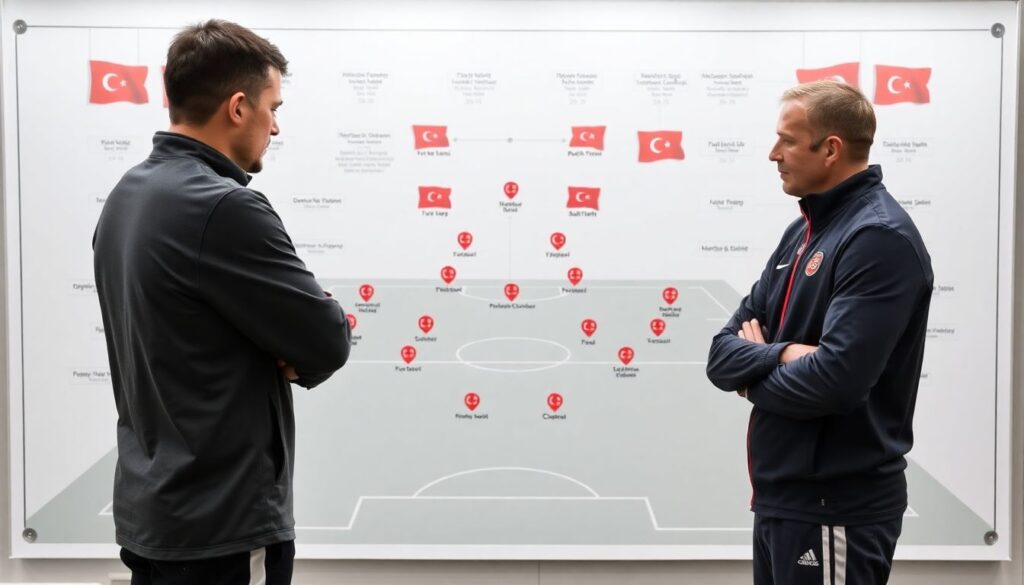
Modern Turkish teams started to adopt hybrid structures: 4‑2‑3‑1, 4‑1‑4‑1, 3‑4‑3 and 4‑3‑3 with asymmetries in wide areas. These shapes are tools to manage pressing angles and rest-defense. The real innovation lies in role redefinitions, not in fashionable numbers on graphics.
| Role | Classic 4‑4‑2 expectation | Modern pressing expectation |
|---|---|---|
| Striker | Score, press centre-backs individually | Screen pivots, press on triggers, coordinate with wingers |
| Winger | Stay wide, beat full-back, track opposition full-back late | Protect half-space, jump to full-back on cue, support counter-press |
| Central midfielder | Win duels, cover large areas individually | Control pressing height, manage distances, guide play to traps |
| Full-back | Defend 1v1, overlap when possible | Form back three in build-up or step inside, support rest-defense |
Several common misconceptions slow this evolution and create avoidable mistakes.
- Confusing back three with defensive mindset: Many think adding a third centre-back is only to “park the bus”. In reality, it often helps pressing by freeing a full-back to attack space or step into midfield with security behind.
- Assuming pressing must be all-field: High pressing is just one phase. Mid-press and situational low-press are crucial tools. Smart coaches in Turkey design multiple heights of pressure rather than one fixed approach.
- Ignoring rest-defense while attacking: Teams overload the last line in attack without leaving enough players to control counters. The quick fix is to always keep at least two players plus one midfielder connected behind the ball.
- Overloading theory, underloading repetition: Staff consume videos, attend a modern pressing tactics in football course, but run one pressing drill per week. Without daily repetition, players fall back into old chase-the-ball habits under fatigue.
- Copying elite-team shapes without context: Trying to imitate a Champions League side’s 3‑2‑5 build-up without their technical level leads to cheap turnovers. Adapt structures to your squad’s first touch, passing range and decision-making.
- Coaching takeaway: Define each role with and without the ball in one clear sentence, and check if every player can repeat it. Clarity destroys many myths.
Implementation Guide: Training Practices to Build a Sustainable Press
Moving from classic 4‑4‑2 habits to a modern pressing team is a process. Think of it as a practical, on-field 4‑4‑2 to modern pressing tactical transformation rather than an abstract theory. The most successful Turkish coaches created small, repeatable drills that encoded pressing rules into players’ instinctive decisions.
Stepwise training focus for quick improvements
- Week 1-2: Distances and compactness. Use 6v6+2 neutral players in a 40x30m rectangle. Award extra points for vertical passes between opposition lines. Defending team must stay within a marked “compactness zone” (e.g. max distance between first and last defender). This teaches units to move as one.
- Week 3-4: Pressing triggers. Introduce specific cues: backward pass to full-back, slow horizontal pass, bad body shape from centre-back. On these triggers, nearest forward presses ball, far-side forward cuts central lane, wingers close full-backs, and back line steps 5-7m higher.
- Week 5-6: Counter-press after loss. In 7v7+keepers, every time the attacking team loses the ball, they have three seconds to win it back. If they succeed, they get an extra “bonus attack”. This connects attacking risk with immediate defensive responsibility.
- Ongoing: Role-specific microdrills. Forwards work on curving runs to block passing lanes; wingers practice switching from wide press to half-space cover; pivots drill “check shoulder, then step” habits. Tie each drill to real match clips from your own games or from turkey super lig tactical analysis subscription services.
Mini-case: Correcting a broken front press in two weeks
A mid-table Süper Lig side struggled because their front two chased centre-backs alone while the midfield line stayed passive. Video-based turkish football tactics analysis showed 20-30m gaps and easy passes into unmarked pivots. The coach set a simple rule: “the second line must cross the halfway line within two seconds of the first line’s press.”
Training focused on 4v4+3 positional games where midfielders were punished (extra sprints, not shaming) if they reacted late to a pressing trigger. Within two matchweeks, distances shortened, turnovers moved 15-20m higher up the pitch, and the team conceded fewer direct entries into the central zone.
For coaches, players and analysts, combining targeted exercises with concepts derived from football coaching books on tactical evolution and structured video work is more powerful than copying elite shapes. The goal is not to look modern on a tactical board but to make pressing habits automatic under Turkish match pressure.
Practical Clarifications on Tactics, Roles and Transition Timelines
How long does it usually take to shift from classic 4-4-2 habits to a coordinated pressing style?
Assuming you train pressing behaviours several times per week, players typically show visible improvement within a few weeks, but full automaticity takes longer. The key is consistency: don’t change the rules every match, refine them instead.
Can smaller Turkish clubs with limited budgets realistically implement modern pressing?
Yes, because pressing depends more on clear rules and repetition than on star talent. Smaller clubs can gain an edge by defining a narrow game model, running simple, repeatable drills, and recruiting players with high concentration and willingness to work off the ball.
Is high pressing always better than a compact mid-block in the Süper Lig context?
No, the best approach depends on your squad profile and match context. Many teams use a mid-block as the default and apply high pressing selectively after set triggers, such as backwards passes or poor touches near the touchline.
What roles should I prioritise when recruiting for a pressing-focused team?
Prioritise centre-backs comfortable defending high space, central midfielders with scanning and communication skills, and forwards who accept defensive work as non-negotiable. Wide players who can protect the half-space are more valuable than pure dribblers.
How can analysts support coaches in building a pressing identity?
Analysts should provide clear clips and simple metrics rather than overwhelming reports. Track where and how the ball is recovered, which players react fastest to triggers, and how compact the team remains during pressing waves, then feed that back to training design.
Are online courses and books necessary to learn modern pressing, or is practice enough?
Practice is essential, but resources like a modern pressing tactics in football course or well-chosen coaching books accelerate understanding and provide vocabulary. The most effective coaches blend study with on-field experimentation rather than relying on one source.