Galatasaray to Sue After Lang’s Horrific Injury as Racism Controversy Mars Liverpool Win
A Champions League knockout tie that should have been remembered for footballing drama has instead spiralled into legal threats, medical emergencies and an ugly racism storm. Liverpool advanced to the quarter-finals with a 4-1 aggregate victory over Galatasaray, but events at Anfield have dragged UEFA, the English club and the Turkish champions into a heated debate over player safety and online abuse.
Noa Lang’s “sickening” injury sparks legal move
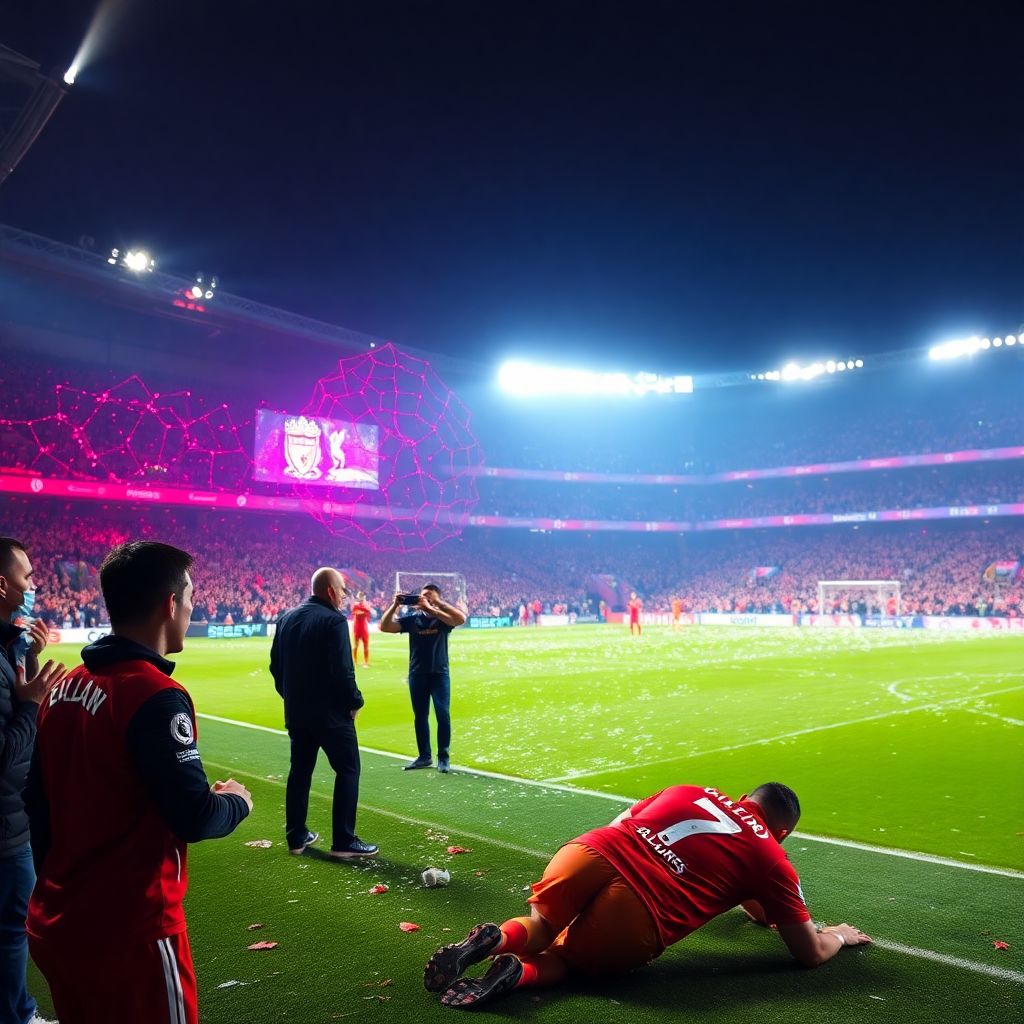
The flashpoint came when Galatasaray winger Noa Lang was involved in a freak accident with the LED advertising boards surrounding the pitch. During an attack down the flank, the 26‑year‑old lost his balance and crashed into pitch‑side hoardings, becoming entangled in the exposed structure.
Witnesses described the scene as “horrific.” Lang lay in visible distress as medical staff rushed to attend to him. He had to be given oxygen on the field before being stretchered away and transported to a Merseyside hospital. There, doctors performed emergency surgery on a deep, severe laceration to his thumb, raising serious questions about how such a basic safety risk was allowed to exist in a top‑level UEFA competition.
According to Galatasaray General Secretary Eray Yazgan, the club holds UEFA and, potentially, the stadium authorities responsible for what they regard as inadequate protection for players. He confirmed that Galatasaray is preparing to launch legal proceedings, arguing that the exposed edges and structure of the advertising boards constituted a clear hazard.
Galatasaray targets compensation and accountability
Galatasaray’s legal complaint is expected to focus on what the club terms “victimization” of their player. Beyond the immediate medical bills, the Turkish side is planning to seek compensation related to Lang’s salary and other financial obligations during his rehabilitation period. From their perspective, a key asset has been sidelined due to negligence in event organisation.
Club officials insist this is not just about one incident, but about setting a precedent. They argue that if advertising technology is to be integrated so closely with the playing area, then governing bodies must ensure strict safety standards to prevent sharp edges, gaps, or unstable structures that can cause injury in high‑speed collisions.
Behind the scenes, Galatasaray’s legal team is believed to be compiling medical reports, match footage and expert assessments on stadium infrastructure. The case could open a wider debate on whether current UEFA regulations around pitch‑side equipment are fit for purpose, especially given the increasing use of digital LED boards that are heavier, more rigid and more complex than traditional signage.
A tie overshadowed by trauma
The injury to Lang arrived on a night that was supposed to showcase elite European football. Liverpool, already in a strong position from the first leg, controlled much of the play and ultimately confirmed their passage to the last eight with a comfortable aggregate scoreline. Yet the football quickly became secondary.
Players from both sides appeared visibly shaken as Lang received treatment, with the game paused for several minutes. The incident disrupted the rhythm of the match and shifted attention from tactics and performances to player welfare and the responsibilities of organisers hosting high‑intensity fixtures.
For Galatasaray, the setback was more than just sporting. Lang is considered one of the key creative outlets in their attack, and his absence in upcoming domestic and continental fixtures is a significant blow. The club’s anger reflects not only concern for his health but also frustration at the sporting and financial implications of losing an important player in preventable circumstances.
The Osimhen-Konaté collision changes the contest
The game’s intensity had already been cranked up by another major incident: a first‑half collision between Liverpool defender Ibrahima Konaté and Galatasaray’s star striker Victor Osimhen. In a hard‑fought challenge, the Nigerian forward came off worse, suffering a broken arm that forced him to leave the match at halftime.
Osimhen’s withdrawal dramatically weakened Galatasaray’s threat in the final third. With their main striker sidelined, the Turkish side struggled to generate sustained pressure, and Liverpool exploited the situation to see out the tie in relative comfort. The injury effectively killed off any realistic chance of a dramatic comeback.
From a purely sporting angle, the collision could be viewed as an unfortunate but common consequence of high‑level football, where physical duels between defenders and forwards are constant. However, what followed the incident took the narrative into far darker territory.
Racist abuse directed at Konaté
In the aftermath of the challenge, Liverpool’s Ibrahima Konaté became the target of a torrent of racist comments across multiple social media platforms. While the tackle itself was part of normal play and went unpunished by the referee as anything beyond a standard challenge, the online reaction quickly turned toxic.
Liverpool responded with a strongly worded official statement condemning what they described as “dehumanizing” abuse directed at their defender. The club emphasised that such behaviour was unacceptable under any circumstances and called it “a stain on the game.”
The statement underlined a familiar but troubling reality in modern football: players continue to face vile abuse, often from anonymous accounts that are difficult to trace or sanction effectively. Liverpool reiterated that their squad members are human beings first and foremost, not entertainment products or emotional punchbags for angry supporters.
“Racism has no place in football, no place in society and no place anywhere – online or offline,” the club declared, stressing that their players must not be treated as targets. They urged stronger collective action from authorities, platforms and fans alike to stamp out discriminatory behaviour.
UEFA and Liverpool under pressure to act
The twin crises of Lang’s gruesome injury and racist abuse towards Konaté place UEFA and Liverpool under intense scrutiny. On one hand, there is a clear expectation that UEFA will thoroughly investigate the circumstances surrounding the pitch‑side hoardings, assess whether stadium regulations were breached and, if necessary, strengthen its safety protocols.
On the other, the governing body and the clubs involved face renewed pressure to tackle racism in and around the game with more forceful measures. Campaigns and slogans have become standard, but critics argue that without consistent punishments – including stadium bans, point deductions or real consequences for discriminatory behaviour – the problem will remain entrenched.
Liverpool, as the host club, must also examine how their match‑day environment and digital channels are monitored. While insults and slurs may originate from users worldwide, home clubs are increasingly expected to be proactive in flagging abuse, cooperating with law enforcement and supporting affected players psychologically as well as publicly.
Player welfare at the centre of the debate
Taken together, the events at Anfield highlight an uncomfortable truth: in a competition that generates enormous revenue and global attention, the physical and emotional safety of players is still not guaranteed. Lang’s injury raises fundamental questions about whether commercial priorities, such as high‑impact LED advertising, are being properly balanced against the basic need to protect athletes.
Likewise, the sustained racism that targets players after borderline or even routine on‑pitch incidents shows that existing deterrents are not strong enough. For footballers, the final whistle no longer means an end to exposure; abuse continues long after the match, in spaces that are less regulated and harder to control.
These issues intersect in a way that should concern every stakeholder in the sport. If players do not feel safe – either on the field, where equipment may endanger them, or off it, where online platforms can become vehicles for hate – the integrity and appeal of the competition inevitably suffer.
Potential long‑term consequences for Galatasaray and the game
For Galatasaray, the outcome of their legal challenge could set an important precedent. If they win compensation or force regulatory changes, other clubs may be encouraged to pursue similar actions when players are injured due to stadium infrastructure or organisational oversight. That, in turn, might compel UEFA to accelerate reforms in stadium design, equipment approval and risk assessment.
From a sporting perspective, losing both Osimhen and Lang in the same tie could derail Galatasaray’s season. They face the task of reshaping their attack without two of their most influential forwards, while managing the emotional fallout from seeing a teammate injured in such distressing fashion.
The episode may also influence how clubs negotiate insurance, player contracts and risk clauses in the future. As the modern game becomes faster and more commercialised, legal teams are increasingly aware that liabilities extend far beyond basic medical coverage.
The wider fight against racism in football
Konaté’s experience sadly fits into a pattern familiar across Europe and beyond. High‑profile matches, especially when marked by contentious moments or injuries, often trigger waves of racist abuse aimed at Black players and other minorities. Despite years of awareness campaigns and anti‑racism messaging, the cycle continues.
This case may intensify calls for social media platforms to cooperate more closely with football authorities and law enforcement, including faster removal of abusive content, stricter verification systems and easier mechanisms to identify repeat offenders. Clubs and national associations are also being urged to pursue legal routes, not just internal sanctions, when players are racially abused.
For Liverpool, standing publicly alongside Konaté is crucial, but so is pushing for systemic change that reduces the likelihood of such abuse being repeated. For Galatasaray and other clubs, there is an opportunity to show solidarity across competitive lines, reinforcing that some issues – like racism – transcend rivalry.
A night that changed the narrative
What should have been remembered as a routine step in Liverpool’s European campaign is now likely to be recalled for very different reasons. The scoreline, impressive as it was, is overshadowed by the image of Noa Lang lying on the turf, bound to oxygen, and by the knowledge that Ibrahima Konaté spent the hours after victory scrolling through dehumanising slurs.
The fallout from this tie will not be resolved quickly. Legal proceedings take time, and cultural shifts in how fans behave online take even longer. But Anfield’s night of trauma may prove to be a turning point if it leads to more stringent safety regulations, tougher measures against racism and a renewed emphasis on treating footballers as people first, entertainers second.
In the meantime, Galatasaray prepares its lawsuit, Liverpool braces for investigations, and UEFA faces difficult questions about how a flagship competition could allow both a gruesome injury and a wave of racist abuse to dominate the conversation long after the final whistle.