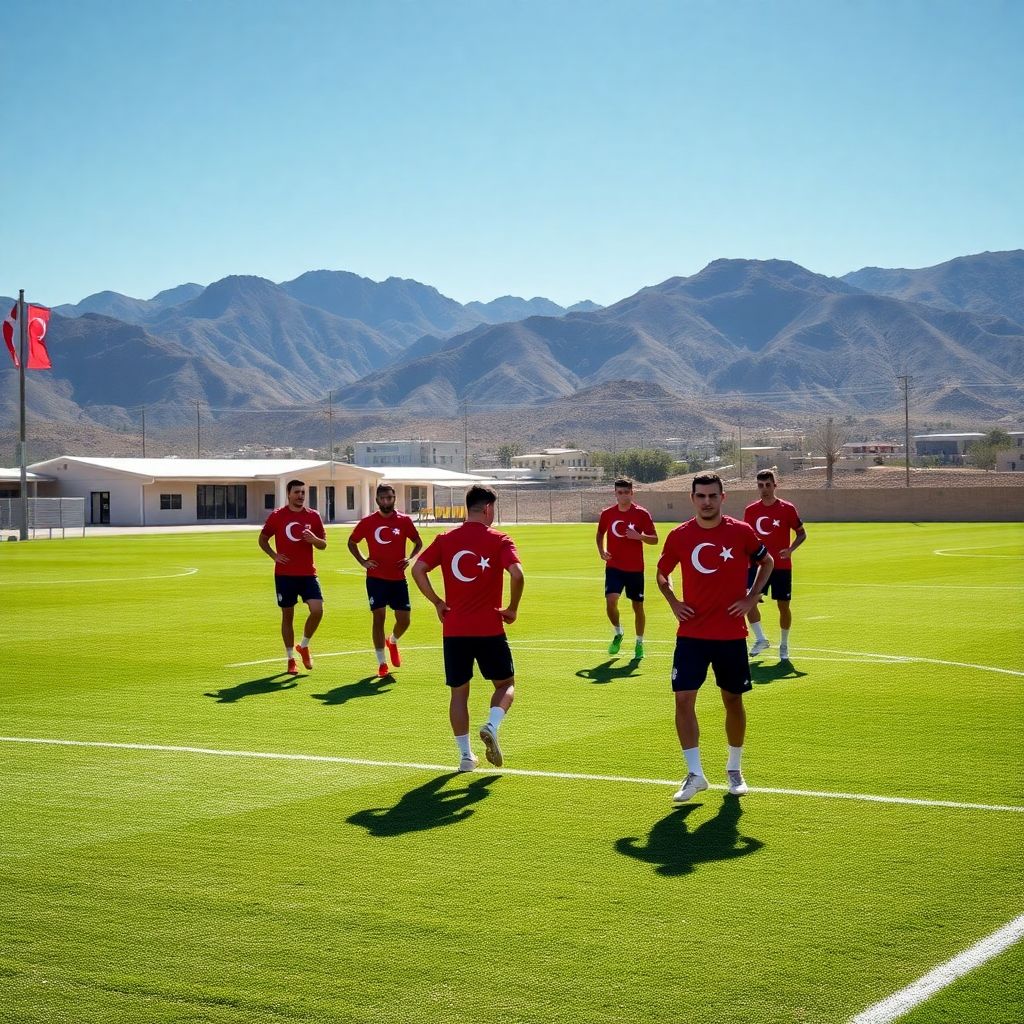
Turkish National Team Sets 2026 World Cup Base in Arizona: Travel Marathon and Ticket Frenzy Dominate Agenda
The Turkish Football Federation has formally locked in its blueprint for the national team’s 2026 World Cup campaign, placing the center of operations in Mesa, Arizona. Under head coach Vincenzo Montella, the “Crescent-Stars” will use the city as their main training and recovery base while navigating one of the most demanding travel schedules of the group stage.
Arizona as the Tournament Headquarters
Mesa, part of the greater Phoenix metropolitan area, has been chosen for its modern infrastructure, reliable weather conditions, and proximity to major flight routes across the continent. The team is expected to arrive well ahead of their opening Group D match to acclimatize to the high temperatures, dry climate, and time zone shifts that will define their World Cup routine.
Training facilities in and around Mesa will be converted into a tightly controlled camp environment, combining high-performance pitches, advanced sports science centers, and tailored recovery zones. Montella’s staff has reportedly prioritized short transfer times from hotel to training ground to limit additional fatigue on top of already intensive travel.
An 8,700 km Group-Stage Marathon
While Mesa will function as a logistical anchor, the geography of the 2026 World Cup leaves Türkiye facing a punishing travel route. Across just three group-stage fixtures, the team will rack up more than 8,700 kilometers in the air, testing both the physical and mental resilience of the squad.
Their Group D assignments require repeated flights between the United States and Canada, with Mesa as the recurring point of return:
– Türkiye vs Australia – Vancouver, Canada (BC Place)
Approximate distance from Mesa: 2,500 km each way.
This will be one of the longest legs, sending the team to the Pacific Northwest for a match in a typically cooler, more humid environment than Arizona.
– Türkiye vs Paraguay – San Francisco, USA (Levi’s Stadium)
Approximate distance: 1,200 km.
A shorter but still significant journey to California’s Bay Area, where variable coastal weather will contrast sharply with the desert conditions of their base.
– Türkiye vs USA – Inglewood/Los Angeles, USA (SoFi Stadium)
Approximate distance: 650 km.
This is the lightest travel load on paper, but it leads into what is already being described as one of the most politically and emotionally charged fixtures of the group.
Factoring in outbound and return flights for each match, the squad is expected to spend between 9.5 and 10.5 hours in the air during the group phase alone. For a tournament in which fine margins often decide progress or elimination, managing this airborne workload becomes a decisive strategic factor.
Managing Fatigue: The Hidden Battle
Montella and his backroom staff are planning the World Cup as much around rest and recovery as tactics and formations. The combination of cross-border flights, differing climates, and tight turnaround time between games has pushed sports science to the forefront of Türkiye’s preparations.
Specialists are expected to design individualized recovery protocols including controlled sleep schedules, nutrition plans tailored to flight times, and light training sessions immediately after travel to accelerate adaptation. The aim is to arrive at each match venue in peak condition, minimizing the sluggishness and muscle fatigue that often accompany long-distance journeys.
Rotation within the squad could become a central tactical tool. Some players may be earmarked for heavier minutes in less travel-intensive fixtures, while others might be preserved for the most physically demanding or tactically critical matches. Bench depth and readiness will matter just as much as the starting eleven.
Climate and Conditions: From Desert Heat to Coastal Air
Another complexity is the drastic change in playing conditions between Mesa and the host cities. Training in Arizona’s desert climate offers advantages in terms of guaranteed dry sessions and stable conditions, but match venues will present a very different reality:
– Vancouver’s BC Place, with its roof and location near the Pacific coast, may involve cooler temperatures and a more humid feel.
– San Francisco’s Bay Area is famous for its microclimates, where wind and temperature can shift rapidly, even within a single game.
– Los Angeles in late June typically brings warmth, but marine layers and night-time conditions can alter pitch behavior and ball speed.
Adapting dress codes, hydration strategies, and warm-up routines to each environment will be an ongoing challenge. The staff will also need to monitor how sudden shifts in humidity and temperature affect muscle load and injury risk.
Tactical Implications of a Traveling Team
The travel-heavy nature of Group D could influence how Türkiye approach each opponent. Rather than pressing relentlessly for ninety minutes in every match, Montella may opt for controlled phases of intensity, alternating between high pressing and compact mid-blocks to conserve energy.
Match planning could be designed backward from the travel schedule. For example, the long flight to Vancouver may encourage a more cautious, possession-oriented game plan to avoid constant sprinting. The comparatively shorter trip to Los Angeles for the USA clash could open the door to a higher-intensity approach, especially if qualification from the group is on the line.
Set pieces, transitional moments, and efficient finishing will be even more crucial than usual. When physical resources are being spent heavily on logistics, maximizing every chance becomes a core requirement rather than a luxury.
Ticket Fever: Türkiye’s Return After 24 Years
The 2026 tournament marks Türkiye’s first appearance at a World Cup in 24 years, a gap that has only amplified anticipation among supporters. This long-awaited return has collided with the global allure of a World Cup staged across North America, creating an explosive demand for match tickets.
While official sales phases through FIFA are still in progress, the reality on the ground is that many fans have already turned to the secondary market. The spotlight fixture is the June 26 showdown against the United States at SoFi Stadium in Inglewood, which has quickly become one of the most sought-after tickets for Turkish fans and locals alike.
On the resale market, prices for this single match have soared:
– Entry-level listings starting around 48,000 TL (approximately 1,400 USD)
– Premium seats reaching a staggering 317,000 TL (around 9,500 USD)
These figures underline how the USA-Türkiye match has transcended a regular group-stage fixture to become a high-profile global event.
Fighting the Grey Market: Final Ticket Phase Expected
The spiraling costs on secondary platforms have raised concerns about accessibility for average supporters. In response, FIFA is expected to open a final official ticket sales phase later this month. The intention is to offer more face-value tickets, reduce speculative reselling, and partially deflate the inflationary pressure of the black market.
For Turkish fans, this upcoming phase represents a crucial second chance. Many have postponed travel bookings in the hope of securing official tickets at more reasonable prices before committing to costly flights and accommodation across North America.
However, given the limited capacity of venues and intense international interest, demand is likely to far outstrip supply, keeping pressure high and resale prices elevated, particularly for marquee fixtures like the USA match.
Turkish Supporters on the Move
The choice of Mesa as a base and the allocation of matches in Vancouver, San Francisco, and Los Angeles also shape fan travel plans. Many supporters are expected to treat the tournament as a tour of North America, following the team from one coastal city to another.
Travel packages including flights from Türkiye to major US and Canadian hubs, internal connections to the group-stage host cities, and in some cases, excursions to Arizona itself, are already being assembled by agencies. Fans eager to feel close to the team may attempt to stay near the Arizona camp between matches, hoping to catch open training sessions or simply share in the atmosphere.
Logistical realities, however, are challenging: high accommodation costs in host cities, the need for visas or electronic travel authorization, and fluctuating airfares. For many, attending even a single group match will be a major financial commitment.
Psychological Boost of a Home-From-Home Base
Despite the travel intensity, establishing a stable World Cup “home” in Mesa carries clear psychological advantages. Rather than hopping from one training base to another in each host city, players will repeatedly return to a familiar environment, staff, routines, and recovery settings.
This sense of continuity can reinforce team cohesion, reduce stress, and help players mentally reset after tough matches. Over the course of a month-long tournament, these small psychological edges may be as decisive as tactical adjustments on the pitch.
Montella is also likely to use the camp atmosphere to build a stronger group identity: closed-door team meetings, analysis sessions, and bonding activities designed to keep the squad tightly unified despite the constant movement.
A Strategic Statement by the Federation
By finalizing their preparations early and staking a claim to Mesa as their operational center, the Turkish Football Federation is signaling its intent to treat the 2026 World Cup as a long-term project rather than a symbolic return. Every element-training environment, travel schedule, medical support, and fan engagement-is being approached as part of a single strategic puzzle.
For the federation, managing expectations is also important. The combination of a demanding Group D itinerary, high-profile opponents like the USA, and a long absence from the tournament creates both opportunity and pressure. A strong performance could redefine Türkiye’s global football image for the next decade.
Looking Ahead: Between Opportunity and Ordeal
As plans crystalize, two parallel narratives are unfolding. On the one hand, the logistical framework is undeniably grueling: over 8,700 km of travel, multiple climate zones, and a packed flight schedule within the group stage alone. On the other, the emotional surge around Türkiye’s World Cup return has produced a ticket craze that speaks to the depth of belief and excitement in the fanbase.
How well the Crescent-Stars can turn a travel marathon into a competitive advantage-using Mesa as a stable hub, managing fatigue with precision, and feeding off the energy of thousands of traveling supporters-may define not only their route out of Group D, but the legacy of their entire 2026 campaign.