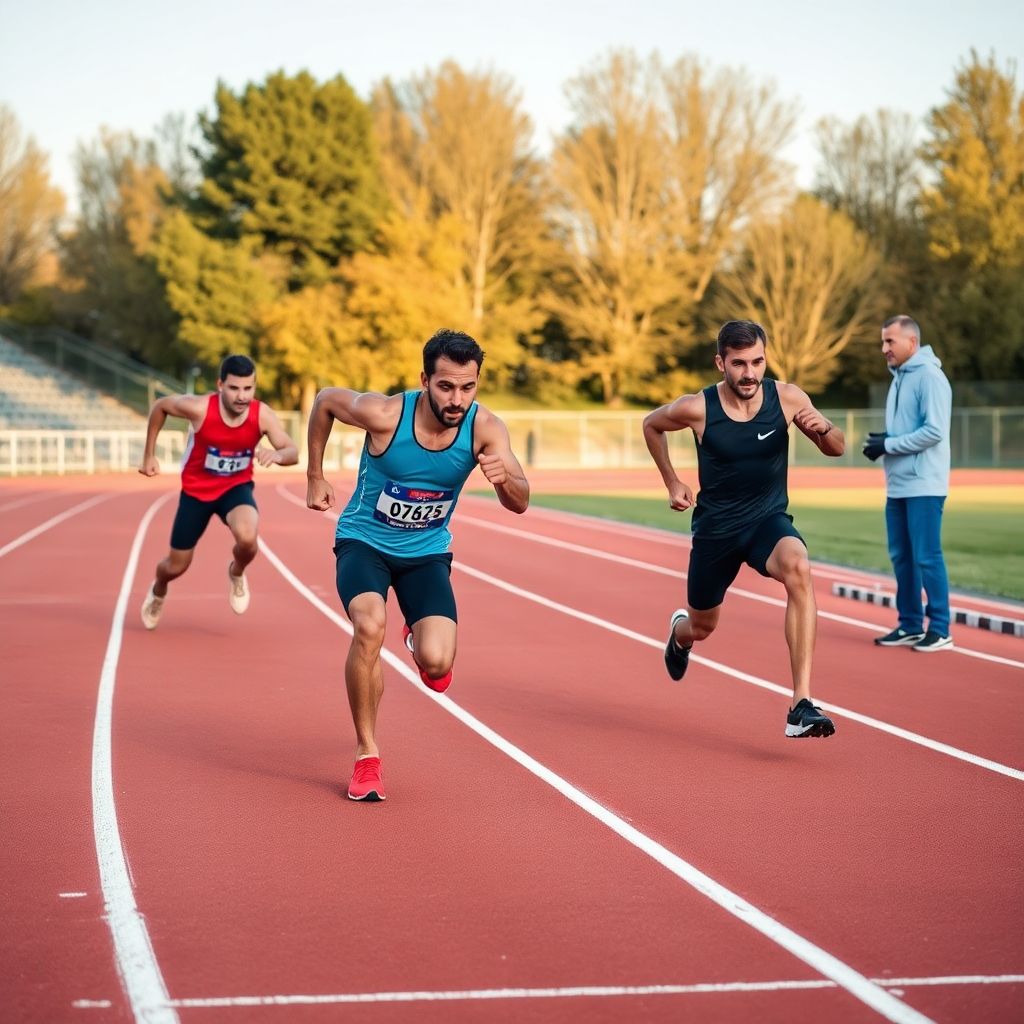
The science of sprinting for elite Turkish sprinters combines periodized planning, technical drills, strength and plyometrics, and strict recovery control. Use short, high-quality accelerations, progressive volumes, and clear timing-based cutoffs. Start with a conservative load, prioritise technique, and adjust weekly based on flying sprints, jump tests and wellness, or with guidance from a speed and sprint coach in Turkey.
Sprint Science Snapshot
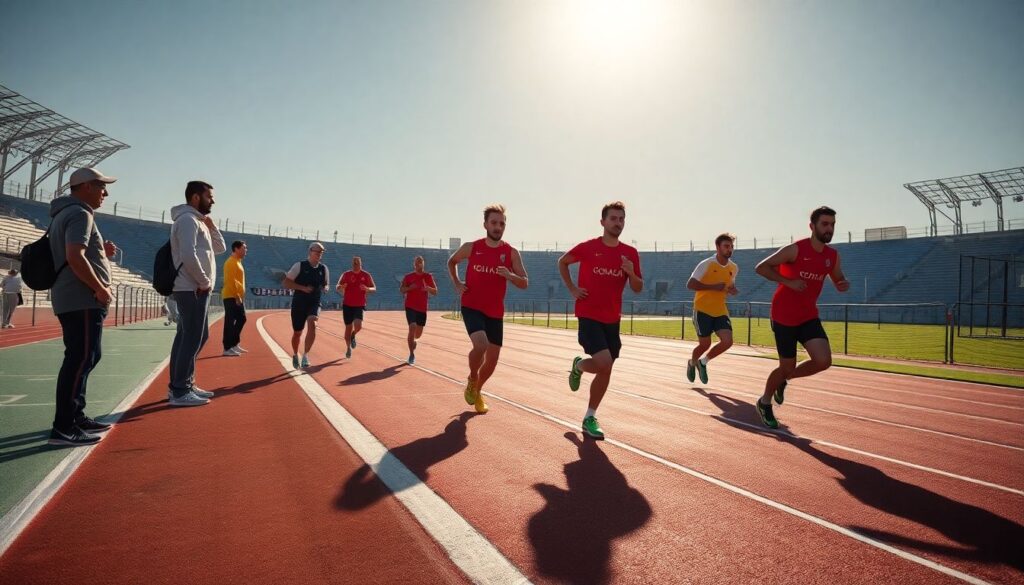
- Elite sprint performance in Turkey depends on managing neural fatigue, heat, hydration and high-speed running exposure, not only “hard work”.
- A structured sprint training program for elite athletes uses 2-3 high-intensity sprint days, 2-3 strength/plyometric days and active recovery.
- Technique work (acceleration angles, stiffness, arm action) comes before chasing the best sprint workouts to run faster 100m.
- Monitoring times for 30-60 m, jumps and subjective fatigue is essential for safe progress in any online sprint training plan for sprinters.
- Fast-track protocols emphasise more frequent but smaller speed exposures; standard protocols build volume more gradually.
- Professional sprint training camp Turkey environments add competition and facilities, but the same scientific principles still apply.
Physiology of Elite Turkish Sprinters
These methods target athletes who already tolerate sprinting at or near maximal speed and understand basic warm-up and gym work. They are suitable for national-level youth, adult club sprinters and field-sport athletes needing top speed, especially when supported by a qualified speed and sprint coach in Turkey.
Avoid using this guide as-is if you:
- Have recent lower-limb injuries (hamstring, calf, Achilles, knee) without medical clearance.
- Have cardiovascular or neurological conditions not cleared by a sport physician.
- Are a complete beginner to running; learn general running mechanics and basic strength first.
- Train alone without safe space; maximal sprinting requires a flat, unobstructed track or turf.
- Lack basic strength (cannot perform at least several quality bodyweight squats and single-leg calf raises per side).
For health and safety, build forward gradually. When in doubt, choose submaximal runs (80-90% effort) and lighter jumps instead of maximal sprints or depth jumps.
Periodized Training Cycles and Microcycles
To apply sprint science systematically, you need clear periods, simple tools and consistent testing. Even if you are not in a professional sprint training camp Turkey, you can reproduce much of the structure.
Essential tools and conditions
- Track or measured straight line: 60-120 m flat synthetic track or consistent grass/turf with marked distances.
- Timing method: stopwatch, timing gates or a reliable phone timing app, plus a notebook or spreadsheet.
- Strength equipment: barbell, adjustable dumbbells or kettlebells, boxes (30-60 cm), mini-bands.
- Safe footwear: sprint spikes for track, grippy trainers for gym or turf; avoid worn-out shoes.
- Space for drills: 20-30 m flat area for A-skips, dribbles and buildups.
- Recovery support: water, electrolytes, light snacks, shade or indoor access in hot Turkish summers.
Comparing fast-track vs standard protocols
| Feature | Fast-track protocol | Standard protocol |
|---|---|---|
| Main goal | Quickly sharpen speed for near-term competition (4-6 weeks) | Build robust speed, strength and resilience over a longer block (8-12+ weeks) |
| Weekly sprint days | 3 shorter, high-intensity sessions | 2-3, with slightly more volume per session |
| Typical max sprint distance | Up to 40-60 m most days, rarely longer | Progressive 10-80 m, sometimes split 120-150 m for 200 m athletes |
| Strength focus | Maintain strength, emphasise power and neural freshness | Alternate strength building phases and power phases |
| Best use case | Short runway before key meets, or during in-season for team sports | Off-season and pre-season base for repeated high-level performance |
| Risk if misused | Higher fatigue and soft-tissue injury risk if recovery is ignored | Improvement may feel slower; motivation can drop without clear testing |
Sample microcycle templates (standard approach)
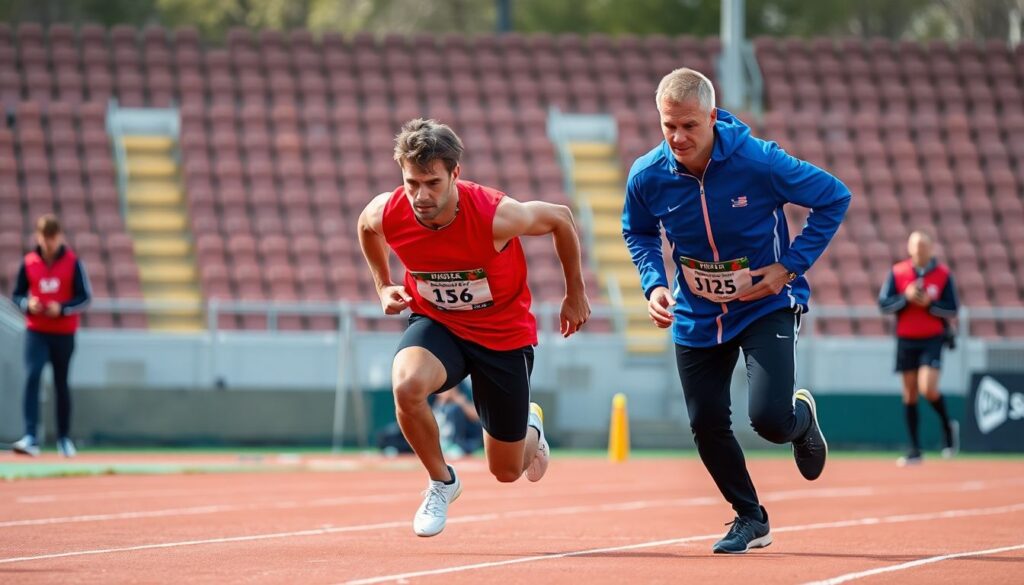
Use these as blueprints for a sprint training program for elite athletes; adjust volume down if you are sub-elite or coming back from a break.
Microcycle A – Early preparation (technical emphasis)
- Day 1 – Acceleration + strength
- Objective: Learn projection angles and powerful first steps.
- Sprints: 6-8 × 10-20 m from 3-point or block start, full recovery.
- Strength: Squat or trap bar deadlift (moderate load), lunges, core.
- Day 2 – Extensive tempo / aerobic support
- Objective: Light conditioning and technical rhythm at low intensity.
- Runs: 8-12 × 100 m at ~60-70% perceived effort, short rests.
- Day 3 – Maximal velocity drills
- Objective: Improve upright mechanics and stiffness safely.
- Sprints: 4-6 × 30 m buildups to 90-95% from a smooth rolling start.
- Jumps: 3-4 × 5 pogo jumps, 3 × 5 bounds per leg.
- Day 4 – Strength & core
- Objective: Build general strength and robustness.
- Gym: Hip hinge (RDL), single-leg squat variation, calf raises, anti-rotation core.
- Days 5-7 – Active recovery and mobility
- Objective: Restore, maintain range of motion, low stress.
- Activity: Easy cycling, walking, mobility, light drills only.
Microcycle B – Pre-competition (speed & power focus)
- Day 1 – Speed endurance
- Objective: Maintain speed under mild fatigue, relevant for 100-200 m.
- Runs: 3-5 × 80-120 m at 90-95% with generous rest.
- Day 2 – Strength and plyometrics
- Objective: Convert strength to power.
- Gym: Heavy main lift (squat or deadlift), light Olympic lift derivative, 3-4 plyometric exercises with low volume.
- Day 3 – Pure acceleration + max velocity
- Objective: Explosive starts and top speed.
- Runs: 4-6 × 30 m acceleration + 3-5 × 30 m flying sprints (20 m build, 10 m timed).
- Day 4 – Regeneration
- Objective: Offload nervous system while staying active.
- Activity: Easy pool session or low-intensity tempo; mobility and soft-tissue care.
Microcycle C – Fast-track variant (short block sharpening)
Fast-track version suitable when there are 4-6 weeks until competition and you already have a base:
- Day 1: Acceleration (6-8 × 20 m) + light strength.
- Day 2: Max velocity (4-6 × 30 m flying) + low-volume bounds.
- Day 3: Speed endurance (3-4 × 80 m) only if fully recovered.
- Day 4: Short strength / power session (2-3 main lifts, 2-3 plyometrics).
- Other days: Recovery, mobility, technical drills at low intensity.
Speed Mechanics: Technique and Biomechanics
This section outlines a safe, clear how-to process to improve sprint mechanics using simple drills and measurable checkpoints.
-
Establish posture and projection
Good sprinting starts with a stable, slightly forward body position from the first step. Practice this in low-risk, short accelerations.
- From a standing or 3-point start, lean forward until you feel weight over the balls of your feet without losing balance.
- Keep head neutral (eyes down for first steps), ribs stacked over hips, no excessive arching of the lower back.
- Use 6-8 × 10 m accelerations at 80-90% effort, focusing only on posture.
-
Coordinate arm action
Arms drive rhythm and help produce force. Clean, strong arm swings reduce unwanted rotation and improve stride frequency.
- Sit or stand tall, swing arms from cheek to hip with bent elbows, avoiding crossing the midline.
- Perform 2-3 × 20 seconds of arm swings before sprints, then carry the same pattern into 20-30 m accelerations.
-
Refine acceleration steps
During the first 10-30 m, aim for gradual rise from a lean to upright posture. Avoid popping up too early.
- Mark 10, 20 and 30 m on the track.
- Run 4-6 × 20-30 m accelerations; video from the side if possible.
- Check that shin angles gradually rise, steps are powerful but not overstriding, and contact times shorten slightly with distance.
-
Optimize upright sprint mechanics
Once you reach max velocity, think “tall, relaxed, elastic”. Quality here depends on stiffness and rhythm, not pushing harder.
- Use dribble drills (low, medium, high) over 20-30 m, focusing on quick, light contacts under the hips.
- Progress to 4-6 flying sprints over 30 m (e.g., 20 m build + 30 m fast), staying relaxed in face, neck and shoulders.
- Stop the session if times slow noticeably or technique breaks down for two reps in a row.
-
Improve stiffness and ground contacts safely
Stiffer, quicker ground contacts increase horizontal speed but must be trained gradually to protect the lower legs and Achilles.
- Start with 3-4 × 10-20 m ankling and A-skips, focusing on active, short ground contacts.
- Add 3-4 sets of 6-8 pogo jumps and low-level hops 1-2 times per week.
- Only introduce more advanced bounds and hurdle hops after several weeks of pain-free basic drills.
-
Use simple timing to guide intensity
Timing ensures sprints stay fast and safe. Without timing, athletes often add junk meters and increase injury risk.
- Choose a test distance (e.g., 30 m from standing) and record a best training time.
- During sessions, end a set when your sprints are clearly slower than early reps or you feel technique slipping.
- Retest every 2-3 weeks; small improvements show training is on track.
Fast-track mechanics focus
For a fast-track block within an online sprint training plan for sprinters, condense technique work into short, high-quality segments:
- Perform 5-6 × 10 m posture-focused accelerations at the start of two sprint sessions per week.
- Add 3-4 × 20 m dribbles and 3-4 × 30 m flying sprints once per week for upright mechanics.
- Include 3 sets of pogos and A-skips after warm-up on two days weekly, keeping total contact count moderate.
- Use video (phone) from side and rear angles every 1-2 weeks to check posture, arm swing and overstriding.
Strength, Power and Plyometrics Protocols
Use this checklist to verify whether your strength and plyometric work supports sprint performance safely and effectively.
- Lower-body strength sessions are placed at least 24 hours away from key maximal sprint sessions.
- Main lifts (squat, deadlift, hip hinge) use loads heavy enough to challenge but with 2-3 reps left in reserve to avoid grinding.
- Unilateral work (lunges, step-ups, single-leg RDLs) appears at least once per week to balance left-right strength.
- Plyometric exercises start with low-level jumps (pogos, low box jumps) before progressing to more intense bounds or depth jumps.
- Total plyometric ground contacts per session stay moderate and do not cause shin, knee or Achilles pain afterwards.
- Upper-body strength (presses, rows, pull-ups) is trained 1-2 times per week to stabilise arm action, not as bodybuilding volume.
- Strength sessions finish with core work that resists movement (planks, anti-rotation) rather than excessive sit-up volume.
- In pre-competition phases, power-oriented lifts (lighter, faster movements) replace most heavy grinding sets.
- You can complete strength sessions feeling “switched on”, not wiped out or too sore to sprint fast within 24-48 hours.
Recovery Strategies, Nutrition and Environmental Acclimation
Common recovery and environment-related mistakes reduce the benefits of even the best sprint workouts to run faster 100m. Avoid these errors to keep training safe and productive in Turkish conditions.
- Ignoring heat and humidity: Training hard in midday summer heat without shade, hydration or gradual acclimation increases risk of heat illness and poor quality reps.
- Skipping cool-down: Ending sessions abruptly without easy jogging and mobility can increase next-day stiffness and reduce readiness.
- Inconsistent fluid and electrolyte intake: Drinking only when very thirsty and not replacing electrolytes on hot days leads to cramps and fatigue.
- Under-fuelling around sessions: Sprinting fast with almost no carbohydrate intake before or after training undermines power and recovery.
- Overloading off-days: Turning recovery days into extra hard football, futsal or long runs stops adaptation and raises injury risk.
- Sleep neglect: Staying up late with screens or social events after intense sessions reduces hormone balance, reaction time and muscle repair.
- Changing surfaces too quickly: Moving from soft turf to hard track (or vice versa) with no gradual adaptation can irritate shins, knees and Achilles.
- Using aggressive soft-tissue techniques right before sprinting: Deep massage or very strong stretching immediately before maximal speed can reduce stiffness and stability.
- No plan during travel or camp: Arriving at a new professional sprint training camp Turkey and jumping straight into maximal work on day one without lighter orientation sessions.
Monitoring, Testing and Data-Driven Adjustments
If you cannot run full testing batteries or do not have access to advanced timing systems, there are practical alternatives that still keep you safe and progressing.
- Simplified timing approach: Use phone video with distance markers to estimate 20-30 m times and compare week-to-week instead of relying on expensive electronic timing.
- Jump and strength proxies: Monitor standing long jump, countermovement jump and submaximal bar speeds as indirect indicators of sprint readiness.
- Session RPE and wellness logs: Record perceived exertion, sleep quality and muscle soreness daily; lower sprint intensity or volume when these trend worse for several days.
- Mini-tapers before key tests: Reduce volume for 3-4 days while keeping some high-speed touches to see true speed without full peaking protocols.
Common Implementation Concerns
How many sprint days per week are safe for an intermediate athlete?
Most intermediates do well with two high-intensity sprint days plus one optional lighter speed or technical session. Only move to three intense sprint days when recovery, sleep and nutrition are reliably in place and injury history is minimal.
Can I follow this plan without a personal coach on track?
Yes, if you progress conservatively, respect recovery, and use basic timing plus occasional video. However, periodic feedback from a qualified speed and sprint coach in Turkey can correct technique issues you may not notice yourself.
How should I adapt sessions during Ramadan or other fasting periods?
Shift high-intensity sprint and strength work closer to times when you can eat and drink, reduce total volume, and prioritise quality over quantity. Keep more technical sessions and mobility at other times of the day.
What if I only have access to a gym but no track for several weeks?
Focus on strength, power, and low-level plyometrics while maintaining some short, fast runs on a treadmill or safe indoor surface. Reintroduce gradual acceleration and max velocity sessions once you regain access to a proper track.
Is it safe to mix football or basketball with this sprint program?
It can be, if you treat team sports as additional high-intensity work and adjust sprint and plyometric volumes downward. Avoid hard matches one day before or after your most intense sprint sessions to reduce injury risk.
How quickly should I expect to see improvements in my 100 m time?
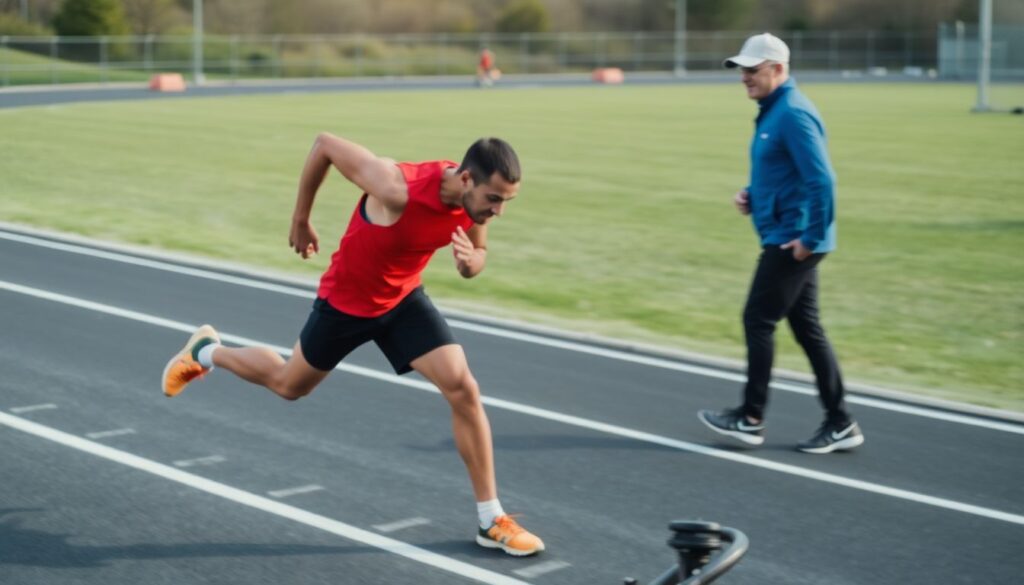
Improvements depend on training history, consistency and recovery. Focus on better technique, smoother accelerations and more stable times over 30-60 m during training; race times will usually follow as these markers improve.
Do I need special equipment used in elite Turkish sprint groups?
No. Timing gates, resisted sleds and advanced gym tools are helpful but not mandatory. A flat track, simple weights, basic plyometric boxes and a phone for timing and video are enough for most intermediate athletes.