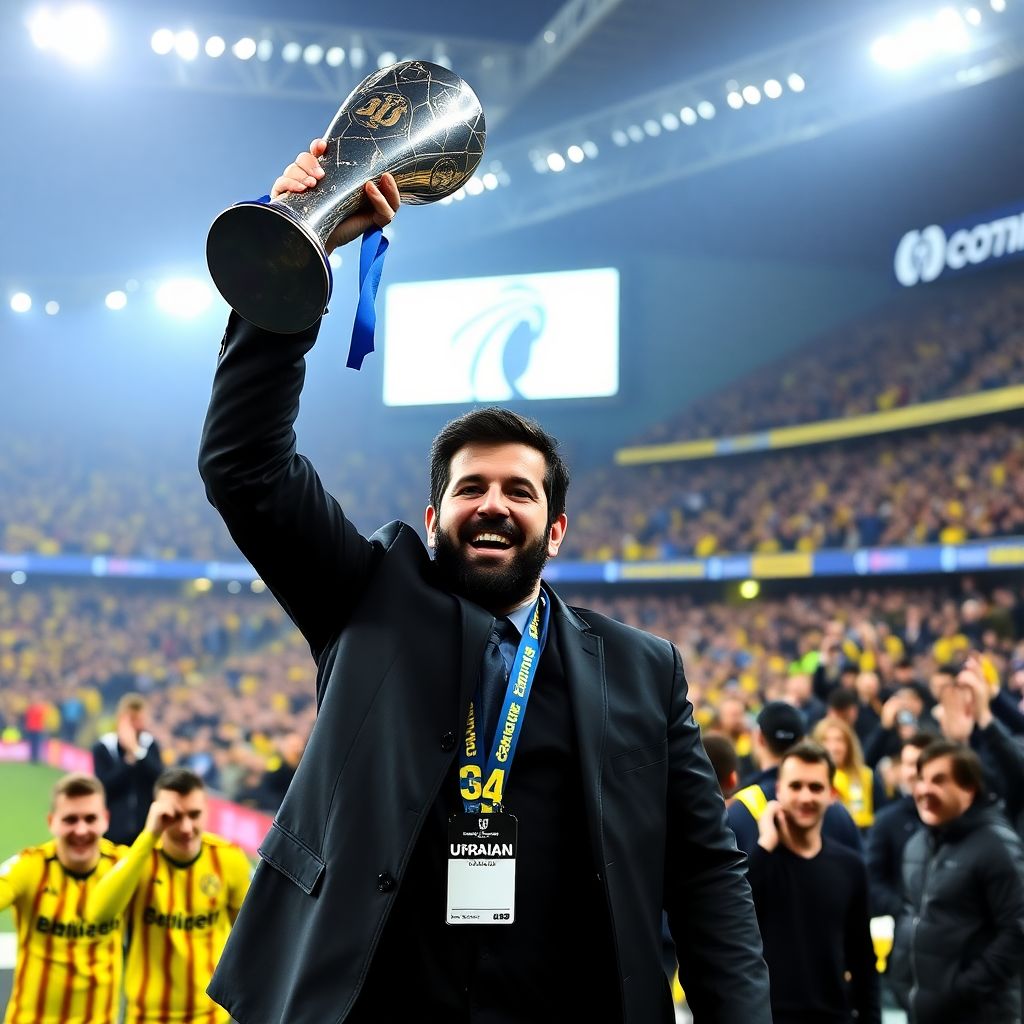
Arda Turan Crowned Ukrainian Premier League Manager of the Year After Landmark Debut Season
Arda Turan has written a new chapter in his already eventful football story. The former Turkish international has been voted Ukrainian Premier League Manager of the Year for the 2025-26 campaign after a breathtaking first season in charge of Shakhtar Donetsk. The official league vote saw Turan win by a clear margin, reflecting how thoroughly he reshaped the club into the dominant force in Ukrainian football.
Vitaliy Ponomaryov, who impressed with LNZ Cherkasy, finished as runner-up in the voting, while Ruslan Rotan of Polissya completed the top three. Yet it was Turan’s name that stood out, as coaches, players and observers acknowledged the scale of what he achieved in such a short time.
A Domestic Title Built on Consistency and Control
Appointed just before the season kicked off, Turan wasted no time stamping his authority on Shakhtar. Over 30 league matches, his side collected an impressive 72 points, storming to the title with a level of consistency that few anticipated when he arrived. In a league known for its physical intensity and unpredictable results, Shakhtar lost only once all season.
This near-perfect record was not built on star power alone but on a clear structure. Shakhtar combined aggressive pressing with disciplined defensive organization, often suffocating opponents before they could find any rhythm. The team’s ability to manage games, control tempo and remain focused in key moments became a defining feature of Turan’s debut campaign.
Players spoke about a new clarity in roles and expectations. Full-backs pushed high with confidence, midfielders interchanged fluidly, and the forward line pressed in coordinated waves. Mistakes did not vanish overnight, but they were increasingly rare, and when they did occur, Shakhtar had the collective calmness to recover.
A Historic First for Turkish Football
By guiding Shakhtar to the summit of the Ukrainian Premier League, Turan achieved more than just a domestic trophy. At 39, he became the first Turkish manager in history to win a top-flight league championship in Europe. It is a milestone that resonates well beyond Donetsk or Kyiv, marking a new reference point for Turkish coaches aiming to make their mark abroad.
For a nation long associated with passionate football culture but relatively few managerial exports at the top European level, Turan’s success is symbolic. His triumph demonstrates that Turkish coaches can not only adapt to foreign environments but also thrive tactically and emotionally under demanding conditions.
European Adventure in the Conference League
Shakhtar’s excellence was not confined to domestic competition. Under Turan’s guidance, the club embarked on a memorable run in the UEFA Conference League, advancing all the way to the semi-finals. This deep continental campaign underlined Shakhtar’s evolution from a strong local side into a team capable of competing with diverse European opponents.
Turan’s tactical flexibility stood out in Europe. Against technically superior teams, Shakhtar could sit deeper, compress space and hit on the counter. When facing more cautious opposition, they were able to dominate possession and break down low blocks. This adaptability enhanced Turan’s reputation as more than just a motivator; he proved himself a detailed strategist.
Reaching the last four of a European competition under current circumstances in Ukraine carried an added weight. The club had to juggle domestic ambitions with midweek fixtures against unfamiliar styles and challenging environments, yet the squad rarely looked overwhelmed.
Coaching Through Crisis: Football Amid War
The context of Shakhtar’s success cannot be separated from the realities of modern Ukrainian football. With the country still affected by ongoing geopolitical conflict, the logistical and emotional burdens on players and staff were immense.
Due to airspace closures, travel for European away matches often meant exhausting journeys by bus and train, sometimes stretching to 16 hours or more. Recovery periods were shortened, preparation time was limited, and mental fatigue was ever present. Turan has openly spoken about this side of the job, emphasizing the resilience his squad had to show just to maintain basic competitive standards.
He frequently highlighted that the spirit of the Ukrainian people had become a source of inspiration for him personally. In interviews earlier in the season, Turan described how he tried to foster positivity within the squad, mirroring the strength he saw around him daily. He said he had come to regard the people he worked with and the community that supported Shakhtar as “family,” a word he used deliberately to underline the depth of the bond.
From Star Player to Emerging Elite Coach
Turan’s rapid adaptation to life on the touchline might surprise those who remember him primarily as a creative midfielder at Atletico Madrid and Barcelona. His playing career, stacked with titles and high-pressure matches, became an unconventional coaching education long before he officially stepped into management.
As a player under Diego Simeone, he experienced an aggressive, compact style built on work-rate and structure. At Barcelona, he witnessed a possession-heavy, positional game where details in space and timing were everything. Elements of both schools appeared in his Shakhtar side: intensity without the ball combined with confidence and patience when in possession.
That blended footballing identity, coupled with his natural charisma, helped him quickly command respect in the dressing room. For many Shakhtar players, having a coach who had shared the biggest stages in world football added weight to his instructions and demands.
Man-Management at the Core of Shakhtar’s Rise
Beyond formations and systems, Turan’s first season suggested that his greatest strength may lie in man-management. Players described a communicative coach who was willing to listen but also unafraid to make tough calls. Established names were occasionally benched if their performances dipped, while younger talents were given real opportunities to impress.
This merit-based approach fostered competitive tension within the squad while maintaining a sense of unity. Training sessions were said to be intense but carefully structured, with a focus on clear objectives rather than endless drills. Turan insisted on strong internal standards, encouraging senior players to take ownership of the dressing room’s atmosphere.
Crucially, he managed to protect the group from external pressure. While expectations grew with every win, Shakhtar’s public messaging remained measured: taking one game at a time, focusing on performances rather than only results, and refusing to consider the title race decided until it was mathematically secure.
Tactical Hallmarks of Turan’s Shakhtar
On the pitch, several patterns became closely associated with Turan’s Shakhtar during the 2025-26 campaign:
– High but controlled pressing: The team pressed aggressively in certain zones, especially immediately after losing the ball, yet avoided reckless chasing.
– Flexible midfield structure: Midfielders frequently rotated positions, allowing one to drop between the centre-backs while others pushed higher to support attacks.
– Attacking full-backs: Wide defenders provided width and depth, stretching the opposition and creating overloads in the final third.
– Compact defensive block: When defending deeper, Shakhtar maintained tight spacing between the lines, forcing rivals into low-percentage shots from distance.
This mix allowed Shakhtar to dominate lower-ranked domestic teams while still having a blueprint to frustrate stronger European sides. The balance between creativity and control was central to Turan’s Manager of the Year recognition.
Impact on the Ukrainian League Landscape
Turan’s arrival and immediate impact have also raised the overall competitive bar in the Ukrainian Premier League. Rivals were forced to respond tactically, revisiting their own approaches to pressing, build-up play and squad rotation.
His success adds another interesting storyline to a league that has produced several notable coaches and players in recent years. For young Ukrainian managers, Turan’s work serves as a case study in how quickly a clear idea, strong communication, and brave decision-making can transform a club’s fortunes.
What Comes Next for Turan and Shakhtar
Winning the title and reaching a European semi-final in a debut season inevitably raises expectations for what follows. For Turan, the challenge now is to prove this was not a one-off miracle but the beginning of a sustained era of competitiveness.
Maintaining motivation in a squad that has already reached significant heights can be complex. Opponents will study Shakhtar’s patterns more closely, searching for weaknesses. Squad turnover, potential transfers, and the physical toll of another packed schedule will also test his adaptability.
Yet if his first season is any indication, Turan appears prepared for long-term work rather than short bursts of success. His acceptance of the Manager of the Year award symbolizes not the end of a project, but the confirmation that his ideas can function at the highest level.
A New Benchmark for a New-Generation Coach
Arda Turan’s award as Ukrainian Premier League Manager of the Year caps a season that could easily be described as transformative: for Shakhtar Donetsk, for the league, and for the perception of Turkish coaches abroad.
In a campaign shaped by remarkable consistency, tactical maturity, and extraordinary resilience under off-field pressures, he has established himself as one of the most intriguing young managers on the European scene. For now, his legacy is already secure as the first Turkish coach to conquer a European top division. The deeper question is how far this new chapter in his career can ultimately go.