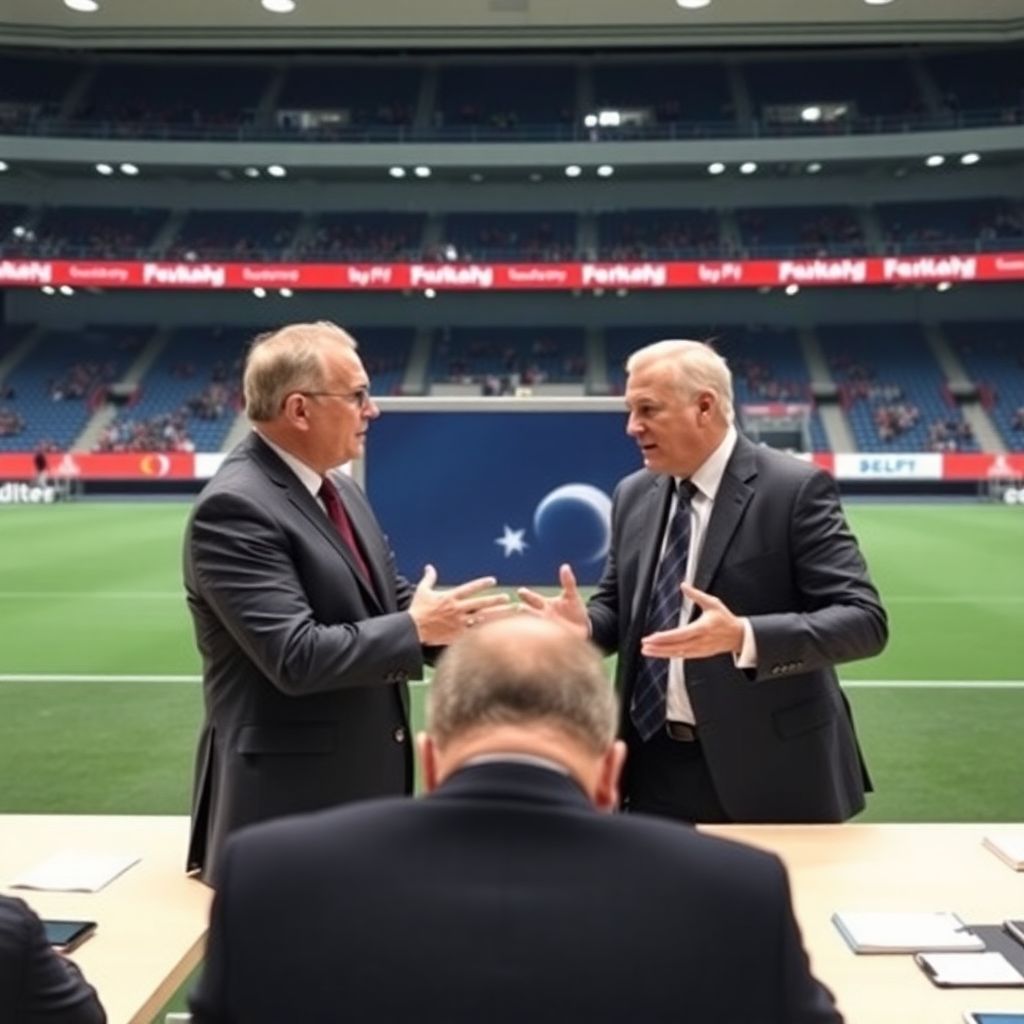
War of Words Deepens as TFF President Clashes with Fatih Terim Amid World Cup Turmoil
Tension inside the Turkish camp at the 2026 FIFA World Cup has shifted from tactical shortcomings on the pitch to an open power struggle off it. In the wake of a sobering 2-0 defeat to Australia in their Group D opener, Turkish Football Federation (TFF) president İbrahim Hacıosmanoğlu has ignited a fierce verbal confrontation with legendary coach Fatih Terim, turning a sporting setback into a full-blown political storm.
Turkey’s return to the World Cup stage after a 24‑year absence had been framed as a long-awaited renaissance. Drawn into what many analysts considered a manageable group, the “Crescent-Stars” were widely expected to progress with relative ease. Instead, Vincenzo Montella’s side now finds itself staring at the possibility of an early exit, with an upcoming clash against Paraguay in Santa Clara looming as a do-or-die showdown.
The Spark: Terim’s Call for “Accountability”
The conflict was triggered not by a dressing-room leak or a heated touchline incident, but by a video analysis. Fatih Terim, the 72‑year‑old former national team boss and one of the most influential figures in Turkish football history, dissected Turkey’s loss to Australia on his YouTube channel.
Terim’s tone was measured. He emphasized the need for the public to support Montella and the players, stressing that unity and calm were essential while the tournament was still alive. His intention, at least on the surface, was to protect the team’s morale and prevent panic.
Yet it was his closing remark that detonated the controversy. Terim insisted that once Turkey’s World Cup journey was over, there must be a serious process of “accountability” – a clear assessment of what had been done right and wrong, and who should ultimately answer for the outcome.
Hacıosmanoğlu Strikes Back
Those words landed badly at the TFF headquarters. Speaking from the turf of the Arizona Athletic Grounds in Mesa, where the team has been training at a state-of-the-art high-performance facility, TFF president İbrahim Hacıosmanoğlu delivered a pointed, emotional response.
“I would have preferred him to conclude his remarks in a manner truly fitting for an emperor,” Hacıosmanoğlu said, referencing Terim’s nickname, “İmparator” (The Emperor). “Who exactly are you planning to hold responsible? Those comments did not align with his experience or wisdom.”
The federation chief, clearly irritated, didn’t stop there. He demanded clarity on the target of Terim’s warning. “With whom are you doing this?” he asked. “Are you intending to blame the squad? Will you target the coaching staff? Will you look to executive management, or are you pointing at the president?”
In a matter of minutes, a post-match tactical analysis had been transformed into a question of power, respect, and legitimacy at the very top of Turkish football.
A Crisis of Timing
The war of words could hardly have come at a worse moment for Montella and his players. Rather than focusing solely on tactical adjustments and mental recovery after the loss to Australia, the squad now finds itself at the center of a media storm, with questions about leadership overshadowing questions about line-ups and formations.
Turkey’s base in Arizona was designed to give the team every conceivable advantage: modern recovery facilities, custom training programs, sports science staff, and complete isolation from external distractions. Ironically, it is now serving as the backdrop to a political drama that threatens to undo those carefully laid preparations.
As the players board the plane to California to face Paraguay in Santa Clara, they do so under a cloud. Not only are they fighting for survival in the tournament, they are also involuntary actors in a clash between the sport’s most iconic elder statesman and its current power broker.
The Stakes in Santa Clara
The scenario is brutally simple. If Turkey lose to Paraguay and Australia fail to drop points against the United States, the “Crescent-Stars” will be knocked out of the World Cup at the group stage. A campaign that began with dreams of emulating or surpassing the heroics of 2002 could end before it truly begins.
This harsh mathematical reality adds extra weight to every training session, every tactical tweak, every decision Montella makes. An early elimination would inevitably intensify the debate over “accountability” and, by extension, the feud between Terim and Hacıosmanoğlu. The president’s angry reaction suggests he already feels that a narrative of blame is being seeded ahead of time.
Legacy vs. Authority
At the heart of this conflict lies a deeper struggle that goes beyond a single match or tournament. Fatih Terim is more than just a former coach; he is a symbol of an era, a figure whose achievements and charisma give his words unusual influence. When he speaks about the national team, it resonates not just with fans but with players, coaches, and club directors.
Hacıosmanoğlu, by contrast, represents the current institutional authority. As TFF president, he is politically accountable for the overarching direction of Turkish football – the hiring of Montella, the planning of preparations, and the long-term strategy surrounding youth development and competitive ambitions.
When Terim calls for “accountability,” it is almost impossible to interpret that in purely abstract terms. Even if he did not name individuals, his stature ensures that those in charge will feel directly implicated. Hacıosmanoğlu’s sharp response reveals alarm at the possibility that, in the public eye, responsibility for failure may be pre-assigned before the final whistle is blown.
The Montella Equation
Caught between these heavyweight figures is Vincenzo Montella, a foreign coach trying to navigate not only tactical challenges but the unique political landscape of Turkish football. The Italian manager was hired with the expectation of blending a new generation of talent with experienced leaders and implementing a modern playing style capable of competing at the highest level.
Against Australia, however, Turkey looked disjointed and hesitant, especially in transition. Defensive lapses, lack of cohesion in midfield, and an inability to break down a disciplined opponent exposed the fragility behind the pre-tournament optimism. Those issues are strictly within Montella’s remit, and they would have been scrutinized even without the Terim‑Hacıosmanoğlu row.
Now, every decision Montella makes – selection, substitutions, tactical system – will be viewed through a political lens. If Turkey recover and progress, it will strengthen the federation’s argument that stability and support were the right path. If they crash out, calls for structural change and leadership review, already implied by Terim’s use of “accountability,” will grow louder.
Pressure on the Players
While figures in suits and former legends trade barbs, the most immediate pressure falls on the players. For veterans who remember earlier disappointments, and for youngsters experiencing their first World Cup, this controversy adds another layer of anxiety.
In an ideal environment, a squad under threat of elimination would be shielded from external turmoil, allowed to focus solely on game plans and mental resilience. Instead, players now face questions about off-field comments and must navigate allegiances to former coaches, current management, and their own careers.
The leadership group within the dressing room – captains and senior professionals – will be crucial in setting the tone. Their ability to keep the squad united, to insist that the noise outside remains outside, may be as important as Montella’s tactical board.
The Broader Question for Turkish Football
This episode also spotlights an enduring theme in Turkish football: the tension between emotional, personality-driven leadership and the demands of long-term strategic planning. Terim embodies the former – passion, charisma, and results born from intense personal influence. The TFF under Hacıosmanoğlu is expected to deliver the latter – structures, continuity, and measured decision-making.
The World Cup is amplifying the clash between these two models. A single word like “accountability” can become a battlefield because it touches on nerves that were already exposed by years of underachievement, internal disputes, and high expectations from a football‑obsessed nation.
What Happens After the Final Whistle?
Regardless of what unfolds against Paraguay and, potentially, beyond, the question Terim raised will not disappear. When Turkey’s World Cup campaign ends – whether in the group stage or later – there will inevitably be a reckoning.
Key issues will demand answers:
– Was the preparation appropriate for the scale of the tournament?
– Did the TFF make the right call in appointing Montella and in the timing of that decision?
– Was the balance between experience and youth in the squad correctly judged?
– Did the internal atmosphere, now clearly strained, contribute to performance on the field?
If Turkey underperform, Hacıosmanoğlu’s harsh words toward Terim may be revisited as a sign of defensive insecurity rather than strength. If the team rallies and advances, Terim’s critique may be reframed as premature or unnecessarily provocative. Either way, both men have anchored themselves firmly to the narrative of this World Cup.
A Tournament Overshadowed
For now, the urgent task for Turkey is simple yet enormous: find a way to silence the noise, rediscover cohesion, and win. The match in Santa Clara is not just about three points; it is about salvaging a campaign, restoring belief, and reclaiming control of a storyline currently dominated by off‑field confrontation.
The “War of Words” between İbrahim Hacıosmanoğlu and Fatih Terim has transformed what should have been a purely sporting crisis into a broader test of leadership, legacy, and direction. On the grass of California, under the brightest lights, the players will try to answer in the only way they can – with a performance that delays, if only temporarily, the day of reckoning that both sides know is coming.