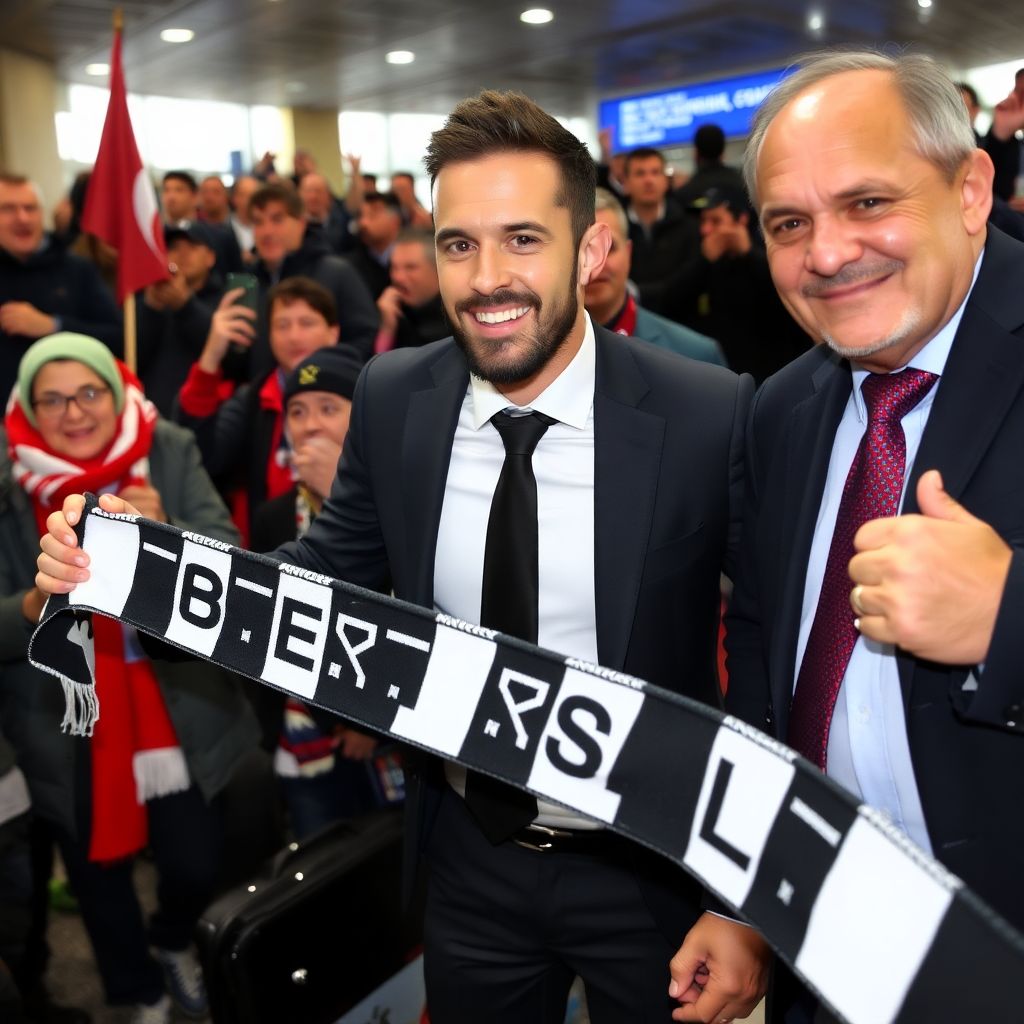
Beşiktaş president Serdal Adalı has disclosed that the club finally landed Belgian winger Leandro Trossard from Arsenal on significantly better financial terms than those they were prepared to accept a year ago, when their initial move was rejected.
Speaking after the 31-year-old arrived in Istanbul to complete his transfer, Adalı explained that Beşiktaş’s long-standing pursuit of Trossard ultimately played in their favor. By waiting a year and maintaining contact, the club reduced both the transfer outlay and the salary package compared with their original proposal.
Adalı revealed that Beşiktaş had pushed hard to sign Trossard in the previous summer window, only to be blocked by Arsenal, who were unwilling to sanction a deal at that time. The Turkish side had been ready to commit to a substantial financial package.
“Last year, I offered €25 million for Trossard and a salary of €8 million, but it didn’t happen – they wouldn’t let him go,” Adalı said. “This time, we are signing him for lower wages.” He stopped short of specifying the exact figures involved in the current agreement, but repeatedly stressed that the deal is now “much more favorable” from the club’s perspective.
Despite Trossard’s age, negotiations with Arsenal were far from straightforward. According to Adalı, the Premier League club insisted on including a future sell-on clause even though the player is already 31. Beşiktaş accepted this condition, seeing it as a reasonable trade-off for reducing the immediate financial burden of the transfer.
Adalı framed the Trossard move as an example of patient, calculated transfer work rather than extravagant spending. He emphasized that Beşiktaş did not simply chase a big name at any cost, but instead waited until the financial environment shifted in their favor, allowing the club to secure a player of top-level European experience without destabilizing their budget.
The president used the opportunity to respond to criticism of the club’s recent transfer activity. Some observers had raised concerns that Beşiktaş were committing themselves to significant outlays in a challenging economic climate. Adalı rejected that notion, insisting that the current leadership has tightened financial discipline while still keeping the team competitive.
He underscored that Beşiktaş’s bank debt has been dramatically reduced during his tenure. “Our bank debt was €128 million; now it is down to €53 million,” Adalı stated, presenting the figures as a direct counterargument to claims of irresponsible spending. In his view, the club’s transfer operations are now underpinned by a far more stable financial base than in previous years.
A key part of that restructuring has been the “Dikilitaş” real estate development project, which Adalı described as a financial lifeline for the club. According to him, the project generated 1.5 billion Turkish Lira in revenue. From this, a total of 3 billion Lira has been repaid to banks to reduce Beşiktaş’s overall debt and ease their interest obligations, combining project income with other cash flows and restructuring efforts.
Adalı pointed out that this strategy is not about one-off windfalls, but about creating room for sustainable investment in the squad. The remaining funds from the real estate initiative, he said, are being carefully directed toward strengthening the team in key positions, rather than spread thinly or used for short-term fixes.
He also stressed that the current transfer window is being approached with a clear, long-term plan. “We are not making random signings,” Adalı implied, suggesting that every arrival is being weighed against both the sporting needs identified by the coach and the club’s medium-term financial projections. The Trossard deal, in his view, fits that model: a high-impact player acquired on terms that are better than those on the table a year ago.
During the same briefing, Adalı shed light on the club’s internal dynamics between the board, the recruitment department, and head coach Vincenzo Italiano. He portrayed the relationship as collaborative but firmly structured, with the coach having a decisive voice on the types of players needed for his system, and the board determining what is feasible within the budget.
One example he cited was the transfer of left-back Kassoum Ouattara. Adalı confirmed that Ouattara’s signing was carried out at the explicit request of Italiano. The technical staff had analyzed several options for the position, but once the Italian coach identified Ouattara as his preferred choice, the recruitment team accelerated talks to finalize the deal.
“The coach made it clear he wanted Ouattara, and after that we moved quickly,” Adalı said, illustrating how Beşiktaş are trying to streamline their decision-making. Instead of prolonged debates over multiple candidates, the club aims to combine scouting data, the coach’s tactical requirements, and financial realism to act decisively.
Adalı argued that this more integrated approach to transfers reduces waste and minimizes the risk of signings who do not fit the manager’s game plan. In his explanation, every euro spent is now more scrutinized, with both sporting and financial departments aligned on priorities. Trossard’s arrival was portrayed as the product of this alignment: a player whose versatility in attack suits Italiano’s plans, acquired at a reduced cost thanks to a strategic delay.
The president also hinted that the Trossard transfer is part of a broader effort to raise the team’s technical quality and international profile. Bringing in a player with Premier League and European experience is seen as a way to increase competitiveness both domestically and in continental competitions, while also enhancing the attractiveness of the club for future signings.
At the same time, Adalı made it clear that age profiles are being handled pragmatically rather than dogmatically. While Trossard is 31, Ouattara belongs to a younger category with potential resale value, and the club is trying to balance seasoned professionals with emerging talents. The sell-on clause demanded by Arsenal, he suggested, reflects that even players in their early thirties can still hold market value if they perform well.
Looking ahead, Adalı reiterated that Beşiktaş will continue to operate within the framework shaped by their debt reduction and real estate income. The club, he said, will not abandon financial discipline for short-term glory, but instead hope that carefully managed investments like Trossard can deliver both sporting results and financial stability.
He concluded by underlining that the current squad-building process is still ongoing. Further adjustments may be made if new opportunities arise that fit the club’s criteria: a clear role in Italiano’s tactical structure, reasonable financial conditions, and a contribution to Beşiktaş’s long-term competitiveness. In that context, the Trossard deal is being showcased not as an isolated coup, but as a symbol of a new, more calculated era in the club’s transfer strategy.