“We Don’t Trade Lifelong Partners for Strangers”: TFF President Stands by Montella and Blasts Fatih Terim After World Cup Exit
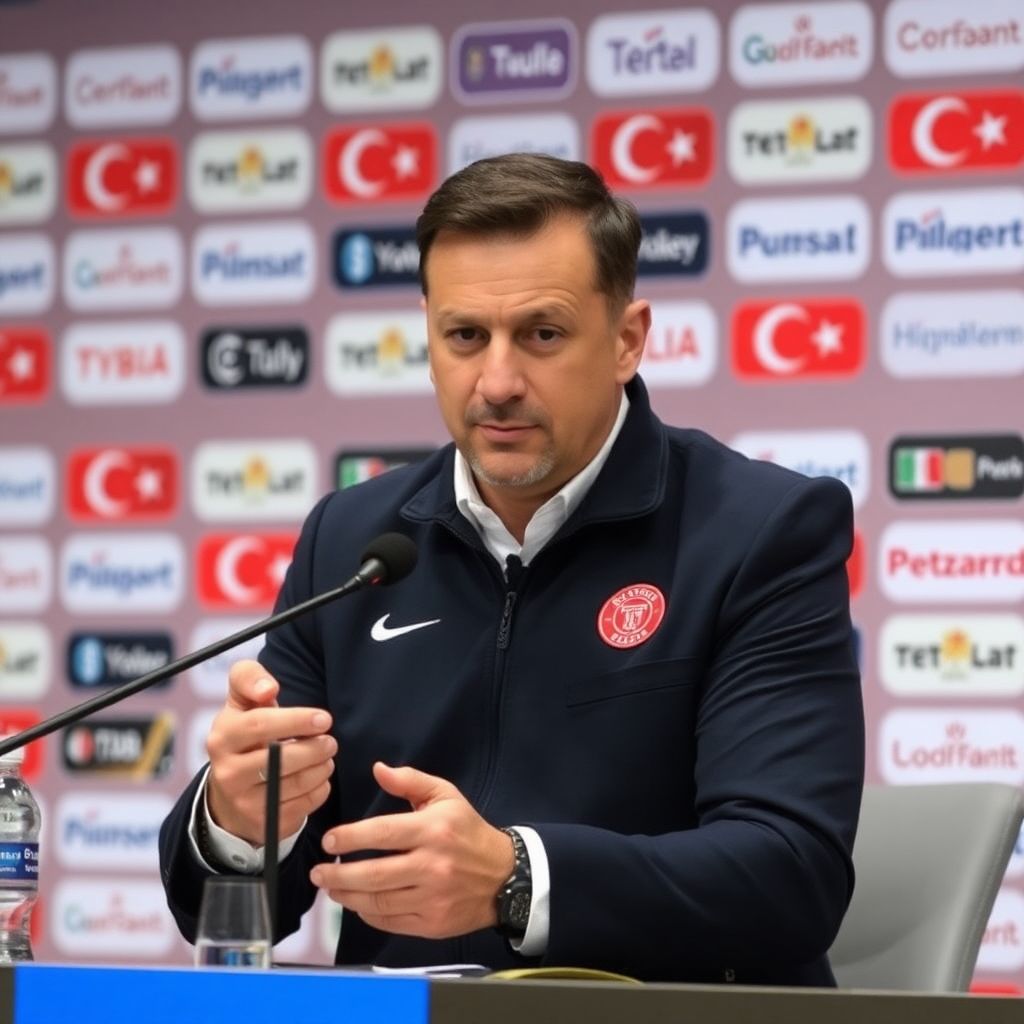
Turkish Football Federation (TFF) president İbrahim Hacıosmanoğlu has moved decisively to calm the storm surrounding the national team after Turkey’s mathematical elimination from the 2026 FIFA World Cup. Facing the media at the national team camp, he issued an unequivocal vote of confidence in head coach Vincenzo Montella and the current technical staff, while delivering a pointed and highly personal rebuke to legendary coach Fatih Terim.
Montella’s Position: “Resignation Was Never on the Table”
With calls growing louder for Montella’s dismissal following consecutive defeats to Australia and Paraguay, Hacıosmanoğlu cut through the speculation. According to him, the idea of a coaching change was never seriously considered.
“I didn’t even give him the chance to bring up resignation,” the federation president said. “There has never been such a conversation between us, and there is no reason to have it. When you sit in this chair, you must know the psychology of your coach and your players. Your job is to protect them and prevent them from being dragged into toxic environments.”
Hacıosmanoğlu framed the situation not as a managerial crisis, but as a test of leadership and stability. In his view, reacting impulsively to disappointing results by sacking the coach would only deepen the structural problems of Turkish football.
“This Is Not a Club Team”: Defense of Continuity
The TFF president drew a firm line between national team management and club football, arguing that knee-jerk overhauls only feed long-term underperformance.
“A national team cannot be run like an ordinary club,” he insisted. “In club football, you see constant changes, and that is exactly why chronic failure sets in. You cannot just send away 15 players and bring in 15 others. You cannot casually throw away a manager or a president.”
He then delivered one of his most memorable lines, summarizing his philosophy of loyalty and continuity:
“Those who know my character understand this: we do not abandon the people we walk the road with for those we simply stumble upon along the way.”
In other words, the federation’s strategy is to stand by its chosen technical staff through turbulence, rather than flipping direction after every setback.
A Direct Clash with Fatih Terim: “Sincere vs. Insidious”
The press conference escalated in tone when Hacıosmanoğlu turned to recent comments from Fatih Terim, one of the most powerful and controversial figures in Turkish football history. Terim had recently suggested that after the tournament, there would be a “day of reckoning” and a period of “accountability” for the current federation leadership.
Hacıosmanoğlu did not shy away from confrontation.
“I am 60 years old,” he said. “Ask me about the last 40 years of Turkish football, and I can tell you exactly whose hand was in whose pocket, down to the day and the hour – including inside the national team structure.”
He pointedly rejected the idea that a federation president should always speak in guarded, diplomatic language.
“Everyone asks whether a federation president should be this blunt. Yes, he should. You will have to get used to it.”
“Heart and Tongue Aligned”: A Moral Counterattack
In a thinly veiled critique of Terim’s style and public posture, Hacıosmanoğlu contrasted what he called his own transparency with what he described as others’ hidden agendas.
“My heart and my tongue are completely aligned,” he said. “I say what is in my soul because I carry no hidden burden from my past. Those who cannot reflect their heart on their tongue can only slip insidious sentences between their words.”
He went further, describing people who, in his view, are oppressed by their own history:
“Those who are crushed under the weight of their past do not have the courage to speak openly with their mouths. They try to respond with hand gestures instead.”
The message was clear: in the struggle over who defines the future of Turkish football, Hacıosmanoğlu was placing himself as the honest, direct voice against what he painted as manipulative and covert criticism from the old guard.
Denial of Dressing Room Rifts and Captain’s “Influence”
Alongside the political and personal battles, Hacıosmanoğlu also addressed rumors of internal divisions within the national team camp. For weeks, there had been speculation that captain Hakan Çalhanoğlu was interfering in tactical decisions, allegedly dictating starting line-ups to Montella.
The TFF president rejected those claims outright.
“We are speaking directly to those who manufacture lies that this squad is at war with itself,” he said, visibly frustrated. “We are addressing the immoral people who claim that the captain is choosing the starting eleven. This team will make every one of them swallow their words.”
He insisted that the players are not collapsing under football-related pressures, but rather under an avalanche of malicious narratives.
“There is zero psychological pressure on these boys from a football perspective,” he stressed. “What they are feeling is deep unease caused by these shameful, unethical inventions that keep circulating around them.”
Call for Legal Action Against Online Abuse
The president then shifted his focus to what he described as a crisis of “digital morality.” The torrent of abuse, insults, and personal attacks directed at national team players and staff on social media platforms, he argued, has crossed all acceptable boundaries.
“I am making a direct appeal to our Minister of Justice, Akın Gürlek,” Hacıosmanoğlu declared. “People may analyze, they may criticize, but they cannot cross the red lines of basic human decency. In which other country is such disgraceful digital abuse tolerated?”
He called for urgent legal reforms aimed at protecting both the individuals under attack and the institutional stability of Turkish football.
“Emergency regulatory measures are absolutely necessary if we want to safeguard the structural integrity of our game,” he said. “If we allow this climate of online lynching to continue, no coach, no player, no federation official will be able to work in peace.”
World Cup Failure: Zero Goals, Zero Points – But Not Zero Plan
Turkey’s group-stage exit, sealed without a single goal scored and without a single point gained, has sparked deep frustration among fans. However, Hacıosmanoğlu urged the public to separate emotional disappointment from strategic decision-making.
From his perspective, the disastrous campaign is not a reason to rip everything up, but a moment to diagnose what went wrong within an existing long-term framework.
Football, he argued, is full of examples where national teams endure short-term collapses yet rebuild successfully by preserving a clear vision and keeping faith with their chosen technical leaders.
Long-Term Vision Over Short-Term Outrage
Hacıosmanoğlu’s stance reflects a broader debate within Turkish football: whether to prioritize immediate changes to appease public anger, or to stick to a coherent project even when results are poor.
He clearly favors the second path. According to him, constant resets – new coaches, new squads, new narratives – are precisely what prevent Turkish football from building a stable identity.
He believes that the national team needs continuity in principles: a consistent playing philosophy, clear pathways from youth levels to the senior squad, and a stable leadership that is not paralyzed by each bad tournament.
In his view, Montella is not a temporary solution but a strategic appointment whose work must be judged across several cycles, not a handful of group-stage matches.
A Power Struggle for the Soul of Turkish Football
The clash between Hacıosmanoğlu and Terim is more than a personal feud; it represents a larger power struggle over who shapes Turkish football’s future.
On one side stands a federation leadership that speaks in the language of institutional reform, digital regulation, and long-term planning. On the other is a football icon with decades of influence, backed by sections of the public nostalgic for past glories and demanding swift accountability.
By targeting “insidious sentences” and “hidden baggage,” Hacıosmanoğlu signaled that he sees the resistance to his leadership as originating not just in sporting concerns, but in entrenched interests and old networks that feel threatened by his confrontational style.
Protecting Players as a Strategic Priority
Behind the political headlines, there is also a generational issue. Turkey’s current squad includes players who have grown up in an era where every performance, mistake, and personal detail is amplified online in real time.
Hacıosmanoğlu’s insistence on shielding the team from “toxic environments” is not only about defending them in the media; it is also about preventing a culture where young players are scared to represent their country for fear of becoming targets.
He is effectively arguing that if Turkish football wants courageous, expressive players on the pitch, it must offer them protection off it – especially from the relentless scrutiny and hostility that can define the digital age.
What Comes Next for Montella and the TFF
Despite the World Cup debacle, all signs from the federation suggest that Montella will keep his job and be tasked with overseeing the next phase of rebuilding. That likely includes:
– Reassessing tactical approaches and player roles without tearing up the entire squad.
– Rebuilding the team’s psychological resilience after a bruising campaign.
– Integrating promising younger talents into a core group that can grow together.
– Establishing clearer communication with the public to manage expectations.
Hacıosmanoğlu’s repeated emphasis on loyalty and continuity suggests that he views this tournament as a painful but necessary learning step, not as the end of a cycle.
A Message of Loyalty in a Climate of Instability
At the heart of the TFF president’s address was a broader message: in a football culture often driven by emotion, outrage, and quick fixes, he wants to draw a line in the sand.
“We do not trade lifelong partners for strangers,” he said, positioning himself, his coach, and his players as fellow travelers on a long road rather than disposable pieces on a board.
Whether that philosophy will withstand the pressure of public opinion and political resistance remains to be seen. But for now, despite the empty scoreboard and early plane home, one thing is clear: the federation is not ready to throw Vincenzo Montella – or its broader project – overboard in response to a single catastrophic campaign.