
Why women’s sports in Turkey are suddenly everywhere
Scroll Turkish sports news in 2026 and you’ll notice something: women’s games are no longer a footnote. Arenas fill up, streaming numbers grow, and young girls quote stats as confidently as any pundit. To stay on the same page, let’s clarify terms. When we say “women’s sports in Turkey”, we mean officially organized competitions where women’s teams or individual female athletes participate under national or club federations, with rankings, calendars and formal rules, not just recreational play. This shift from hobby to structured profession is the core of today’s transformation.
Key definitions: athletics, basketball, volleyball
Before diving into success stories, fix three terms. “Athletics” covers track and field events (sprints, middle distance, long distance, jumps, throws, multi-events), managed in Turkey by the national federation that runs the turkish women athletics championships. “Professional basketball” here means club leagues with salaries, transfers and playoffs, plus national team competitions. “Professional volleyball” follows the same logic, but with more substitution rules and rotation patterns. Understanding these definitions helps separate casual school sport from the high‑performance ecosystem that now shapes careers and media narratives.
A quick “diagram” of the women’s sports ecosystem
Picture the system as layered infrastructure rather than isolated stars. Imagine a diagram in text:
[Diagram: Base = school PE and local clubs → Middle = regional leagues and youth academies → Top = national leagues, European cups, Olympics and world championships → Surrounding ring = media, sponsors, federations, and fans.]
If any layer fails, the pipeline cracks. Turkey’s recent progress came from strengthening each tier simultaneously: better school access, serious academies at big clubs, and aggressive investment in top divisions that made women’s games worth watching live and online.
Turkish women in athletics: from lanes to podiums
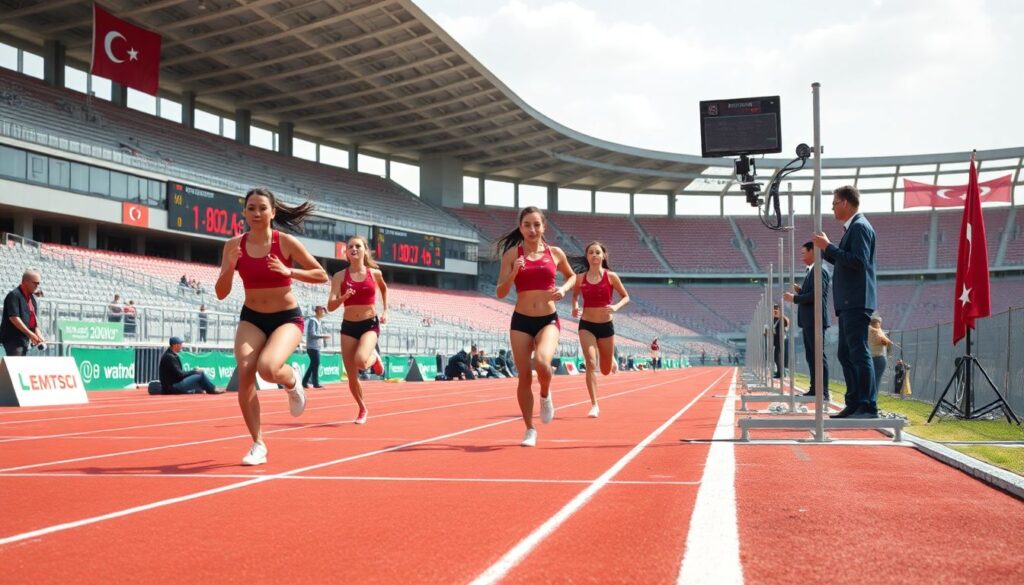
Women’s track and field in Turkey quietly professionalized in the 2010s and 2020s. The turkish women athletics championships shifted from a single big meet into a yearly reference point that scouts and sponsors actually watch. Here performance benchmarks matter: times, distances and wind readings quantify progress with brutal precision. Compared to early 2000s levels, national records improved across sprints and middle distances, putting more athletes into European finals. While depth still trails powerhouses like the US or Jamaica, Turkey now competes respectably with several European mid‑tier nations, especially in endurance and race‑walking events.
What makes athletics different from team sports
Athletics has a simple rule: the stopwatch and tape measure don’t care about reputation. That objectivity changes development. In basketball or volleyball, a coach’s preference might bench an athlete; on the track, hitting a qualifying standard forces doors open. This transparency helped Turkish women argue for equal access to training camps and funding. Another contrast: careers in athletics are often more individual, so agents, sports psychologists and medical staff play outsized roles. Where team sports lean on club identity, track athletes build personal brands around signature events, something more Turkish runners are exploiting on social media in 2026.
Basketball: from side court to prime-time product
Women’s basketball has arguably made the biggest commercial leap. Twenty years ago, halls were half‑empty; today turkey women’s basketball league tickets sell on regular e‑ticketing platforms, with dynamic pricing and season‑ticket campaigns mirroring the men’s league. Structurally, the women’s league now features clear promotion–relegation, youth quotas and foreign‑player limits intended to protect local talent. Compared with many European leagues, Turkey ranks near the top in both salaries and competitive level, which is why high‑profile imports from the WNBA and EuroLeague Women sign here between other commitments, raising standards for domestic guards and forwards.
How fans consume the women’s game now
Follow the viewing journey to see the shift. First, fans see short clips on social media; then they try a free stream; later they decide to buy turkey women’s basketball league tickets for a derby or playoff game. Clubs track this funnel with detailed data: clicks, view duration, conversion rates. This analytical approach, borrowed from tech and e‑commerce, contrasts with older “post a poster and hope” strategies. The result is visible in 2026: more organized fan clubs, family‑friendly arenas, and game‑day experiences (music, kids’ zones, meet‑and‑greets) that turn a single match into a repeatable habit.
Volleyball: the flagship of women’s team sport in Turkey
If basketball is catching up, volleyball has been the frontrunner. For a decade, women’s volleyball teams in Turkey have dominated European competitions, beating clubs from Italy, Russia and Poland on a regular basis. That success rests on three pillars: robust club academies, serious investment in sports science, and a tactical culture that treats video analysis as non‑negotiable. turkish female athletes volleyball stars are now global reference points for serve‑receive systems and fast‑tempo offense. Compared to men’s volleyball, the women’s league actually commands similar, sometimes higher, audience interest domestically, which is unusual in global sport.
Comparing the three: why volleyball pulled ahead
To understand why volleyball leads, contrast constraints. Volleyball requires less physical contact and allows earlier specialization, which made it a safer sell for conservative families; basketball often looked “rougher”, and athletics demanded more travel and solitary training. At club level, volleyball also benefitted from European competition slots that Turkish teams quickly converted into titles, creating a success feedback loop: wins → sponsorship → better foreign signings → more wins. Athletics lacked that club‑based European structure, while women’s basketball hit ceilings in some international tournaments. These structural quirks, not just talent, explain today’s hierarchy.
Social impact and role models
Performance is only half the story; visibility is the other. When a national volleyball star or a leading point guard appears in mainstream TV shows or campaigns, they normalize the idea of sports as a profession for girls. This social validation matters in regions where early marriage or limited mobility still shape choices. Compared to the 1990s, families today are more likely to support weekend tournaments and long training camps, because they have concrete examples of women turning sport into scholarships, international careers and later coaching or media jobs, not just short‑lived teenage hobbies.
Text‑based trend diagram: where 2026 stands
To summarize the current moment, imagine another diagram:
[Diagram: 2010 = low visibility, minimal TV → 2020 = breakthrough stars, more sponsorship → 2026 = stable pro leagues, export of talent, youth saturation in big cities → 2030 (projection) = deeper regional academies, broader corporate backing, stronger Olympic medal chances.]
Turkey now sits in the 2026 box: sustainability is the key word. Leagues exist, fan culture is real, and youth pipelines are busy. The main challenge is keeping this from plateauing, especially outside Istanbul, Ankara and Izmir, where resources are still uneven.
Forecast to 2035: what’s likely next
Looking ahead from 2026, expect three big trends. First, analytics and wearable tech will spread down from elite clubs into youth systems, especially in volleyball and basketball, making injury prevention and load management part of everyday coaching. Second, athletics will likely gain depth rather than a single superstar: more finalists in European meets and at least one strong relay squad coming from the expanded turkish women athletics championships ecosystem. Third, internationalization will accelerate as more Turkish women sign abroad, and foreign players continue to view Turkey as a career hub, knitting the country tighter into global women’s sport.
Policy priorities to keep the rise going
For this trajectory to hold, decision‑makers need to treat women’s sport as infrastructure, not a trend. That means equal facility access in municipalities, transparent funding criteria in federations, and media deals that guarantee women’s games steady, not occasional, coverage. Compared with many countries, women’s sports in Turkey already punch above their historical weight, especially in volleyball. The next phase is qualitative: better coaching education, stronger protections against harassment and discrimination, and dual‑career support so athletes can move into coaching, refereeing and management, keeping experience inside the system instead of losing it at retirement.
What this means for the next generation

For a girl picking a sport in Turkey in 2026, the decision now involves concrete questions: “Which club has the best pathway? Who are the top women’s volleyball teams in Turkey I can actually watch on weekends? What kind of scholarship can basketball earn me? How fast do I need to run to qualify for nationals?” That shift—from abstract permission to detailed planning—is the real sign of progress. If stakeholders keep reinforcing pathways and visibility, the 2035 conversation may not be about whether women belong in sport at all, but about how often they bring home medals and trophies.