Why Turkey Suddenly Feels Like a Tennis Country
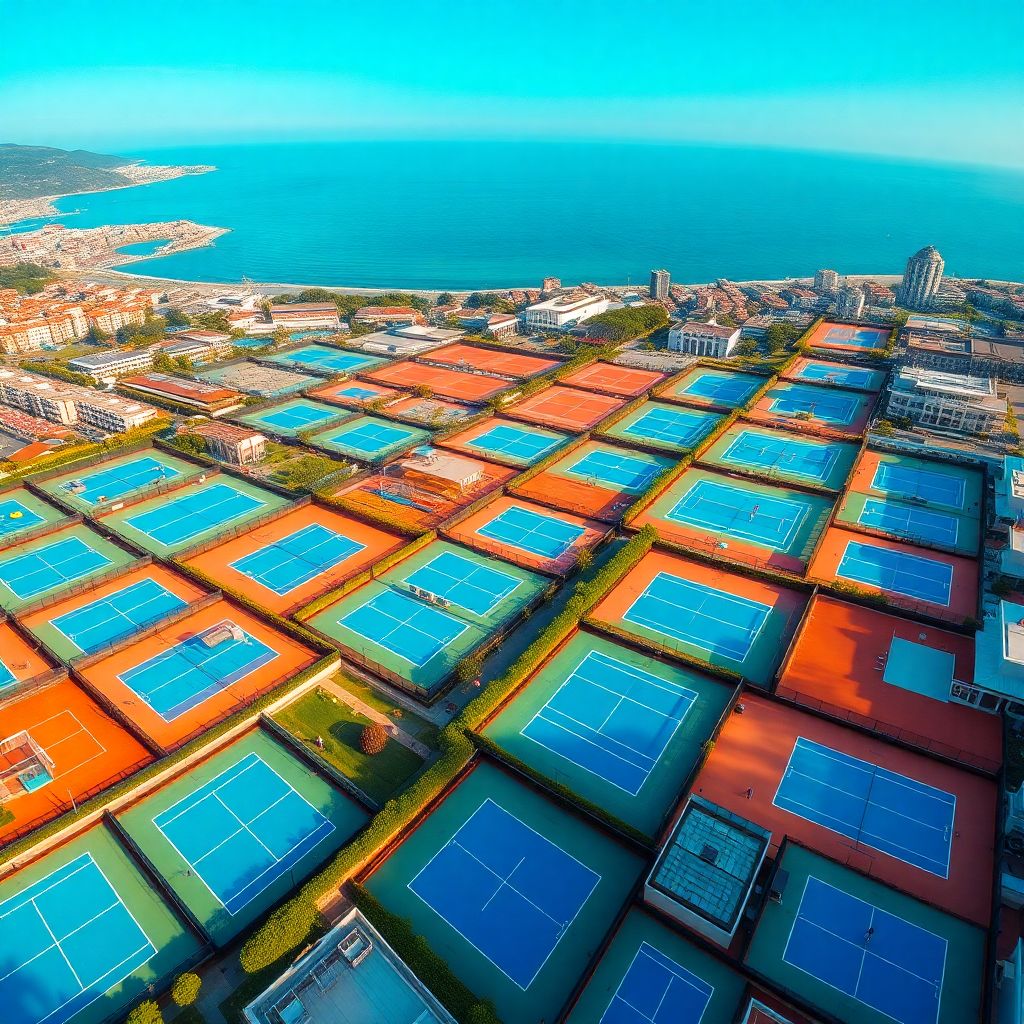
If you’ve flown into Antalya in the last few years and looked down from the plane, you’ve probably noticed it: rectangles of green and red everywhere. That’s not football turf — it’s a rapidly expanding grid of tennis courts in Turkey, from resort complexes on the coast to municipal facilities in inland cities.
Tennis in Turkey isn’t new, but the scale and speed of growth between roughly 2010 and 2025 has been dramatic. In 2005 the Turkish Tennis Federation reported only a few hundred registered courts and a small base of competitive players; by the early‑2020s the number of courts had multiplied several times, and junior tournament participation was up by thousands of percent compared with the early 2000s.
The interesting part isn’t just “more courts”. It’s *how* Turkey is moving — literally — from clay to hard courts, and what that says about its emerging tennis culture and ambitions on the global stage.
—
From Embassy Lawns to ATP Tournaments: A Short History
Early 20th century: a niche expat sport
Tennis arrived in the late Ottoman and early Republican era, mostly via British and other European diplomats in Istanbul and İzmir. Courts were tucked away in embassies and a few members‑only clubs. Until the 1970s, it was essentially an elitist pastime. Infrastructure was minimal, coaching was informal, and the national federation (founded in 1953) was tiny.
1980s–1990s: clay dominance and slow, local growth
From the 1980s into the 1990s, tennis clubs began to appear in bigger cities:
– Clay was the default surface.
– Courts were often built inside multi‑sport complexes that also hosted football and basketball.
– Competitive structure was limited: a handful of national tournaments, very few ITF events, and modest junior programs.
Most courts were classic European‑style red clay: low construction cost, easier on the joints, but high maintenance. Watering, sweeping, rolling — all daily realities. For a developing tennis country, that mattered.
2000s: tourism money and the first big shift
The real turning point started in the 2000s, driven by tourism — not by domestic demand.
Resort owners along the Mediterranean realized that German, Russian and Scandinavian visitors wanted more than a beach. Packages branded as “tennis holidays in turkey” started to appear in European tour catalogues. To satisfy this market, hotels in Antalya, Belek and Side invested heavily in multi‑court complexes:
– Initially mostly clay (or artificial clay) to appeal to Central and Eastern European players.
– Quickly followed by hard courts, because hard was cheaper to maintain at scale.
By the early 2010s, you could find hotel complexes with 20+ courts, on‑site coaches, and organized weekly tournaments. The curious side effect: these facilities became the first exposure to high‑quality tennis infrastructure for many Turkish kids whose parents worked in tourism.
—
Why Turkey Is Moving from Clay to Hard Courts
The economics behind the surface switch
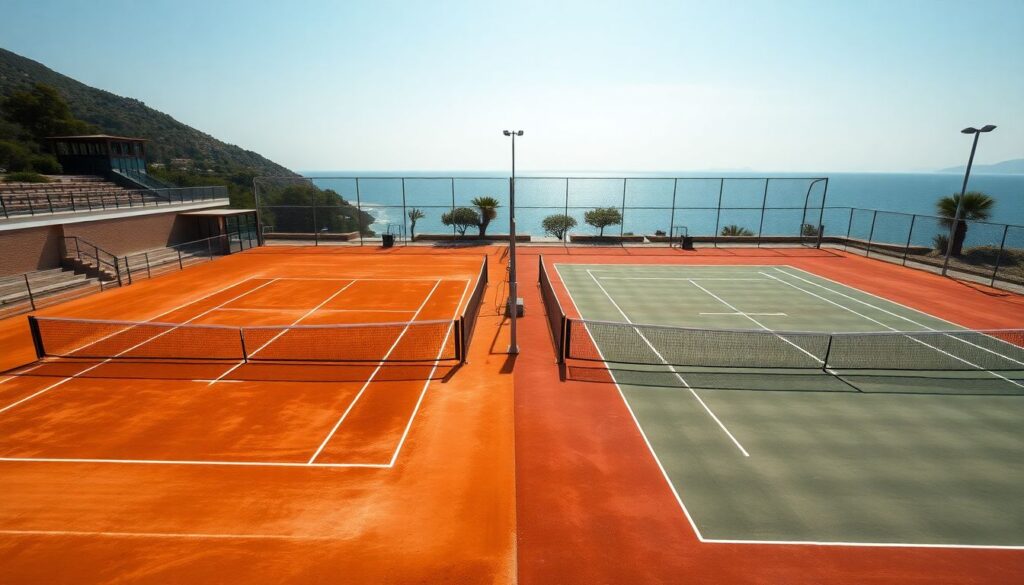
From a distance, “clay vs hard” sounds like a stylistic choice. On the ground, it’s about cost, climate, and performance.
Maintenance costs
– Clay courts need constant grooming: daily brushing, regular watering, periodic re‑levelling. In coastal Turkey, water isn’t always cheap in peak season, and labor costs have risen.
– Hard courts — typically acrylic systems on asphalt or concrete — demand more upfront investment but much lower day‑to‑day maintenance. A proper resurfacing might be necessary every 5–7 years in a busy facility, but operational costs in between are relatively low.
For a 20‑court resort hosting thousands of guests each season, even a 10–15% reduction in maintenance outlay becomes a major line‑item saving. That’s one key reason you now see entire blocks of hard courts replacing older clay installations.
Climate and usage
Mediterranean summers are hot and dry. Clay dries out fast and becomes dusty and uneven without aggressive watering schedules. Hard courts, while hot underfoot, play more consistently in 35–40°C, and can be used almost immediately after rain — critical during shoulder seasons when every playing hour counts for holiday packages and tennis training camps Turkey operators.
Player development
At high-performance level, hard courts more closely resemble the surfaces used on the US Open and Australian Open, plus most major lead‑up events. Turkish coaches and federation planners recognize this: if juniors are to compete internationally, they must be comfortable on hard.
Result: a gradual policy and market shift where new competitive centers are overwhelmingly hard‑court, while traditional private clubs often keep a mix with at least some clay.
—
Inside the Infrastructure Boom
Resorts, public courts and urban clubs
Today, when people talk about tennis courts in Turkey, they’re no longer referring only to private member clubs. The ecosystem has several distinct pillars:
1. Resort complexes (mainly Antalya region)
Facilities with 10–30 courts, on‑site accommodation, and tournament services. These host ITF Futures, junior events, and thousands of visiting amateurs each year.
2. Municipal and university courts
Many cities — from Ankara and Konya to Gaziantep — have invested in public courts as part of sports‑for‑all programs. Some are simple asphalt courts; the better ones use proper acrylic coatings and lighting.
3. Traditional and new‑wave clubs
Especially visible in big cities. Istanbul, Ankara and İzmir saw a surge of mid‑sized clubs between 2015 and 2024, often blending padel, fitness facilities, and café culture with tennis.
—
Tennis clubs in Istanbul: a case study in urban demand
If you want to understand changing culture, look at tennis clubs in Istanbul.
Historically, they were mostly:
– On the European side, connected to long‑established multi‑sport associations.
– Clay‑dominant, with waiting lists and fairly formal membership rules.
Over the last decade, several things changed:
– Indoor courts became a priority due to rain, winter cold, and heavy traffic that limits commuting time. Many private facilities now have at least 2–4 covered hard courts.
– Pay‑to‑play models emerged alongside classic memberships. Working professionals book slots via apps instead of joining for a full year.
– Adult beginners and cardio tennis exploded in popularity, especially among 25–40‑year‑olds looking for a social alternative to the gym.
One club manager in Istanbul recently summarized their court mix like this: “In 2010 we had 5 clay, no hard. In 2024 we have 3 clay, 4 outdoor hard, 2 indoor hard, and we’re planning more.” That shift is a microcosm of the national trend.
—
The Rise of Academies and Training Camps
From local coaching to structured performance pathways
Until the late 2000s, a talented Turkish junior had a fragmented path:
– local coach at a club
– occasional national tournament
– minimal international exposure
Now, several tennis academies in Turkey operate on a more systematic model: full‑time programs, sports science support, and regular ITF tournament scheduling.
These academies typically offer:
– Weekly training volumes in the 15–25 hour range for serious juniors.
– Integrated fitness, including strength, mobility and conditioning blocks.
– Video analysis and match analytics at least at basic level (serve speeds, rally length, unforced error patterns).
They also tend to prefer hard courts for key training blocks, to mirror the surface of most international events youngsters will play.
Technical block: what “high‑performance” really means
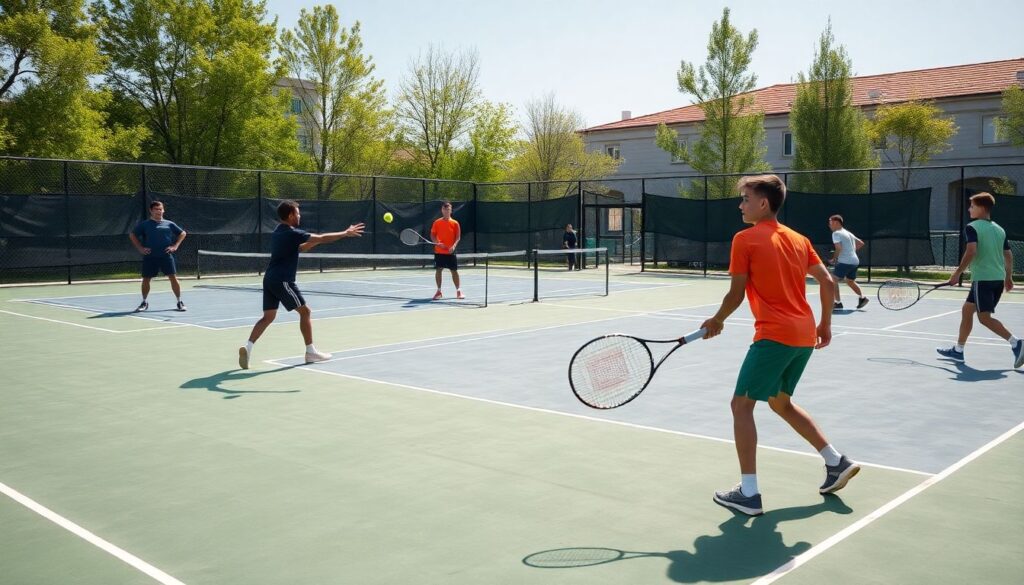
In practical terms, an advanced junior week at a top Turkish academy might look like:
– On‑court drills (12–16 hours)
– Serve + first ball patterns on hard courts at match speed.
– Cross‑court/backhand‑line combinations to build direction change under pressure.
– Point‑based games starting from specific tactical situations (e.g., second‑serve returns).
– Conditioning (4–6 hours)
– Repeated sprint ability (10–20 m sprints with short rest).
– Lateral movement drills with reaction stimuli (light or sound cues).
– Specific strength for deceleration and change of direction (lunges, split squats, anti‑rotation work).
– Match play and review (3–4 hours)
– Practice sets on both clay and hard to adjust footwork patterns.
– Post‑match debriefs focused on decision‑making rather than only technique.
This kind of structure, once rare, is becoming the norm in the country’s more serious programs.
—
Tennis training camps Turkey: from seasonal add‑on to core business
Initially, camps were just a bonus offering at resorts: “play some tennis in the sun”. Over time, they evolved into a specialized product:
– Pre‑season camps for European league players in February–March.
– High‑volume junior camps in school holidays.
– Federation or regional team camps using Turkish facilities as a low‑cost base compared with Western Europe.
Real‑world example: A German regional federation might bring 20 players for a 10‑day block. They get:
– 3–4 hours of court time per day.
– Access to clay and hard courts to simulate both European and US‑style conditions.
– Consistent weather in Antalya when Germany is still under rain or snow.
For local Turkish players, these camps create sparring opportunities and raise the general standard of play.
—
Tourism, Economy and Tennis Holidays
Why tennis holidays in Turkey became a mainstream product
Several underlying factors made Turkey ideal for sports tourism:
– Climate: playable outdoor conditions from roughly March to November in coastal regions.
– Cost advantage: court time, accommodation and coaching packages undercut Spain or Italy at similar quality levels.
– Flight connectivity: direct connections from most major European cities to Antalya and Istanbul.
By the early 2020s, some large resort complexes were reporting:
– Tens of thousands of court‑hours booked per season.
– Up to 60–70% court occupancy at peak spring and autumn weeks.
– A client mix where regular annual visitors — returning groups and clubs — became a stable revenue base.
Looking to 2026, the trend is less about sheer numbers and more about specialization: themed camps (e.g., left‑handers, seniors 50+, tactical bootcamps) and blended packages combining tennis, cycling or wellness.
—
Distinct Playing Styles: Clay vs Hard in Turkish Context
How surface shapes players
The “from clay to hard court” narrative isn’t just about construction companies and budgets. It affects how Turkish players actually play.
Clay‑court upbringing tends to create:
– heavier topspin
– better patience in long rallies
– stronger sliding footwork and defensive skills
Hard‑court emphasis encourages:
– bigger first serves and aggressive second‑serve returns
– flatter, earlier ball striking
– more focus on first four shots of the point
Turkey currently sits in an interesting hybrid zone. Many older coaches grew up on clay, while more and more tournaments — especially ITF events along the coast — run on hard. That tension creates a valuable diversity of styles, and you can see it in junior events: some players are classic clay grinders; others look built for US college tennis from day one.
—
Technical block: surface‑specific adjustments for players
1. Footwork patterns
– On clay: longer, more gliding steps, using controlled slides to decelerate.
– On hard: shorter, more explosive adjustment steps; stronger emphasis on braking early to protect joints.
2. Tactical priorities
– On clay: higher, heavier balls to push opponents back; more use of drop‑shots and angles.
– On hard: lower, penetrating shots, flatter backhands, frequent serve + 1 patterns.
3. Training load management
– On clay: slightly higher on‑court volume is often tolerated due to lower impact.
– On hard: greater attention to recovery, footwear, and strength work for knees/hips.
Top Turkish academies now deliberately rotate juniors between surfaces to build adaptable games rather than specialists locked into one style.
—
Numbers, Reality Checks and the Road to 2030
What’s working — and what isn’t
By the mid‑2020s, a few trends are clear:
1. Participation
– Recreational tennis has expanded far beyond traditional elites. Middle‑class adults and kids now fill evening slots at city clubs and public courts.
– Waiting lists at popular urban centers demonstrate that demand is outpacing court construction in some districts.
2. Performance
– Turkey has produced more players who can compete at ITF and Challenger level, especially on the women’s side.
– The step from solid professional to consistent top‑100 ATP/WTA contender is still challenging. Infrastructure alone isn’t enough; coaching depth and competition density matter.
3. Regional inequality
– Major hubs like Istanbul, Ankara, İzmir and Antalya flourish.
– Smaller Anatolian cities may have only a handful of decent courts and very limited coaching, which restricts talent discovery outside big centers.
—
Looking ahead: realistic expectations for 2026 and beyond
In 2026, the “growing tennis culture” in Turkey is less about a sudden revolution and more about consolidation and sophistication:
– More integrated pathways from beginner to performance player.
– Better quality control in coaching education.
– Continued expansion of hard‑court venues, especially multi‑court centers that can host regional and international events.
If the current trajectory continues, you can reasonably expect:
1. A broader base of competitive juniors feeding both university tennis pathways abroad and domestic pro attempts.
2. Further evolution of resorts from simple holiday venues into respected training hubs, used year‑round by foreign federations.
3. Stronger local leagues and inter‑club competitions, especially within metropolitan regions.
—
So, Is Turkey a Tennis Nation Now?
It might be early to put Turkey in the same sentence as traditional heavyweights like France or Spain, but the direction is clear. Over roughly two decades, the country has gone from a small, clay‑heavy niche scene to a varied ecosystem of resorts, public facilities, urban clubs, and serious academies — with a decisive strategic nudge towards hard courts.
For visiting players, the changing landscape means more choice: you can hit on red clay in spring, grind through practice blocks on fast acrylic in autumn, or dive into structured programs at modern tennis academies in Turkey without leaving the Mediterranean.
For locals, it means something deeper: tennis has shifted from a symbol of exclusivity to a realistic option for kids in many middle‑class neighborhoods. The red dust of classic clay isn’t disappearing, but the blue and green of hard courts are increasingly shaping what Turkish tennis will look like — and how its players will compete — in the years leading up to 2030.
Комментарии