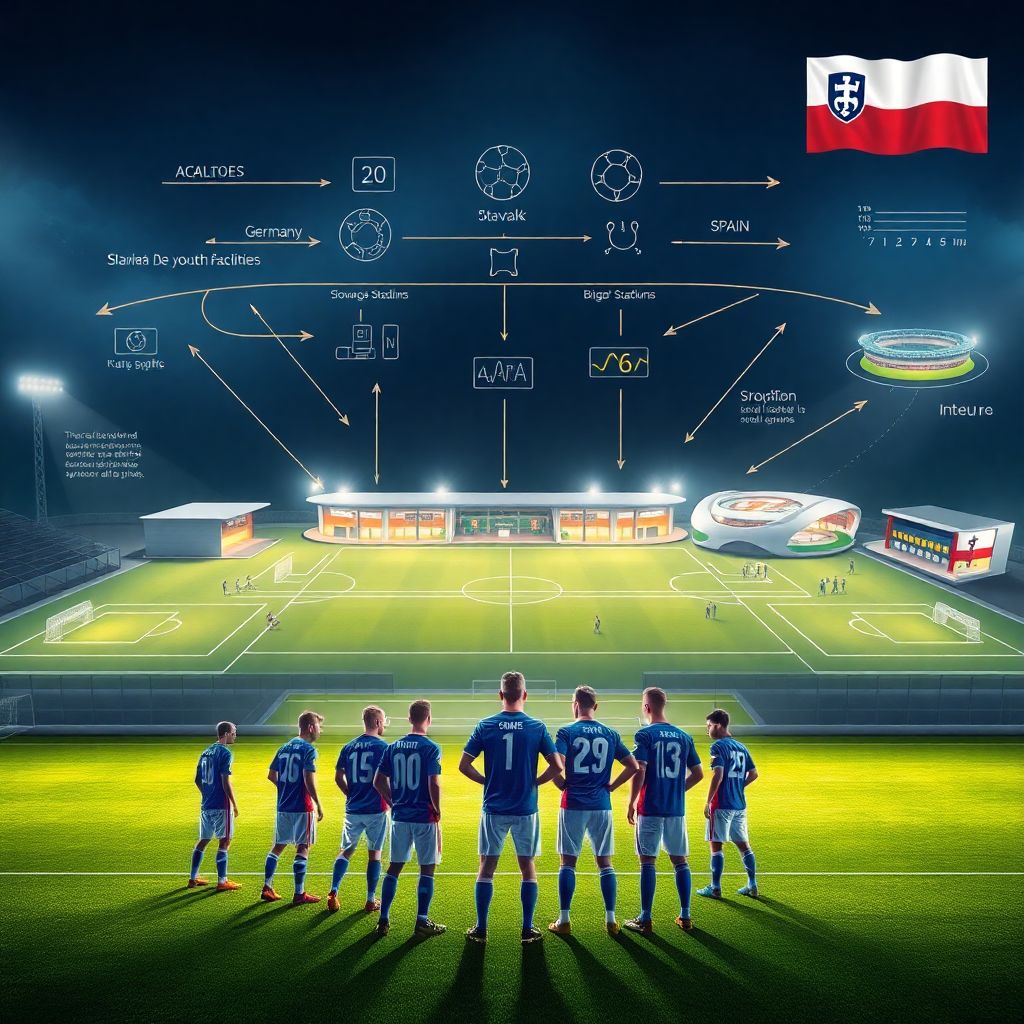
Slovakia’s calculated rise in European football
Slovakia’s emergence as a serious presence in European football is anything but accidental. Behind the national team’s resilience at major tournaments and the steady flow of Slovak players into top leagues lies a deliberate, long-term project. Over the past decade, the country has invested in youth, modernized its coaching culture, and rebuilt its football infrastructure with a clear objective: to compete consistently with Europe’s elite rather than merely take part.
Strategic foundations: building a modern football ecosystem
Instead of chasing short-term results or relying on a single star, Slovak football authorities and clubs agreed—implicitly and explicitly—on a wider vision. The focus shifted from patching up senior teams to creating an ecosystem where talent is identified early, nurtured properly, and given clear pathways to professional football.
This strategy rests on three pillars:
– robust youth academies attached to professional and semi-professional clubs
– continuous education and upskilling of coaches at all levels
– infrastructure improvements that make high-quality training accessible nationwide
The Slovak Football Association was crucial in coordinating these efforts, setting standards, and helping smaller regional clubs access resources that were once reserved for the top tier. The result is a far more coherent system where a talented child in a smaller town has a realistic shot at professional development, not just the lucky few born near a major club.
Youth academies: the engine of progress
Youth development has become the heartbeat of Slovak football. Instead of treating academies as side projects, many clubs now see them as their core business model—especially in a smaller market where transfer income can keep a club sustainable.
Clubs such as MŠK Žilina and DAC Dunajská Streda have become known for their academy-centric approach. They invest not only in pitches and gyms, but in creating environments where technique, decision-making, and football intelligence are prioritized over early physical dominance. Small-sided games, position-specific training, and scenario-based drills are now standard, even at younger age groups.
What distinguishes the current generation of Slovak academies is their consistency. Players move through clearly defined age-group structures, with an overarching playing philosophy that runs from under-12 teams to the senior side. That continuity helps young footballers understand what will be demanded of them at the professional level long before they make their debuts.
Scouting and structured player pathways
Modern Slovak clubs understand that talent can surface anywhere, not just in major cities or traditional football hotbeds. As a result, scouting networks have become more systematic. Regional talent identification events, closer cooperation between grassroots clubs and professional academies, and data-supported scouting are increasingly used to ensure prospects are not overlooked.
Once identified, talented players are offered more than just a place in a team. They are guided along clearly designed pathways—from local youth leagues to academy squads, reserve teams, and eventually first-team football. Many clubs also emphasize dual-career options, encouraging education alongside football to protect young athletes from the risks of early burnout or injury.
Importantly, Slovak clubs have fostered strong relationships with larger European sides. These partnerships create a realistic “export” pipeline: when a player outgrows the domestic league, there are clear channels for moving to higher levels abroad. That model, in turn, brings transfer fees back into Slovak football, funding further development.
The “golden generation” and homegrown stars
The recent wave of Slovak players plying their trade in the Bundesliga, Serie A, La Liga, and other top competitions is a visible outcome of this deeper structural shift. Names like Tomáš Suslov symbolize a broader trend: academy graduates who are not only technically polished but also tactically mature and mentally resilient.
Rather than one-off exceptions, these players represent a cohort raised in similar conditions—playing in competitive youth leagues, exposed early to international tournaments, and trained by coaches who see development as a long-term process. This “homegrown golden generation” has raised standards for what is expected from Slovak footballers, both at home and abroad.
Coaching revolution: from old-school to modern methods
The transformation of Slovak football would not be possible without a comparable shift in coaching. Traditional, rigid approaches—focused heavily on fitness and repetitive drills—have been supplemented and, in many cases, replaced by modern, game-realistic methods.
Coaches now receive ongoing education that emphasizes:
– tactical periodization and structured training cycles
– use of video analysis and statistics to refine tactics
– psychological preparation and man-management
– individualized development plans for each player
Younger coaches, often with experience abroad or exposure to international coaching courses, have brought fresh ideas back into the domestic game. They are more open to adapt global trends to the Slovak context, whether it be pressing systems, positional play, or flexible formations that suit the national talent pool rather than copying foreign styles blindly.
A distinctive Slovak playing identity
All of this has shaped a recognizable Slovak playing style. The stereotype of a purely physical, defensive-minded team no longer tells the full story. Modern Slovak sides tend to blend discipline and work rate with much-improved technical quality and tactical versatility.
At the national team level, this often means:
– compact defensive organization as a base
– quick, purposeful transitions rather than hopeful long balls
– midfielders comfortable in tight spaces and under pressure
– full-backs and wide players encouraged to join attacks intelligently
Slovak teams have become adept at adapting to opponents—whether soaking up pressure against stronger sides in European competitions or taking the initiative against comparable or weaker teams. That tactical flexibility has made them increasingly awkward opponents on the continental stage.
Competing in Europe: learning through exposure
As Slovak clubs and players gain more access to European competitions, the learning curve has steepened in a positive way. Facing clubs with bigger budgets and deeper squads has forced Slovak teams to become more efficient in preparation, strategy, and in-game management.
Even when they fall short, the experience of playing in qualifying rounds for European tournaments or group-stage matches is deposited back into the domestic game. Staff bring home insights on nutrition, recovery, training intensity, and tactical innovation, gradually narrowing the gap between Slovakia and more established football nations.
In parallel, Slovak internationals who succeed abroad bring back professionalism and high performance standards to the national team camp. Their exposure to top leagues creates a feedback loop that benefits younger teammates and domestic clubs.
Football’s expanding role in Slovak society
The sport’s progress has gone well beyond the pitch. Football has become a visible source of national pride, particularly when Slovakia competes strongly at European Championships or World Cup qualifiers. Major matches unite people across political and social lines, offering a rare shared emotional experience.
For many young Slovaks, the growing presence of homegrown players in major European leagues is both motivating and aspirational. Grassroots participation has climbed as children see realistic role models who started in local academies and made it to top clubs. That surge in interest has encouraged municipalities and smaller clubs to invest in pitches, indoor halls, and community programs.
Economic and cultural ripple effects
Economic benefits follow sporting success. Improved performances on the European stage draw greater attention from broadcasters and sponsors. Clubs are able to negotiate better commercial deals, while successful transfers of academy graduates bring in funds that can be reinvested into facilities, staff, and youth structures.
At a cultural level, football is helping shape Slovakia’s modern identity. In a relatively young independent state, shared sporting moments contribute to a sense of belonging and international visibility. Slovak flags in European stadiums, the national anthem sung before knockout matches, and media coverage of Slovak stars abroad all add layers to how the country perceives itself and is perceived by others.
Challenges that still remain
Despite this impressive progress, Slovakia’s football journey is far from complete. The domestic league still faces financial constraints, and keeping top talents at home for longer remains a challenge. Smaller clubs often struggle to balance the need for immediate results with a long-term development mindset.
There is also an ongoing need to expand access in rural areas, improve women’s football structures, and ensure that coaching quality is consistent across all regions. Maintaining momentum requires not just investment but also governance transparency, strategic planning, and patience from fans and stakeholders alike.
The next phase: sustainability and refinement
Looking ahead, Slovakia’s next step is to transform its current wave of success into something sustainable. That means:
– deepening collaboration between clubs, schools, and the federation
– continuing to professionalize youth and women’s football
– expanding sports science and performance analysis in everyday training
– keeping talented coaches within the system through competitive conditions
If Slovakia can maintain its focus and avoid complacency, it has every chance to turn its present rise into a long-term presence among Europe’s respected football nations. The foundations—youth, coaching, infrastructure, and identity—are now firmly in place.
In 2025 and beyond, the real question is no longer whether Slovakia belongs on the European stage, but how far this carefully constructed project can go. The answer will depend on the same ingredients that powered its climb: clear vision, intelligent planning, and the courage to keep evolving.