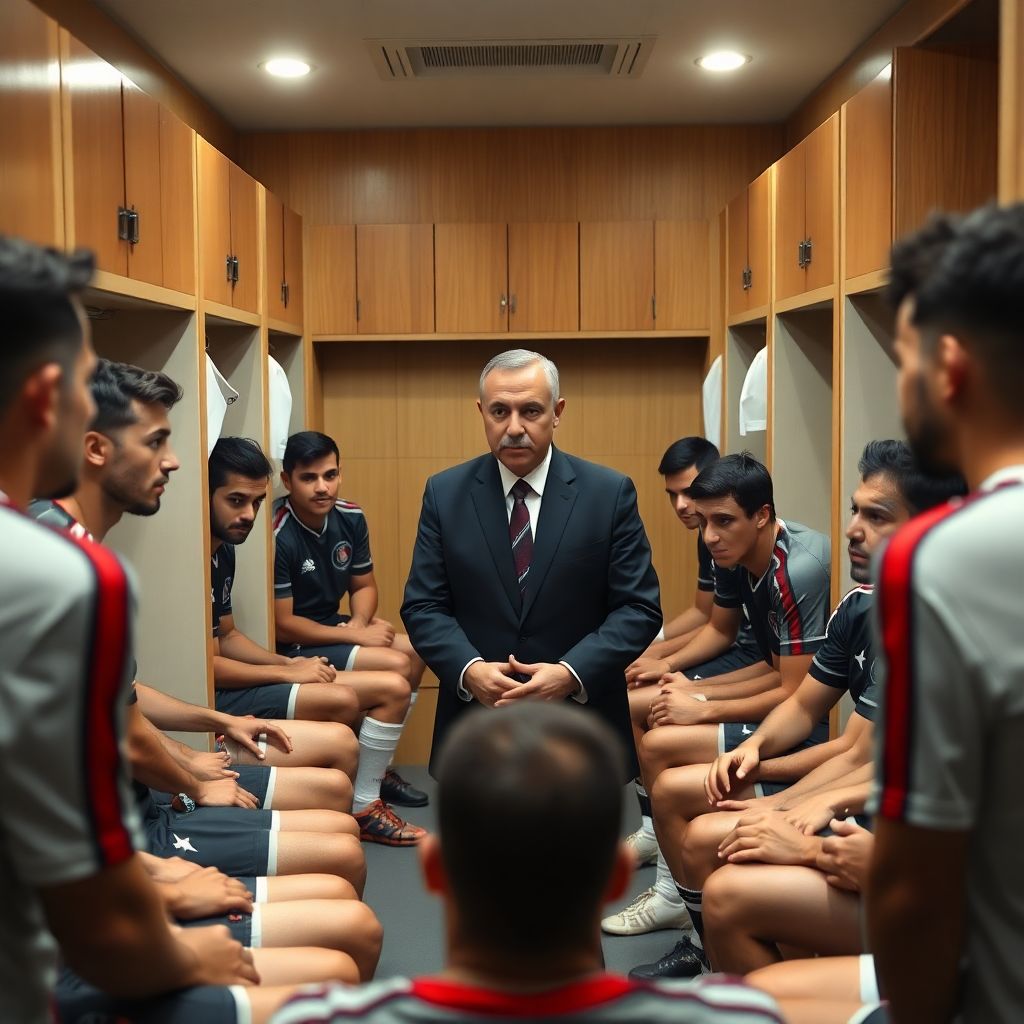
Erdoğan Moves to Calm Turmoil in Turkey Camp Before Crucial Paraguay World Cup Showdown
Turkish President Recep Tayyip Erdoğan has personally stepped into the mounting crisis around the national football team, ordering an immediate halt to political and institutional infighting on the eve of Turkey’s do‑or‑die 2026 World Cup clash with Paraguay.
The intervention comes after days of simmering tension, explosive public statements and intensifying media coverage that threatened to overshadow Turkey’s entire campaign in North America, already off to a poor start with a 2-0 defeat to Australia in their opening Group D match.
Federation vs. Legend: How the Crisis Erupted
The national team camp descended into chaos when Turkish Football Federation (TFF) President İbrahim Hacıosmanoğlu publicly attacked iconic coach Fatih Terim.
Terim, speaking on his YouTube channel, had remarked that there would be a time for “accountability” once the tournament was over. Though he did not name individuals directly, the implication that decisions at the federation level would be scrutinized later clearly struck a nerve.
Hacıosmanoğlu responded with a sharp, highly charged rebuke delivered from the team’s base in Arizona. His comments, widely circulated in Turkish media, escalated the feud from a simmering disagreement into a full-blown institutional clash right in the middle of the World Cup.
The spectacle of a powerful federation president and one of the most influential figures in Turkish football publicly trading barbs created the impression of a divided football establishment at precisely the moment when unity was crucial.
Presidential Intervention: Order From the Top
Recognizing that the off‑field chaos was seeping into the dressing room and eroding public confidence, Erdoğan moved to reassert control. Reports from Ankara say the president held urgent phone calls with senior football officials and representatives close to the squad.
His message was direct and uncompromising: all public disputes must end immediately. Erdoğan demanded that every stakeholder – from federation leadership to prominent former coaches – present a united front while the national team competes on the world stage.
Personal grievances, debates over leadership and institutional accountability, he insisted, would have to wait until after the tournament. The priority, for now, is to protect the players, restore focus and prevent further damage to the team’s morale.
Protecting Montella and the Dressing Room
Central to Erdoğan’s intervention is the attempt to shield current manager Vincenzo Montella and his players from the political storm.
Before the president stepped in, the mood inside the camp had already darkened. Defender Samet Akaydin was among those who voiced concern, admitting that the relentless media pressure and online criticism were making it difficult for players to concentrate even during routine training sessions.
The atmosphere risked becoming toxic: every mistake on the pitch was being interpreted through the lens of the federation feud, and every rumor off it was magnified by intense scrutiny back home. For a team already under pressure for underperforming against Australia, the added noise was becoming unbearable.
Erdoğan’s move aims to draw a clear line between football matters and political power struggles, at least temporarily. By demanding silence and discipline from the warring factions, he is trying to give Montella space to work, refocus his squad and rebuild fragile confidence before the Paraguay test.
Relocating and Resetting in California
With a temporary truce now in place, Turkey has shifted its base to San Jose, California, to finish preparations for the second group game. The change of location offers a chance to reset mentally as well as tactically.
In San Jose, the coaching staff has reportedly emphasized simplicity and clarity: reduce external distractions, reinforce tactical principles, and rebuild trust within the group. Training sessions have been focused on tightening defensive organization – exposed badly against Australia – and improving transitions in attack.
Behind closed doors, senior players are understood to be taking on a greater leadership role, trying to insulate younger squad members from the swirl of headlines and social media commentary that followed the initial defeat and the ensuing war of words.
The Table Doesn’t Lie: Turkey’s Perilous Position
The numbers are brutal. Turkey sits bottom of Group D with zero points. The margin for error has vanished.
Against Paraguay at Levi’s Stadium in Santa Clara, Montella’s team effectively faces an elimination match. Anything less than a win would leave their hopes of reaching the Round of 32 hanging by a thread, if not extinguished entirely depending on other results.
Paraguay’s reputation for disciplined, compact defending only raises the difficulty level. They are not a side that will open up easily or allow Turkey the kind of space that might benefit their attacking players. Patience, precision and mental resilience will be crucial.
Tactical Stakes: More Than Just a Result
Beyond the psychological and political dimensions, the Paraguay fixture is also a critical tactical test for Montella. His approach against Australia drew criticism for leaving the team too exposed defensively while failing to create high‑quality scoring chances.
Against a defensively rigid opponent, Turkey cannot afford to become predictable. The coaching staff must find a balance between assertiveness and control: pressing without recklessness, circulating the ball without falling into sterile possession, and ensuring that key creators receive the ball in dangerous zones.
Set pieces may prove decisive. In matches where open‑play chances are scarce, rehearsed routines and precise delivery from dead‑ball situations can break even the most stubborn back line. Given the pressure of the situation, one well‑executed corner or free‑kick could dramatically alter both the scoreline and the tournament trajectory.
Psychological Management: Turning Crisis into Motivation
Erdoğan’s involvement underscores how entwined football and national identity are in Turkey. When the president feels compelled to intervene, it signals both the political sensitivity of the issue and the symbolic weight carried by the national team.
The challenge for Montella and his staff is to convert this political pressure into collective motivation rather than paralysing anxiety. Internally, the message is likely to be that the noise outside the camp must be ignored, and that the players now have a clear mandate: focus only on the pitch.
Sport psychology principles become essential in such moments: shorter, sharper meetings; clear, simple instructions; and an emphasis on controllable factors – work rate, concentration, communication – rather than outcomes that lie partly in the hands of referees or opponents.
Long-Term Questions Parked, Not Solved
Although Erdoğan’s intervention has calmed the waters in the short term, it does not resolve the underlying tensions. Terim’s remarks about future accountability reflect deeper debates about the direction of Turkish football, the performance of the TFF, and the strategic choices made in recent years.
For now, those conversations have been postponed. Should the team fail to progress from the group stage, they are certain to return with greater force. Should Turkey advance, however, the current crisis may be reframed as a turning point in a dramatic recovery story.
Either way, the president’s call has set the rules: critical assessments and institutional reckonings will have to wait until the World Cup chapter is closed.
A Nation Watching: Symbolism Beyond Sport
The Paraguay match is therefore more than a group‑stage fixture. It has become a test of Turkey’s ability to compartmentalize internal disputes, rally around a common goal and perform under extraordinary scrutiny.
For millions of supporters, the team’s response will serve as a barometer of resilience. A composed, united display could restore faith and shift the narrative from chaos to character. Another breakdown – whether tactical, mental or emotional – would likely reignite the tensions that Erdoğan has temporarily muted.
Countdown to Santa Clara
As kick‑off in Santa Clara approaches, one reality dominates: Turkey has no alternative but to win. The president has drawn a line under the public feud, the federation has been ordered into silence, and the players have been granted a fragile bubble of focus.
What happens next will be decided not in Ankara’s offices or in television studios, but on the grass at Levi’s Stadium – where, after days of noise and controversy, Turkey must finally let the football speak.