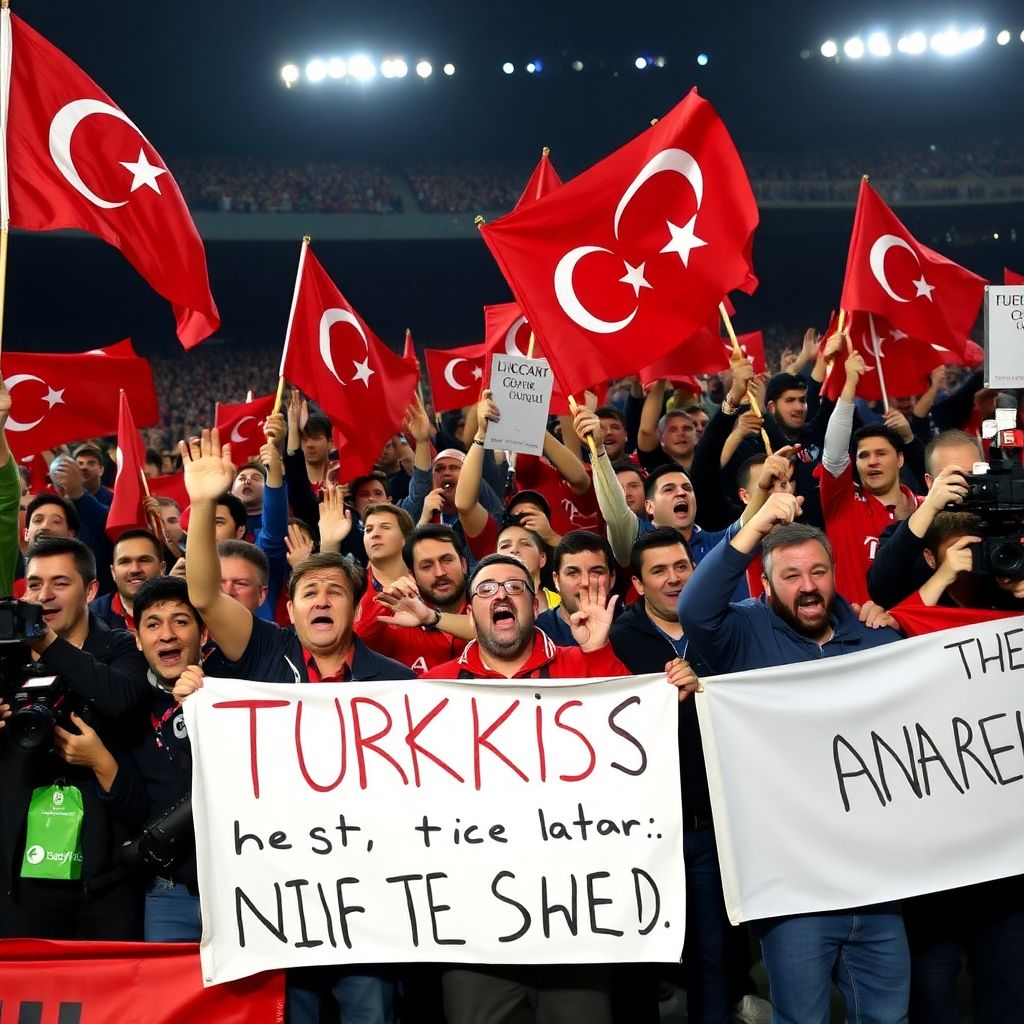
Rage in Turkiye as Media and Fans Unite in Calls for Montella’s Exit After World Cup Disaster
A storm of anger has swept across Turkiye after the national team’s catastrophic early exit from the 2026 FIFA World Cup, with pundits, former players and supporters overwhelmingly demanding the resignation of head coach Vincenzo Montella and the leadership of the Turkish Football Federation (TFF).
The uproar erupted following Turkey’s dismal 1-0 defeat to a 10-man Paraguay side at Levi’s Stadium in Santa Clara. Coming on the back of a 2-0 loss to Australia in their opening Group D match, the “Crescent-Stars” were mathematically eliminated with one game still to play. Two matches, zero points, zero goals scored: for much of the Turkish public, the numbers have become a symbol of humiliation rather than a mere statistic.
Media delivers a brutal verdict
In the aftermath, leading sports commentators delivered some of the harshest criticism seen in recent Turkish football history. Instead of focusing on possession rates, passing accuracy or penalty-area entries, pundits dismissed any attempt to wrap the failure in data-driven explanation.
Candaş Tolga Işık offered one of the most scathing assessments. He argued that no tactical or analytical nuance can excuse the fact that a squad brimming with talent is leaving the World Cup without a single point or goal. Labeling the campaign “shameful,” he predicted that this group will go down as the worst team of the entire tournament, not just in Turkish memory but in the neutral observer’s eyes as well.
Serdar Ali Çelikler cut straight to the question dominating the national debate: Montella’s job. Dispensing with diplomacy, he remarked that the time to say “arrivederci” to the Italian coach had already arrived. For Çelikler and many like him, the discussion is no longer about adjustments or patience, but about an inevitable departure.
Gökhan Dinç aimed his criticism at what he saw as Montella’s attempts to frame the disaster as a temporary blip. “The World Cup is over,” he insisted, rejecting the coach’s narrative that “we lost one match” as an isolated misfortune. “You lost this one too,” Dinç reminded, underlining that in a short tournament, every mistake is magnified and accountability cannot be postponed.
Focus shifts from the bench to the federation
While much of the fury has targeted Montella, several voices insist that the problem is deeper than one man. Former international and current analyst Serhat Akın argued that the TFF’s leadership must stand at the center of any serious reckoning.
Akın accused the federation of trying to deflect blame outward, focusing on critics rather than engaging in self-examination. In his view, PR battles and defensive statements replaced long-term planning and structural reform. “You should leave Montella there tonight,” he said metaphorically, suggesting that the coach, however flawed, should not be used as a shield to protect a failing system. True responsibility, he insisted, lies at the doors of the TFF board.
This argument has resonated with a significant portion of the public, who see a recurring pattern: rapid coach changes, short-term expectations, and no coherent strategy for youth development, tactical identity, or psychological resilience at major tournaments. For them, Montella is only the latest name in a long line of scapegoats, while the cycle of underachievement continues.
A nightmare start and squandered advantage
The Paraguay match itself has become a painful case study in how not to handle pressure on the world stage. Turkey’s plans were shattered almost immediately when, in just the second minute, Matías Galarza stunned the Turkish defense with a powerful long-range strike from outside the box. The goal exposed a lack of concentration and readiness in the opening moments, something no team can afford at a World Cup.
Turkey then tried to regroup through the creativity of Kerem Aktürkoğlu and Arda Güler, attempting quick combinations and central overloads to break Paraguay’s defensive structure. Yet the final pass or finishing touch deserted them repeatedly. The most notable warning sign came in the 35th minute, when right-back Mert Müldür hammered a fierce shot against the frame of the goal – a moment that briefly lifted hopes but ultimately foreshadowed an evening of near-misses.
The match took a dramatic turn on the brink of half-time. Paraguay’s star winger Miguel Almirón was shown a straight red card during first-half stoppage time, leaving the South Americans down to 10 men for the entire second half. At that point, many assumed the tide would turn decisively in Turkey’s favor. Instead, the dismissal only intensified the pressure on Montella and his players to find a way through.
Tactical changes, zero end product
With the numerical advantage, Montella altered his attacking setup, introducing Barış Alper Yılmaz, Can Uzun and Deniz Gül to inject energy and directness. On paper, the changes looked aggressive. On the pitch, they generated possession and territorial dominance but very few clear-cut chances.
As the minutes ticked away, Turkey’s attacks grew increasingly predictable: hopeful crosses, rushed shots and desperate individual attempts in place of structured build-up. The growing frustration was visible not just in the body language of the players but also on the touchline. In the 63rd minute, Montella received a yellow card, a sign that the emotional temperature on the bench had reached boiling point.
The defining moment came in the 89th minute, when Deniz Gül found himself with a golden opportunity to level the score and keep Turkey’s World Cup hopes alive, at least mathematically. His effort, however, failed to hit the target. That miss, more than any other action, has become a symbolic image of the campaign: the chance was there, but the composure and ruthless edge were not.
Montella’s identity remarks ignite a new storm
If the performance on the field had already enraged fans, Montella’s post-match comments poured fuel on the fire. Speaking to state broadcaster TRT Spor, the Italian coach adopted a defensive and highly emotional tone. He complained of what he described as an organized media campaign aimed at destabilizing the team after the loss to Australia.
“I feel Turkish,” Montella declared, insisting that he was more committed to the nation than some of his critics. He went further, saying he considered himself “more Turkish than some of the people trying to engineer chaos and inflict harm on Turkey.”
These remarks triggered immediate backlash. For many, the question of who is “more” or “less” Turkish crossed a red line. Gökhan Dinç and other commentators sharply questioned Montella’s right to lecture the public on national identity. The debate shifted from tactical errors and selection choices to questions of respect, cultural sensitivity, and the limits of emotional outbursts from a foreign coach under pressure.
A dead rubber against the USA and an uncertain future
Turkey still has one match left in Group D, against the United States in Los Angeles. Technically, it is a World Cup game; emotionally, it has been widely labeled a “meaningless” fixture, as Turkey is already eliminated. Yet this match could carry immense symbolic weight.
For some, it is a final audition for Montella – either a chance to bow out with dignity or an opportunity for the federation to act swiftly and install an interim solution. For the players, it could represent a last opportunity to restore a fraction of pride, score a goal, and show that the talent in the squad is not entirely overshadowed by the failure of the campaign.
If Turkey produces another listless performance, the calls for a total overhaul of the entire footballing structure are likely to grow even louder. Conversely, even a convincing win is unlikely to save Montella’s job in the eyes of most observers, but it may at least soften the atmosphere for whatever comes next.
Beyond blame: questions Turkiye must answer
Beneath the raw anger, a deeper set of questions is emerging. How can a country that regularly exports talented players to major European leagues continue to underperform when it matters most? Why does the national team so often enter tournaments with high expectations and exit amid crisis and finger-pointing?
Analysts are pointing to several recurring issues:
– Frequent managerial changes that prevent the building of a clear playing philosophy.
– Intense external pressure, which feeds a culture of fear rather than freedom on the ball.
– Insufficient long-term investment in coaching education and modern tactical approaches.
– An inability to manage transitions between generations, leaving either aging squads or inexperienced teams under unbearable expectations.
Montella’s World Cup failure is now being framed not just as an isolated debacle, but as a symptom of a system that has struggled to align its ambitions with its infrastructure and planning.
The players under the microscope
While the coach and federation are at the center of the storm, the players have not escaped scrutiny. Critics highlight the lack of leadership on the pitch, particularly after conceding early and then gaining a numerical advantage against Paraguay.
Several observers have questioned whether the current squad, despite its technical ability, possesses the mental resilience required to handle tournament football. The inability to respond collectively to adversity – conceding an early goal, or breaking down a compact 10-man defense – has become a central talking point.
Some have called for a re-evaluation of selection criteria: not just picking the most exciting talents, but also building a core of players with strong personalities, tactical discipline, and a proven ability to perform under pressure. The upcoming qualification cycles may force the TFF to decide whether to stick with this generation as the core or to accelerate the integration of even younger prospects.
Pressure on the TFF: reform or repeat?
In the coming weeks, the TFF will face a decisive moment. Public opinion is largely united around the idea that change is unavoidable, but there is far less agreement on what that change should look like.
One scenario involves a swift dismissal of Montella and the appointment of a new coach, possibly with local roots and a better understanding of the emotional landscape surrounding the national team. Another scenario goes further, calling for resignations at the highest levels of the federation and the construction of a long-term, multi-year plan that survives beyond one or two tournaments.
Key decisions will include:
– Whether to prioritize an experienced international coach or a domestic manager.
– How to define a consistent footballing identity that runs from youth teams to the senior squad.
– What mechanisms of accountability and transparency will be implemented to avoid repeating past cycles of blame and denial.
A crossroads for Turkish football identity
Ultimately, the 2026 World Cup campaign will likely be remembered as a turning point. For many, it has exposed not just tactical or selection mistakes, but a deeper identity crisis about what Turkish football wants to be in the modern era.
Montella’s tenure, with its early promise and dramatic fall, has become a mirror reflecting long-standing tensions: between foreign influence and local tradition, between emotion and structure, between short-term expectations and long-term development. Whether he resigns immediately, is dismissed after the USA match, or steps aside later, the debate he leaves behind will outlast his contract.
Turkiye now stands at a crossroads. It can move on with another quick fix, another coach, another reset – or confront the uncomfortable truths highlighted by this World Cup collapse. The fury in the streets and on the airwaves may fade with time, but the fundamental question will remain: will this failure trigger genuine reform, or will it simply become another painful chapter in a cycle that continues to repeat itself?