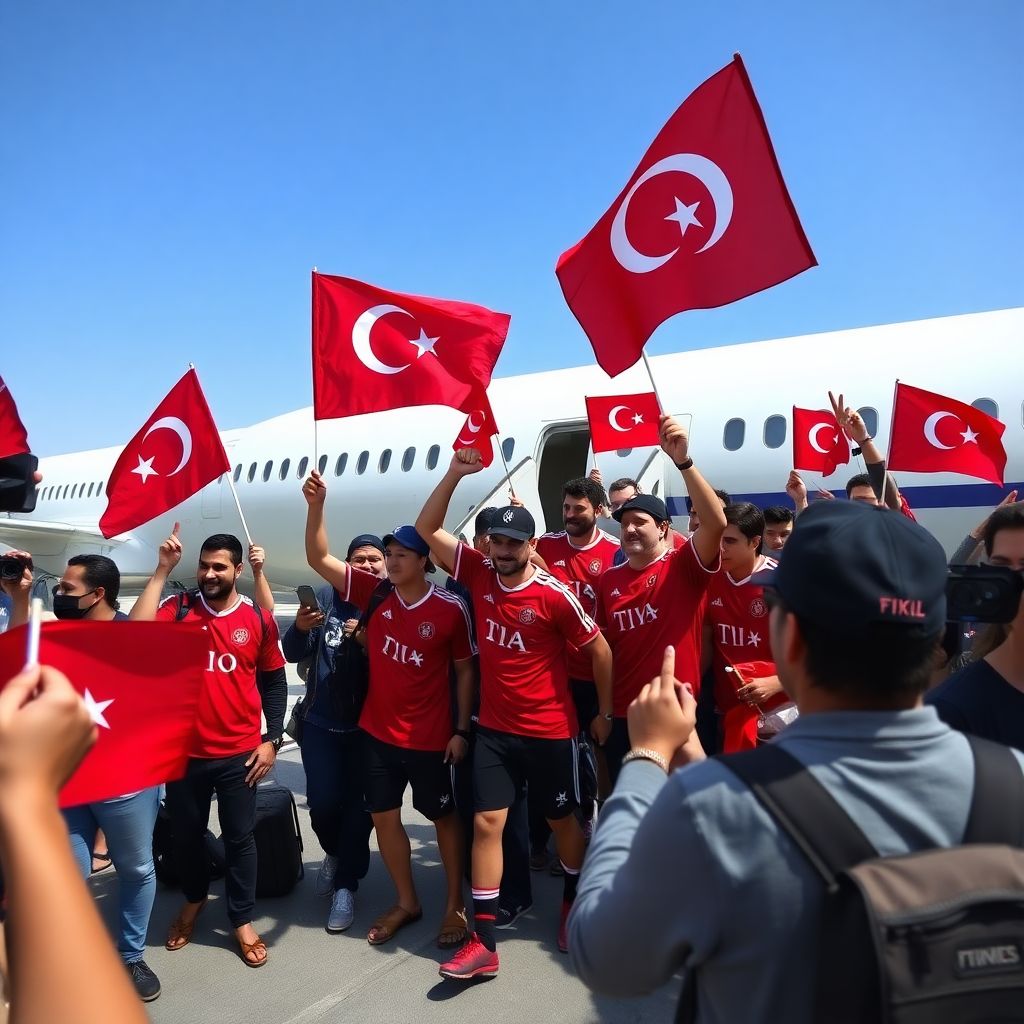
Mixed reactions awaited the Turkiye national football team in Los Angeles as they landed in California already knowing their World Cup journey would end at the group stage. The squad, eliminated prematurely from the 2026 FIFA World Cup after consecutive defeats, arrived to a charged and emotional scene that reflected both disappointment and enduring loyalty among their supporters.
After wrapping up their final training camp in Mesa, Arizona, the team flew west to prepare for their last Group D fixture against the United States. This match, once expected to be a decisive step toward the knockout rounds, had instead become a face‑saving opportunity: a chance to restore some pride rather than chase qualification.
At their team hotel in Los Angeles, a sizable crowd of Turkish expatriates and local fans had gathered hours in advance, many draped in red-and-white flags and wearing national team jerseys. Initially, the atmosphere felt festive, with chants, songs, and drum beats echoing around the entrance. But the mood began to shift the moment the team bus pulled in and the players started stepping off.
The root of the frustration was clear. Back-to-back losses against Australia and Paraguay had left Turkiye with zero points and no mathematical route to the round of 16. Expectations had been high coming into the tournament, and the abrupt collapse in performance was difficult for many to accept. As the delegation disembarked, a vocal portion of the crowd directed their anger at the coaching staff and federation leadership rather than the players themselves.
Security measures around the team base were noticeably tight. Barricades had been set up around the hotel entrance, with a substantial number of security personnel forming a corridor for players and officials. Some supporters grumbled that the arrangements kept them too far from the team, interpreting the heavy presence as symbolic distance between the side and its own fan base. Others, however, acknowledged that recent tensions made strict precautions inevitable.
The sharpest criticism centered on head coach Vincenzo Montella. Several visibly upset fans shouted in English, “Go home!” as the Italian manager walked past, eyes fixed ahead. Discontent had been brewing since the second group match, with many supporters questioning tactical decisions, squad selection, and in‑game adjustments. For a section of the fans, the early exit was not merely bad luck, but the result of deeper structural and strategic flaws.
Yet even amid the boos and angry chants, another narrative was unfolding only a few meters away. A large group of supporters chose a different approach, focusing on encouragement rather than confrontation. They had organized a small convoy of vehicles decorated with flags and scarves, circling near the hotel while singing and honking in support of the players. Their message was clear: the badge on the shirt mattered more than a single failed campaign.
Turkish Football Federation (TFF) President İbrahim Ethem Hacıosmanoğlu emerged from the bus and made a point of engaging with those fans offering backing. He shook hands, posed for photos, and listened to brief comments shouted from the crowd. A handful of players followed his example, stepping aside before heading inside to sign autographs, exchange a few words, and take pictures with children pressed up against the barriers.
For the players, the moment captured the conflicting emotions of a tournament gone wrong. On one side, a reminder of the high expectations and harsh scrutiny that come with wearing the national jersey. On the other, visible proof that many supporters were still willing to stand behind them despite the disappointment. Several squad members, according to those present, looked visibly shaken but appreciative as they interacted with the more supportive fans.
In sporting terms, the upcoming clash with the United States now carries no implications for progression. However, it has taken on a different kind of significance: a final test of character. Inside the team, the message has shifted from qualification targets to redemption. Coaching staff are believed to be urging players to treat the match as an opportunity to showcase their true level, repair at least part of the damaged public image, and send a signal about the direction of the team beyond this World Cup.
The division within the fanbase in Los Angeles mirrors broader debates among supporters everywhere. Many are asking whether the early exit reflects transient problems-such as form, injuries, or individual mistakes-or deeper issues in player development, tactical identity, and long-term planning. The criticism of Montella highlights a growing demand for a clearer footballing philosophy and more consistent performances in major tournaments.
From a psychological standpoint, the Los Angeles reception could become a turning point. Public anger, if handled carefully, can sometimes galvanize a group, prompting introspection and change rather than defensiveness. Conversely, if players feel abandoned or unfairly targeted, the rift between team and supporters can widen. How the federation and coaching staff respond-both in communication and in concrete decisions after the tournament-will play a decisive role in shaping that dynamic.
The squad’s leaders, both on and off the pitch, now face a delicate balancing act. They must acknowledge the fans’ frustration without allowing negativity to dominate the camp. Internally, that means honest team meetings, clear analysis of what went wrong against Australia and Paraguay, and a realistic appraisal of which aspects can be corrected quickly. Externally, it requires transparency and visible accountability from the federation and coaching staff.
The Los Angeles setting also adds a particular backdrop to these events. The city hosts a sizable Turkish diaspora community that had eagerly anticipated this World Cup appearance, organizing gatherings, watch parties, and displays of support. For many of them, the chance to see their national team in person is rare. The mixed reception outside the hotel was not only about two group-stage defeats-it was about dashed dreams of seeing their country make a deep run on football’s biggest stage.
At the same time, the resilient support from part of the crowd underlines a key reality: national teams outlast any single tournament cycle. Young fans asking for signatures, families waving flags, and seasoned supporters chanting encouragement despite the scorelines all represent an investment in the future, not just a verdict on the present.
As Turkiye prepares to face the United States in their final World Cup match, the stakes are now emotional and symbolic rather than mathematical. A determined, disciplined performance will not erase earlier defeats, but it can reshape the tone of the post‑tournament conversation. For players and coaching staff, it is an opportunity to show they have heard the criticism, absorbed the disappointment, and are capable of responding with professionalism and pride.
What happens after the final whistle in Los Angeles-both on the pitch and in the stands-may ultimately prove as important as anything that occurred during the group stage. The evening will likely serve as a reference point for future discussions about the direction of Turkish football, the relationship between team and fans, and the standards expected when the national anthem plays at a World Cup.